Raw land, infill lots and teardowns in Hamilton County, Indiana, bought for cash by a builder who builds luxury homes here. Written offer, or our questions, within one business day.
Including Carmel, Fishers, Westfield, Noblesville, Zionsville (nearby), Sheridan, Cicero, Arcadia.
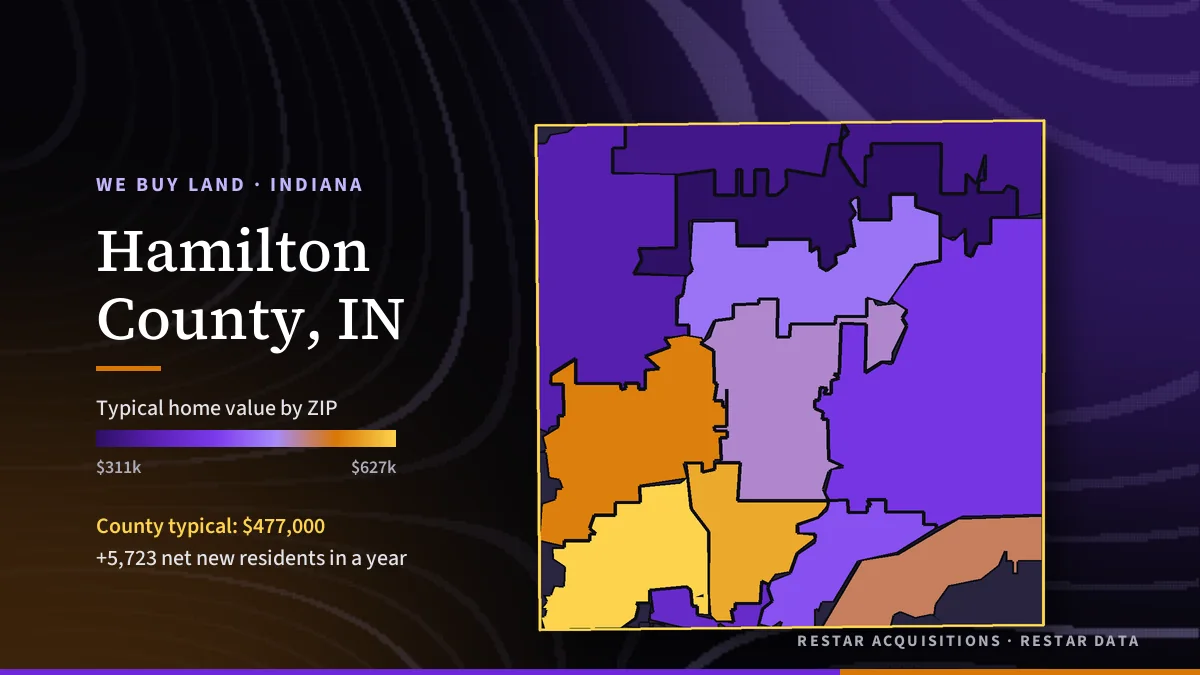
ReStar data: population 2024, net migration year to July 2025, typical single-family value (Zillow ZHVI) August 2026, household income ACS 2024, single-family permits July 2026.
We buy land for cash across Hamilton County, Indiana: raw acreage, infill lots and teardowns in Carmel, Fishers, Westfield, Noblesville and the rest of the county. Send the address or parcel number and you get a written offer, or our questions, within one business day. There is no commission, we cover standard closing costs and we pay for our own survey and soil work. What your land is worth depends mostly on the ZIP it is in and how buildable it is, and both are laid out below.
One difference from most cash land buyers you will find for Hamilton County: they buy vacant land to resell it, often to someone like us. We build on it, so we price your acreage or lot from the home that will stand on it, not from a resale discount.
Indianapolis's affluent north side. Values are up about 27% in five years, household income is near $121,500, and building has moved north from Carmel and Fishers into Westfield, Noblesville and the farm townships beyond them.
Land is worth what the homes built on it can sell for, less what it costs to build them. So the quickest honest read on land value in Hamilton County is the value of the homes around it, ZIP by ZIP. Across the 12 ZIP codes centered in the county, the typical single-family home ranges from $311k in 46030 (Arcadia) to $627k in 46032 (Carmel). The fastest-rising over the last year is 46031 (Atlanta), at +5.8%.
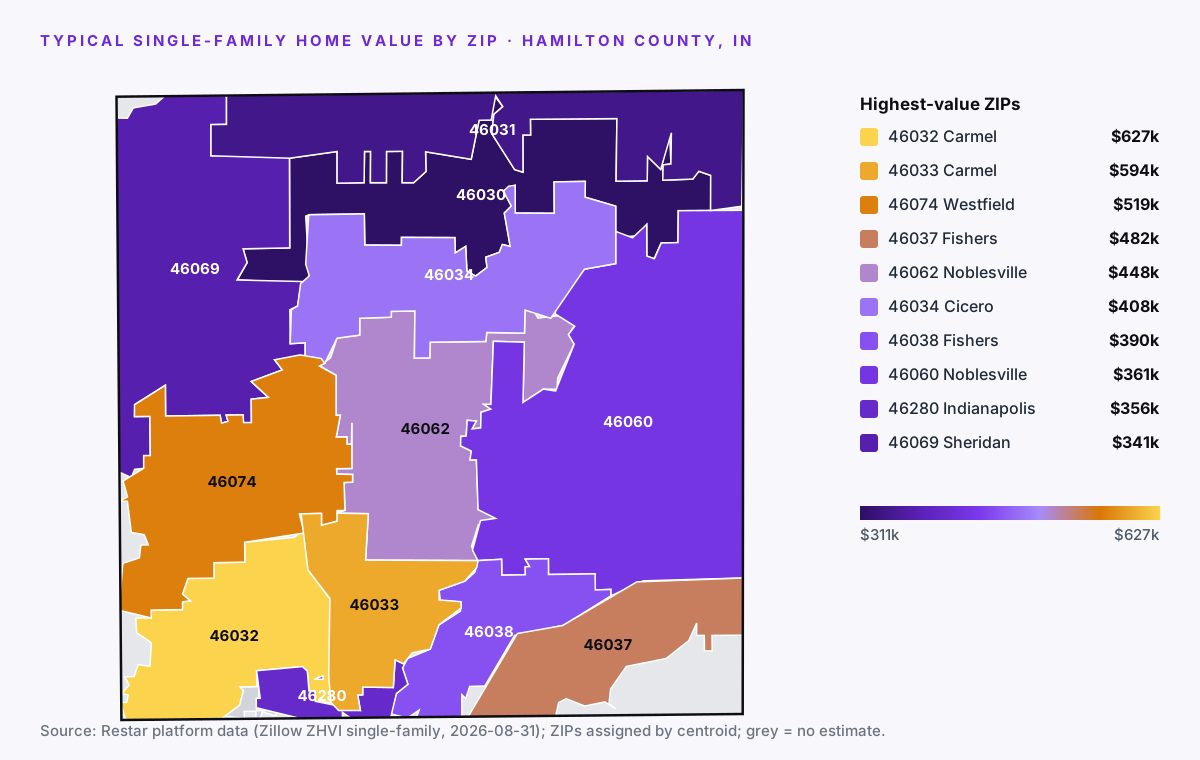
The last column is a benchmark, not an offer. The National Association of Home Builders' 2024 cost survey found the finished lot averaged 13.7% of a new home's sales price nationally. Apply that share to the typical home in each ZIP and you get a rough ceiling on what a builder budgets for a finished lot there, one that already has road access, utilities and approvals. Raw land sells below it by whatever it costs to get there, which is why a parcel with sewer at the road and a parcel that needs a septic system can draw very different offers in the same ZIP.
| Town | ZIP | Typical home | 1-yr | 5-yr | Finished-lot benchmark (13.7%) |
|---|---|---|---|---|---|
| Carmel | 46032 | $627k | +5.4% | +33.5% | $86k |
| Carmel | 46033 | $594k | +4.8% | +33.9% | $81k |
| Westfield | 46074 | $519k | +3.3% | +28.8% | $71k |
| Fishers | 46037 | $482k | +1.5% | +26.9% | $66k |
| Noblesville | 46062 | $448k | +2.4% | +27.7% | $61k |
| Cicero | 46034 | $408k | +2.9% | +28.3% | $56k |
| Fishers | 46038 | $390k | +2.0% | +27.7% | $53k |
| Noblesville | 46060 | $361k | +2.1% | +29.1% | $49k |
| Indianapolis | 46280 | $356k | +3.6% | +36.4% | $49k |
| Sheridan | 46069 | $341k | +5.4% | +35.5% | $47k |
| Atlanta | 46031 | $334k | +5.8% | +35.4% | $46k |
| Arcadia | 46030 | $311k | +5.3% | +32.8% | $43k |
ReStar platform data: Zillow Home Value Index, single-family, 2026-08-31. ZIPs assigned to the county by their center point; a ZIP that straddles a county line is listed where most of it sits. Town is the USPS place name.
Farm ground and wooded parcels in the northern townships toward Sheridan, Cicero and Arcadia, and teardowns and large older lots in Carmel where new custom homes are replacing ranches built in the 1960s and 70s.
Our full buy box is on the sell my land page. It is loose on purpose: send the parcel even if it misses a line, and we will tell you straight if it is a pass.
Two parcels the same size, a mile apart, can be worth very different amounts because of rules that never show up in a listing. These are the ones we check first in Hamilton County.
Hamilton County is crossed by county-regulated drains. Under Indiana Code 36-9-27-33 the county surveyor has a right of entry within 75 feet of a regulated drain, and the county Surveyor's office requires a permit to cross or work in that easement. On farm ground that strip can decide where a house and driveway can go, so we look at the drain map before we price a parcel.
Source: Hamilton County Surveyor drainage permits
Hamilton County is split into nine planning jurisdictions; the Hamilton County Plan Commission regulates the unincorporated areas under its Unified Development Ordinance (amended 2023), while the cities and towns plan their own areas. In the county's A-2 General Agriculture district the minimum lot is 10 acres with 330 feet of width and road frontage, and homes are meant to be tied to a farm operation. A limited 'legacy split' exception lets an owner who has held the parcel since before May 15, 1990 create up to three smaller lots without a subdivision, with no lot or remainder under 3 acres; it does not apply to parcels transferred after that date or held by trusts, estates or companies.
Source: hamiltoncounty.in.gov
Indiana has no separate farmland enrollment program: land is classified as agricultural by how it is actually used, and agricultural land is assessed from a statewide base rate set each year by the Department of Local Government Finance and adjusted by soil productivity. The base rate for the January 1, 2026 assessment date is $2,120 per acre, far below typical development-land prices. When land stops being farmed (for example it is built on or used residentially), classification follows the use (DLGF: 'The classification depends on whether the acreages in question are put to agricultural or residential use'), so it is assessed at its new use going forward. Indiana's guidance describes no rollback or recapture of past tax savings when farmland is sold or developed; the land is simply assessed for its new use going forward.
If your land is taxed at a farm or open-space value, raise it at the start. Who pays any rollback is a term of the contract, and it belongs in the price conversation, not at the closing table.
Indiana caps property tax bills (circuit breaker credits) at 1% of gross assessed value for homesteads, 2% for other residential property and agricultural land, and 3% for all other real and personal property.
Source: in.gov
A separate Sales Disclosure Form is required for each parcel conveyed, except that one form covers two or more contiguous parcels in a single taxing district conveyed by one document. (in.gov)
Getting a septic permit in Hamilton County starts with a licensed soil scientist doing at least three soil borings with a health department representative present; the department then issues a minimum-requirements letter sized to the soils and number of bedrooms. (hamiltoncounty.in.gov)
Hamilton County Recorder fee for recording a deed is $25 (including one oversize page). (hamiltoncounty.in.gov)
We start from the house we would build and work backward. Take a home that would sell at the county's typical value of $477,000. At the national 13.7% lot share, the finished lot behind it is budgeted at about $65k. If the land already has a paved road, water and sewer or an approved septic site, most of that budget can go to the land. If a driveway has to be cut, power brought in and a septic system engineered, those costs come out first, and so does the time it takes to get approvals. That is the whole reason two owners in the same ZIP can get very different numbers, and why we would rather tell you which line is costing you than just quote a figure.
The full method, with the arithmetic and what happens when build costs move, is in how much is my land worth. If you want to take the unknowns off the table before you sell to anyone, start with is my land buildable.
Tell us where it is. We reply within one business day with a written offer or the questions we need answered, and we cover standard closing costs.
No obligation. We reply within one business day with a written offer or the questions we need answered. We call or email; we do not text.
Indiana closings are typically handled by title companies. The Indiana Department of Insurance says title companies handle property closings and hold earnest money in a trust account until the purchase is complete.
| Cost | Selling to us | Listing the land |
|---|---|---|
| Agent commission | None | Negotiated with your agent; land listings often carry a higher percentage than houses |
| Standard closing costs | We cover them | Seller's share per local custom and the contract |
| Deed transfer or recording tax | Follows state custom; set out in the contract | Indiana does not charge a deed transfer tax the way many states do; the costs at recording are fees. What a deed does trigger: a Sales Disclosure Form (State Form 46021) must accompany every conveyance document for value, reviewed by the county assessor, and the county auditor will not accept the deed without it; the filing fee has been $20 since July 1, 2021 (no fee for foreclosure, divorce, court-order, condemnation, probate, partition or charity transfers). Hamilton County's recorder charges $25 to record a deed. Who pays them is set in the purchase contract. |
| Survey, soil or perc tests | We pay for our own | Often requested from the seller |
| Farm-use rollback, if any | Negotiated in the contract | Negotiated in the contract |
| Liens, back taxes, mortgage payoff | Paid from your proceeds | Paid from your proceeds |
Sources: transfer tax · closing practice
Where to check the facts yourself, most of it free. These are the same sources we use.
Send the address or parcel number to a buyer who pays cash and does not need a lender: we reply within one business day with a written offer or our questions, and the due-diligence period is written into the contract. Listing can bring more if the parcel is clearly buildable and you have months to wait.
Farm ground and wooded parcels in the northern townships toward Sheridan, Cicero and Arcadia, and teardowns and large older lots in Carmel where new custom homes are replacing ranches built in the 1960s and 70s.
It depends on the ZIP and on how buildable the parcel is. Typical home values in Hamilton County range from $311k to $627k by ZIP, and at the national 13.7% lot share that implies finished-lot budgets from about $43k to $86k. Raw land sells below a finished lot by the cost of access, utilities and approvals.
No. We make a written offer from public records, maps and land sales, and do the survey, soil and title work ourselves during the due-diligence period, at our cost.
Yes. Indiana has no separate farmland enrollment program: land is classified as agricultural by how it is actually used, and agricultural land is assessed from a statewide base rate set each year by the Department of Local Government Finance and adjusted by soil productivity. The base rate for the January 1, 2026 assessment date is $2,120 per acre, far below typical development-land prices. When land stops being farmed (for example it is built on or used residentially), classification follows the use (DLGF: 'The classification depends on whether the acreages in question are put to agricultural or residential use'), so it is assessed at its new use going forward. Indiana's guidance describes no rollback or recapture of past tax savings when farmland is sold or developed; the land is simply assessed for its new use going forward. Who pays is agreed in the contract, so raise it before you agree a price.
Indiana does not charge a deed transfer tax the way many states do; the costs at recording are fees. What a deed does trigger: a Sales Disclosure Form (State Form 46021) must accompany every conveyance document for value, reviewed by the county assessor, and the county auditor will not accept the deed without it; the filing fee has been $20 since July 1, 2021 (no fee for foreclosure, divorce, court-order, condemnation, probate, partition or charity transfers). Hamilton County's recorder charges $25 to record a deed. Who pays them is set in the purchase contract.
Yes to all three. Back taxes and liens are paid from the proceeds at closing, we work with the executor or every heir on title, and a landlocked parcel is priced around the easement work rather than turned down.
Other counties where we buy land: Williamson County, TN · Collin County, TX · Comal County, TX · St. Johns County, FL · Delaware County, OH · Forsyth County, GA · Washington County, UT
Guides for landowners: How to Sell Land: By Owner, With an Agent, or to a Cash Buyer · How Much Is My Land Worth? Three Methods, With Real Math · Is My Land Buildable? A Seller's Checklist Before You Price It · Selling Land to a Developer: How Builders Price It and What to Ask · Selling a Teardown: How to Sell a House for Its Land Value · Selling Inherited Land: Taxes, Title and Your Real Options
