Selling land to a developer means selling to a buyer who prices your parcel backwards from the homes it can hold. They start with the finished-lot budget, subtract the roads, utilities, permits, time and risk needed to get there, and offer what is left. That is why raw land sells for less than a finished lot, and why the deal structure matters as much as the price.
Own land in one of our eight build markets? Get a written cash offer within one business day.
Get a land offer →Educational only. This explains how these situations generally work. It is not legal, tax or financial advice, and the rules differ by state — talk to an attorney or CPA about your own situation before you act on any of it.
A developer does not price land the way a homeowner prices a house. There is no neighbor’s sale to copy. The builder starts at the other end: what will the finished homes sell for, and how much of that price can go to the lot? Whatever is left after the costs of getting from your raw parcel to a buildable lot is what they can afford to pay you. Appraisers call this the residual method. Builders just call it the lot budget.
The best public benchmark for the lot budget is the National Association of Home Builders’ Cost of Constructing a Home 2024 survey. On the average new single-family home in that survey, the finished lot was 13.7% of the sales price, construction cost was 64.4% and builder profit was 11.0%. The rest went to overhead, financing, marketing and sales commission. The lot share has moved a lot: it was 17.8% in the same survey in 2022.
Read those numbers with their limits. They are national averages from 41 builders who responded, the average home in the sample sold for about $665,000, and NAHB itself warns that land and labour costs vary from place to place. A luxury builder in a high-value county may carry a larger lot share than that, a production builder on cheap farmland a smaller one. What the survey does show is the shape of the problem: the house sets the ceiling on the land, and the builder’s profit and construction budget come first. Our guide to how much your land is worth walks the residual from home price down to the lot; this one picks up where that stops, at the gap between a finished lot and the raw land you own.
Two consequences for you as the seller:
Everything between your land and a finished lot costs money, takes time or carries a risk that the project fails. The builder subtracts all three:
Here is that arithmetic on one illustrative estate lot. The home price and the cost lines are assumptions for this example, not quotes and not a formula we apply; only the 13.7% comes from the NAHB survey. Say the finished home would sell for $1,800,000. At 13.7%, the finished-lot budget is $246,600.
| Line | Amount | Running total |
|---|---|---|
| Finished-lot budget (13.7% × $1,800,000) | $246,600 | $246,600 |
| Less: clearing, driveway, utility extension | −$55,000 | $191,600 |
| Less: survey, soils work, engineering, permits and fees | −$20,000 | $171,600 |
| Less: about 12 months of carrying cost | −$15,000 | $156,600 |
| Less: risk margin, 15% of the finished-lot budget | −$36,990 | $119,610 |
| What the raw land supports | $119,610 |
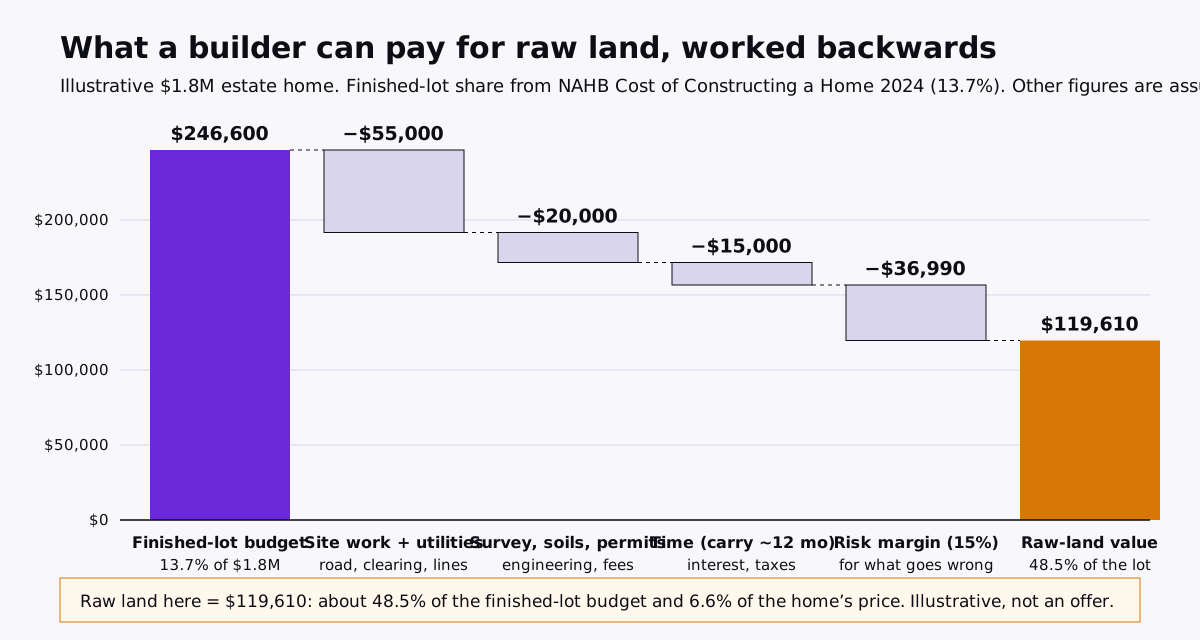
In this example the raw land is worth about 48.5% of the finished-lot budget and about 6.6% of the home’s price. Change any line and the answer moves one-for-one. If public sewer is already at the road, the site-work line shrinks and your land is worth more. If the soil needs an engineered septic system, or the drive has to climb a steep slope, it shrinks the other way. That is why two neighboring parcels with the same acreage can draw very different offers, and why the most useful thing you can do before selling is find out which lines apply to yours. Our guide to whether your land is buildable walks through each one.
“Developer” covers very different companies, and they want different land. Before you sell land to a builder, work out which kind you are talking to, because a sign that says “we buy land for development” can sit in front of either.
| Luxury custom-home builder | Production builder or subdivision developer | |
|---|---|---|
| Lots per deal | One infill lot to a handful of estate lots | Dozens to hundreds |
| What they need | Access, a buildable site, features buyers pay for (views, trees, water, privacy) | Density, public sewer and water, zoning that allows the lot count |
| Typical parcel | Infill lot, teardown, or acreage splittable into a few lots | Large tracts in the path of new subdivisions |
| How they usually buy | Often for cash after a short due-diligence period | Often by option or contingent contract, closing after approvals, sometimes in phases |
| Timeline to your money | Weeks to a few months | Often a year or more |
Restar Acquisitions is the first kind. We buy raw land, infill lots and teardown houses for the lot, to build luxury homes on, and we concentrate on eight counties. We are a good fit for a single lot or a parcel that can become a few estate lots; if yours sounds like that, you can send us the parcel for a written offer. We are the wrong buyer for a 120-acre farm with sewer at the road on the edge of a fast-growing suburb. That land usually belongs with a production builder or a land broker who markets to them, and the price per acre from that route can be higher than anything a small-lot builder can pay, if you have the time to wait for approvals.
The headline price only means something next to the structure it comes with. Here are the three you will see most, compared honestly:
| Cash close after due diligence | Option or contingent contract (waits on rezoning/entitlements) | Joint venture or land contribution | |
|---|---|---|---|
| How it works | Buyer checks survey, title, soils and zoning during a fixed period, then closes for cash | Buyer pays for the right to buy later, once rezoning, plat or permits are approved | You put the land into the project and are paid from lot or home sales |
| Price | Lowest of the three: priced as the land is today | Higher: priced as the land will be once approved | Potentially highest, but not fixed |
| Time to your money | Weeks to a few months | Often one to several years, sometimes paid in phased takedowns | Years, as lots or homes sell |
| Certainty | High once due diligence ends | Lower: the deal can fall through if approvals fail, costs rise or the market turns | Lowest: you share the development risk |
| Your land while you wait | Off the market for the due-diligence period only | Tied up for the whole option term | Committed to the project |
| Fits when | You want a known number and a date: inherited land, out-of-state owners, estates to settle | Land has real upside from rezoning and you can wait | You want upside, can wait, and have an attorney and CPA to structure it |
None of these is the right answer for everyone. An option contract with a production builder can pay meaningfully more for land that genuinely has entitlement upside, and if you can wait and the builder is strong, it may be the better deal. What it costs you is time and certainty: your land is off the market while someone else decides whether to buy it, and the option fee you keep if they walk is usually a small fraction of the price. A cash close trades part of that upside for a number you can plan around. A joint venture is a business partnership with the land as your capital contribution and has tax and legal consequences that need professional advice before you sign.
Listing with an agent or land broker is the fourth route. If your land is easy to finance and you have months, open-market exposure can net more than any single buyer’s offer. Our pillar guide on how to sell land compares that route in detail.
Almost every land contract gives the buyer a due-diligence period: a set number of days to investigate and walk away if they do not like what they find. From your side, that period is a free look for the buyer and a stretch where your land is off the market. What the buyer checks tells you what can go wrong:
The terms around that period matter as much as the price. Points worth negotiating:
Most land buyers are what they say they are. Some are contract flippers who tie land up with little money down and try to sell the contract. These questions sort them out quickly:
A buyer who answers all seven without hesitation is usually worth talking to. A buyer who avoids them is telling you something too.
We concentrate on eight fast-growing, high-income counties where luxury homes sell: Williamson County, TN, Collin County, TX, Comal County, TX, St. Johns County, FL, Delaware County, OH, Hamilton County, IN, Forsyth County, GA and Washington County, UT. We also review land outside them and tell you plainly if it is a pass.
| County | Typical single-family value (Aug-2026) | 5-yr change | SFR permits (Jul-2026) |
|---|---|---|---|
| Williamson, TN | $945,000 | +31.7% | 163 |
| Forsyth, GA | $614,000 | +30.5% | 95 |
| Delaware, OH | $542,000 | +23.6% | 337 |
| Washington, UT | $541,000 | +9.6% | 234 |
| St. Johns, FL | $510,000 | +17.7% | 293 |
| Collin, TX | $477,000 | +13.2% | 880 |
| Hamilton, IN | $477,000 | +26.7% | 341 |
| Comal, TX | $436,000 | +5.1% | 204 |
Restar data: typical single-family value is Zillow ZHVI for August 2026; permits are single-family building permits for July 2026. These describe the county’s existing homes, not the price of any lot.
On a given parcel, the things that make land interesting to us are legal road access or frontage; a buildable site, meaning public sewer or soils that support a septic system; land outside the floodway; reach to the county’s job centers and strong school districts; and features luxury buyers pay for, such as views, mature trees, water frontage and privacy. Those are criteria, not a promise that any parcel meets them.
How it works: you send the address or parcel number on our sell-my-land page. We review the parcel, zoning, flood maps, utilities and land comps and reply within one business day with a written offer or the specific questions we need answered. The contract includes a due-diligence period for survey, soil and perc work, and title, and we pay for our own due diligence. We close at a title company or closing attorney, with no commission, and we cover standard closing costs.
Be clear about the trade. A cash offer from us is priced on the land as it stands today, with the costs and risks in the worked example above coming out of it. If your land has rezoning upside and you can wait, an option with a production builder or a listing with a land broker may net you more, and we would rather you know that before you call. We are a buyer, not a real estate agent, attorney or tax adviser. This guide is educational only, not legal or tax advice; talk to a real estate attorney before signing any land contract, and to a CPA about the tax side of a sale or a joint venture.
Send the address or parcel number through our land offer form. We reply within one business day with a written offer or the questions we need answered.
No obligation. We reply within one business day with a written offer or the questions we need answered. We call or email; we do not text.
Keep reading: How to Sell Land: By Owner, With an Agent, or to a Cash Buyer · How Much Is My Land Worth? Three Methods, With Real Math · Is My Land Buildable? A Seller's Checklist Before You Price It · Selling a Teardown: How to Sell a House for Its Land Value
Where we buy: Williamson County, TN · Collin County, TX · Comal County, TX · St. Johns County, FL · Delaware County, OH · Hamilton County, IN · Forsyth County, GA · Washington County, UT
