Selling inherited land is usually taxed lightly. Under federal rules your basis resets to the land’s fair market value on the date of death, so a sale soon afterwards often produces little or no taxable gain, and any gain counts as long-term. The harder parts are proving that value, confirming who can sign the deed, and getting every heir to agree.

Own land in one of our eight build markets? Get a written cash offer within one business day.
Get a land offer →Educational only. This explains how these situations generally work. It is not legal, tax or financial advice, and the rules differ by state — talk to an attorney or CPA about your own situation before you act on any of it.
Yes, in the sense that the sale is reported. But the tax is on gain, and gain is measured from your basis, not from what your parents or grandparents paid. For inherited property the IRS says basis is generally the fair market value on the date of death (or on the alternate valuation date, if the executor elects it on an estate tax return). That rule comes from Internal Revenue Code §1014 and is explained in the IRS’s gifts and inheritances FAQ and in Publication 551, Basis of Assets.
Two more federal rules work in your favor:
What this means in practice: the tax consequences of selling inherited land are usually driven by how much the land has risen since the date of death, not since the 1980s. Hold it ten years and the gain grows again. Sell within a year or two and it is often small.
Here is an illustrative example. The numbers are assumptions chosen to show the arithmetic, not a forecast or a typical result.
Your parents bought 20 acres in 1988 for $40,000. Your mother dies in early 2026 and leaves it to you and two siblings in equal shares. A certified appraiser values it at $400,000 as of the date of death. Eight months later the three of you sell it for $415,000 and pay $6,000 in selling expenses of your own (an estate attorney to handle the deed and a boundary survey).
| Line | With the step-up | If the land had been gifted during life |
|---|---|---|
| Sale price | $415,000 | $415,000 |
| Less selling expenses | −$6,000 | −$6,000 |
| Amount realized | $409,000 | $409,000 |
| Less basis | −$400,000 (value at death) | −$40,000 (parents’ cost) |
| Taxable gain, total | $9,000 | $369,000 |
| Per sibling (one-third) | $3,000, long-term | $123,000 |
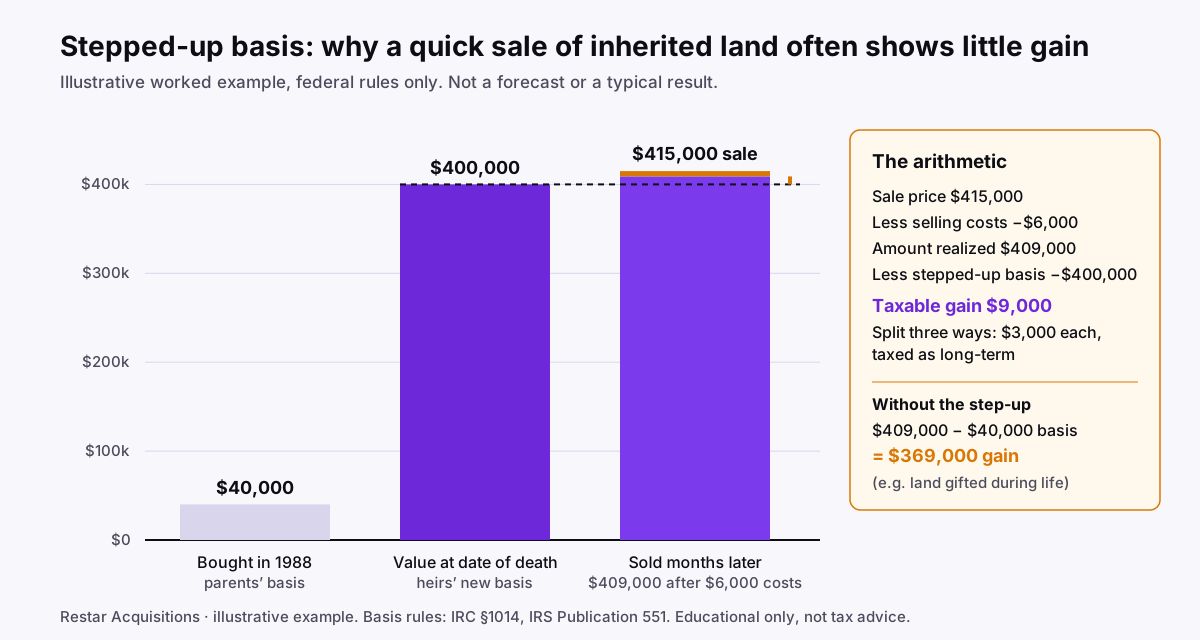
The right-hand column is the trap. If your parents had deeded the land to you while alive, you would generally take over their original basis instead of getting the step-up (Publication 551 covers the gift rules). Families sometimes do that to “keep it out of probate” and hand the children a large tax bill later. If a parent is still living and considering this, that is a conversation for an estate attorney and a CPA before anyone signs a deed.
Some land-specific exceptions matter too. Publication 551 notes that basis can differ if the estate used special-use valuation for farmland or a closely held business, or if part of the value was excluded because of a qualified conservation easement. And if the estate filed a federal estate tax return, you may have received a Schedule A (Form 8971) with a value you are generally required to use. Ask the executor before you pick a number.
If the sale price comes in below the date-of-death value, you may have a loss. Whether that loss is deductible depends on how the heirs held and used the land, so take it to a CPA rather than assuming.
Everything above rests on one number: fair market value on the date of death. The IRS can question it, and you carry the burden of supporting it. A tax-assessor value, a Zillow estimate or “Dad always said it was worth about $300,000” is weak support.
What holds up better:
A low appraisal is not “conservative” here. If the appraiser comes in at $300,000 and you sell at $415,000, you have given yourself roughly $100,000 of extra gain on paper. Ask the appraiser to value the land at its highest and best use, which for land near a growing suburb may be residential lots rather than pasture. For a sense of how land is priced, see how much is my land worth.
Land looks free to hold because there is no roof to fix. It is not free. Here is an illustrative year for a vacant tract near a suburb, using assumed numbers:
| Holding cost | Illustrative annual amount | Why it exists |
|---|---|---|
| Property tax | $3,200 | Billed whether or not anyone uses the land |
| Vacant-land liability insurance | $600 | Someone gets hurt on a four-wheeler or a fallen fence |
| Mowing or brush-hogging, 4 times | $1,200 | Many counties cite overgrown lots; it also keeps the land showable |
| Total | $5,000 a year | About $417 a month, split among the heirs |
Three less obvious costs are worth checking with the county before you decide to hold:
None of this means you should sell. If the land sits in the path of growth and the family can carry it comfortably, holding can be the better long-term decision. Just price the holding in when you compare.
Before any buyer can close, a title company has to be satisfied that the people signing the deed are the right people. Which people depends on how the land passed:
| How the land passed | Who usually signs | What the title company will want |
|---|---|---|
| Through a will or intestacy, with probate | The executor or administrator (personal representative) | Letters testamentary or of administration; in some states or estates, court approval of the sale |
| Transfer-on-death (beneficiary) deed | The named beneficiaries directly, no probate for that parcel | Death certificate and the affidavit or form your state requires to be recorded |
| Living trust | The successor trustee | Trust certification and death certificate |
| Joint tenancy with right of survivorship | The surviving owner | Death certificate recorded to clear the deceased owner |
| Heirs already deeded title, or title never cleared | Every heir on title, together | All signatures, and possibly an heirship affidavit or a court order to fix gaps |
The last row is where land deals stall. Rural land in particular often passes informally for a generation or two, so a parcel can end up owned by a grandparent’s estate that was never opened, with a dozen cousins holding fractional interests. That is fixable, but it is a job for a probate or real estate attorney, and it takes time. Rules differ by state; transfer-on-death deeds, for example, are available in many states but not all.
Inherited land is usually owned by several heirs as tenants in common, each with an undivided share. One sibling cannot sell the whole parcel alone. When heirs disagree, the realiztic options run roughly in this order:
Many states have adopted the Uniform Partition of Heirs Property Act, written because forced partition sales were costing families inherited land for well below its value. Where it applies, it generally requires a court-ordered appraisal, gives the other co-owners a chance to buy out the heir who asked for the sale, and favors dividing the land over forcing a sale. Whether your state has adopted it, and whether your land counts as “heirs property”, is a question for a local attorney.
Most of the heirs who contact land buyers live somewhere else. That is workable:
Restar Acquisitions is a family-owned principal buyer: we buy raw land, infill lots and teardown houses for cash to build homes on, mainly in eight fast-growing counties, and we will review land outside them and tell you plainly if it is a pass. We are not an agent, attorney or tax adviser. Here is how an inherited parcel typically moves with us:
The honest trade-off: a cash buyer who builds on the land has to leave room for construction, carrying costs and risk, so our number will generally be below what a well-marketed listing could bring from the right retail buyer. If the heirs agree with each other, the land is easy to finance, and nobody minds waiting several months, listing with a land agent can net more. A cash sale earns its discount when the heirs are scattered, the title needs patience, the land is hard for a buyer to finance, or the family simply wants it resolved. Our how to sell land guide compares every route side by side.
Everything above is federal income tax. It does not cover state income tax on the gain, state estate or inheritance taxes (a minority of states levy them, with different rates and exemptions), the federal estate tax on large estates, or the special rules for community property states, which Publication 551 describes separately. Your state’s probate procedure and deadlines also vary.
This guide is educational only, not legal or tax advice. Before you sign anything, have a CPA run your actual numbers and an estate or real estate attorney in the land’s state confirm who can sign. When you want a written number to compare against a listing, send us the parcel.
Send the address or parcel number and tell us how it passed. We reply within one business day with a written offer or the questions we need answered, on our sell my land page.
No obligation. We reply within one business day with a written offer or the questions we need answered. We call or email; we do not text.
Keep reading: How to Sell Land: By Owner, With an Agent, or to a Cash Buyer · How Much Is My Land Worth? Three Methods, With Real Math · Is My Land Buildable? A Seller's Checklist Before You Price It · Selling Land to a Developer: How Builders Price It and What to Ask
Where we buy: Williamson County, TN · Collin County, TX · Comal County, TX · St. Johns County, FL · Delaware County, OH · Hamilton County, IN · Forsyth County, GA · Washington County, UT
