Your land is worth what comparable land nearby has recently sold for, adjusted for size, access, utilities and buildability. For buildable land, check that against residual value: what a new home on it would sell for, minus construction, builder profit and soft costs. Nationally, NAHB's 2024 survey puts the finished lot at 13.7% of a new home's price.
Own land in one of our eight build markets? Get a written cash offer within one business day.
Get a land offer →Educational only. This explains how these situations generally work. It is not legal, tax or financial advice, and the rules differ by state — talk to an attorney or CPA about your own situation before you act on any of it.
Appraisers, builders and land buyers use the same three methods. Which one carries the most weight depends on what the land is for.
| Method | How it works | Best for | Where it goes wrong |
|---|---|---|---|
| Sales comparison (land comps) | Find recent sales of similar land nearby, convert to price per acre or per lot, adjust for differences | Almost every parcel; the starting point | Few land sales, so comps are often old, far away or a different size |
| Residual land value | Start from what a finished home on the land would sell for, subtract construction, builder profit and soft costs; the remainder is what the land can support | Buildable lots and land a builder or developer would buy | Very sensitive to the build-cost and sale-price estimates |
| Income approach | Value the income the land produces (farm rent, timber, leases) by dividing it by a market capitalisation rate | Farmland, timberland, land with long-term leases | Understates land near growth where the development value is far above the farm income |
For most owners the answer is a range from comps, checked against a residual if the land is buildable. If both point to the same number, you can trust it. If they disagree a lot, one of your inputs is wrong.
Look for sales, not listings, within the last 12 to 24 months, as close as possible and as similar as possible in size, zoning, access and utilities. Convert each to a unit price. Rural acreage is usually compared per acre; subdivision and infill lots are usually compared per lot, because a buyer pays for one buildable homesite whether it is 0.3 or 0.45 acres.
Then adjust. If a comp had sewer at the road and yours needs a septic system, yours is worth less. If a comp was landlocked and yours has frontage, yours is worth more. Do the adjustments in dollars, not gut feel, and write down why.
A 2-acre homesite and a 40-acre tract in the same county can sell for very different prices per acre, and the small one is almost always higher. There are three reasons:
So never price 40 acres by multiplying a 2-acre sale. Find comps of similar size, or value it as a developer would (Method 2).
Builders do not start from land comps. They start from the house. The question they ask is: if I build the home this lot supports, what will it sell for, and what is left for the land after I pay for everything else and earn a profit? That leftover is the residual land value.
The formula: finished home value − construction cost − builder profit − soft costs (financing, overhead, marketing, sales commission) = what the finished lot is worth to a builder.
NAHB's Cost of Constructing a Home 2024 survey found that, on average, the finished lot was 13.7% of a new home's sales price, down from 17.8% in 2022. Construction cost was 64.4% and builder profit 11.0%. The average new home in the survey sold for $665,298, and its finished lot cost $91,057. The rest went to financing (1.5%), overhead and general expenses (5.7%), marketing (0.8%) and sales commission (2.8%).
Two cautions from the survey itself: it is a national average from 41 builders, not a local cost guide, and a “finished lot” already has roads and utilities in place. Raw land is worth less than a finished lot by roughly what it costs to finish it.
Restar data puts the typical single-family home value in Williamson County, Tennessee at $945,000 (Zillow ZHVI, August 2026). This example is illustrative: it assumes a builder could sell a new home on your lot for exactly that figure, and it uses NAHB's national cost shares as a stand-in for local costs.
| Line | Share (NAHB 2024) | Amount |
|---|---|---|
| Finished home sale price | 100% | $945,000 |
| Less: construction cost | 64.4% | −$608,580 |
| Less: builder profit | 11.0% | −$103,950 |
| Less: financing, overhead, marketing, commission | 1.5% + 5.7% + 0.8% + 2.8% = 10.8% | −$102,060 |
| Residual: what the finished lot can support | 13.8% | $130,410 |
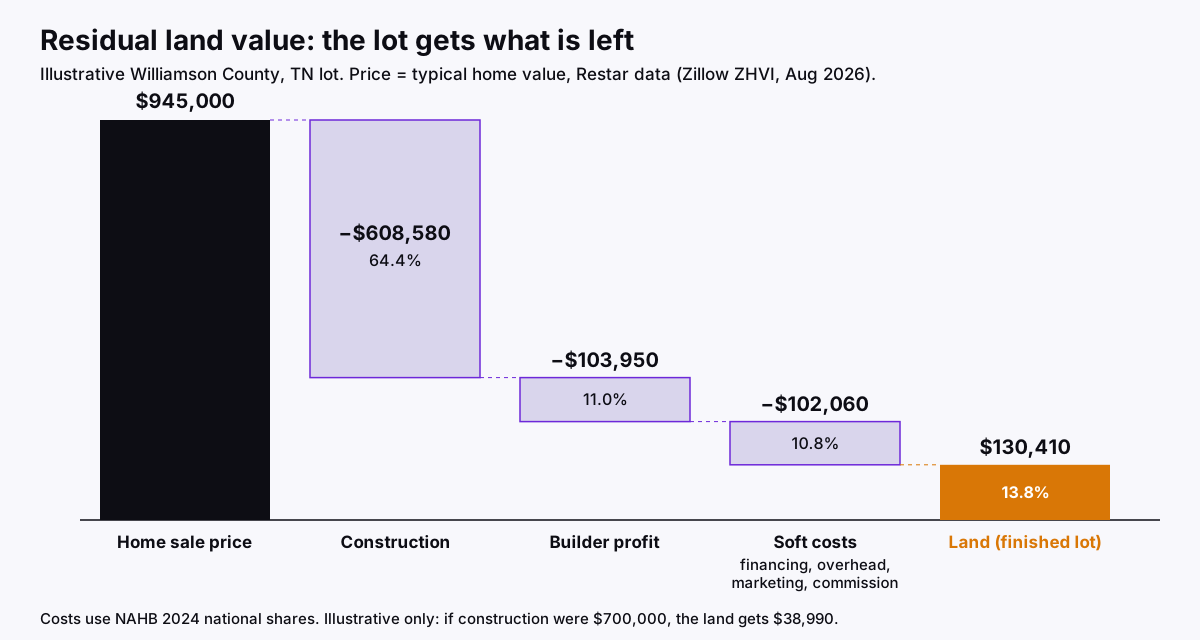
The check: $945,000 × 13.7% = $129,465, within about $1,000 of the residual. (NAHB's published shares add to 99.9% because of rounding, which is why the residual comes out at 13.8%.)
Now the part most valuation articles leave out. Land is the leftover, so small errors in the big numbers produce huge swings in the land value. Suppose a luxury build in Williamson actually costs $700,000, about 15% more than the national share implies. Keep everything else the same: $945,000 − $700,000 − $103,950 − $102,060 = $38,990. A 15% miss on construction cost wiped out about 70% of the land value. That is why two builders can look at the same lot and be $80,000 apart, and why the price a builder offers is really a bet on build costs and the finished sale price.
A developer buying acreage to split into lots runs the same calculation one level up. Illustrative example: 10 acres that can be platted into 4 estate lots, each worth $130,410 finished. Gross lot value is 4 × $130,410 = $521,640. Subtract an assumed $60,000 per lot for a road, utilities, engineering and platting ($240,000), a 20% developer margin on lot value ($104,328) and $30,000 for carrying and approval costs. What is left, $147,312, is what the raw 10 acres can support: about $14,731 an acre, far below the $130,410 each finished lot is worth. Change the lot count from 4 to 3 and the raw land value falls by more than a quarter. Our guide to selling land to a developer covers how those deals are structured.
Farmland, timber and land under long-term leases can be valued on the income they produce. Divide the annual net income (cash rent after property tax, for example) by a capitalisation rate drawn from comparable sales. On land near a growing town, the income value is usually well below what a builder would pay, so income sets a floor rather than a ceiling. If your farm sits in the path of growth, value it both ways.
| Factor | Adds value | Removes value |
|---|---|---|
| Access | Paved public road frontage | Landlocked, or an unrecorded or shared private easement |
| Utilities | Power, public water and sewer at the road | Long utility extensions; well and septic both required |
| Sewer vs septic | Public sewer: more homes per acre, no soil risk | Septic needed on soils that will not perc, or a small usable area |
| Flood | Entirely outside mapped flood zones | Floodway or large flood-zone share (check the FEMA Flood Map Service Center) |
| Wetlands | None mapped or delineated | Wetlands that shrink the buildable area (see the National Wetlands Inventory) |
| Zoning | Allows the homes buyers want, can be split | Minimum lot size too large, restrictive overlay, or a use buyers do not want |
| Topography | Gentle slope, good drainage, a natural building pad | Steep grades, rock, or poor drainage that raise site-work cost |
| Features | Views, water frontage, mature trees, privacy | Power lines, road noise, adjacent industrial uses |
For septic land, look up the soil types on the USDA Web Soil Survey before you set a price. It does not replace a perc test, but it shows whether soils are rated as limited for septic fields. Regional rules matter too: in Comal County, Texas, building over the Edwards Aquifer recharge and contributing zones falls under TCEQ rules (30 TAC Chapter 213) that add cost and time. If you are not sure a house can go on your land at all, read is my land buildable first; buildability is the single biggest value driver.
A parcel with one of these problems still has a value; it is just a lower one, and some buyers are set up to price the risk. If you would rather hand the open questions to a buyer, send us the parcel details and we will tell you what we would need to know.
Use listings only to see your competition. Asking prices on land are often far above what the land sells for, and some land stays listed for years.
Automated home estimates work reasonably well because there are many similar homes and many sales to model from. Vacant land has neither. Parcels differ in ways no database records (whether it percs, whether the frontage is usable, where the wetlands are), and in many counties only a few comparable parcels sell in a year. An online “land value” is often just the county's assessed land value, which may lag the market by years or be set by a formula. Use it as a starting clue, never as a price.
The same goes for a land value calculator. A calculator can do the residual arithmetic above, but the answer is only as good as the home price and build cost you feed it, and as the Williamson example shows, a modest input error can move the result by tens of thousands of dollars.
For the most defensible figure, order an appraisal from a certified appraiser who does land work, especially for estates, divorces or tax matters. For a market check, a land agent can give you a broker opinion from sold comps. And if you want to see what a buyer would actually pay, you can ask for an offer.
Restar Acquisitions is a family-owned principal buyer of raw land, infill lots and teardown lots, not an agent or appraiser. Send the address or parcel number on our sell my land page and we will review the parcel, zoning, flood maps, utilities and land comps, then reply within one business day with a written offer or the questions we need answered. An offer from us is a price we would pay for cash, usually lower than what a patient listing could bring, not an appraisal. For the full picture of your options, see how to sell land. This guide is educational only, not appraisal, legal or tax advice.
Send the address or parcel number on our land offer page. We reply within one business day with a written offer or the questions we need answered.
No obligation. We reply within one business day with a written offer or the questions we need answered. We call or email; we do not text.
Keep reading: How to Sell Land: By Owner, With an Agent, or to a Cash Buyer · Is My Land Buildable? A Seller's Checklist Before You Price It · Selling Land to a Developer: How Builders Price It and What to Ask · Selling a Teardown: How to Sell a House for Its Land Value
Where we buy: Williamson County, TN · Collin County, TX · Comal County, TX · St. Johns County, FL · Delaware County, OH · Hamilton County, IN · Forsyth County, GA · Washington County, UT
