To sell land by owner, pull your deed and parcel record, gather the facts buyers price in (access, utilities, soils, flood zone, zoning), price it from nearby land sales per acre, market it where land buyers look, sign a written contract with a due-diligence period, and close at a title company or closing attorney. Listing with an agent or selling to a cash buyer trades money for time and effort.
Own land in one of our eight build markets? Get a written cash offer within one business day.
Get a land offer →Educational only. This explains how these situations generally work. It is not legal, tax or financial advice, and the rules differ by state — talk to an attorney or CPA about your own situation before you act on any of it.
A house buyer walks through, likes it, and a lender with a standard 30-year mortgage program does most of the vetting. A land buyer is buying a set of unknowns. Before they will pay a real price they need to know whether they can legally get to the parcel, whether power and water reach it, whether the soil will take a septic system or there is sewer at the road, whether any of it sits in a flood zone, and what the zoning lets them build. Every one of those answers moves the price, and every one of them takes time and money to confirm.
Two things follow from that, and they drive everything else in this guide:
That is why the most useful work in selling land is not marketing. It is collecting the facts a buyer will otherwise discount you for not knowing. If you want to understand the value side first, start with how much your land is worth, and if you are unsure whether a house can go on it at all, read is my land buildable.
There are three realiztic routes. None is best for everyone. The right one depends on how much time you have, how much work you are willing to do, and how easy your parcel is to finance and understand.
| Sell by owner | List with a land agent | Sell to a cash buyer | |
|---|---|---|---|
| Commission | None (you may pay a flat-fee listing or a buyer's agent if you agree to) | Negotiated; land commissions can run higher than on houses because land often takes longer to sell | None |
| Your other costs | Marketing, attorney or title review, your share of closing costs, holding costs while it sits | Your share of closing costs, holding costs while it sits | Varies by buyer; some, including us, cover standard closing costs |
| What drives the timeline | How many buyers you reach and how fast you answer their questions | Market demand for your type of parcel, then the buyer's due diligence and financing | The buyer's own due diligence (survey, soils, title), not financing |
| Price | Can be the highest net if you find the right buyer, but you reach fewer of them | Usually the widest exposure and often the highest gross price | Usually lower than a well-marketed listing; you trade price for certainty and speed |
| Work for you | All of it: pricing, marketing, calls, showings, contract, coordinating the closing | Gathering documents, decisions on offers | Sending the address or parcel number, answering questions, signing |
| Who it suits | Owners with time, a parcel that is easy to explain, and a nearby buyer pool (neighbors, local builders) | Owners with time who want the most exposure, especially for buildable lots in active markets | Inherited or remote-owned land, parcels with open questions, owners who want a known date and number |
The honest summary: if your land is easy to finance, easy to understand and in a market with steady demand, and you have months, listing it or selling it yourself will usually put more money in your pocket than a cash sale. A cash buyer earns its place when the parcel is hard to finance, when you live far away and cannot manage a months-long process, or when you simply value a firm date more than the last dollar.
Gross price is the wrong number to compare. What matters is what reaches your bank account after commissions, closing costs and the property taxes and upkeep you keep paying while the land sits. Here is one parcel run three ways. Every figure below is illustrative, chosen to show the arithmetic, not a quote and not a typical result.
The parcel: 5 wooded acres with road frontage, power at the road, no sewer. Property tax and upkeep (mowing a frontage strip, liability insurance) come to roughly $267 a month.
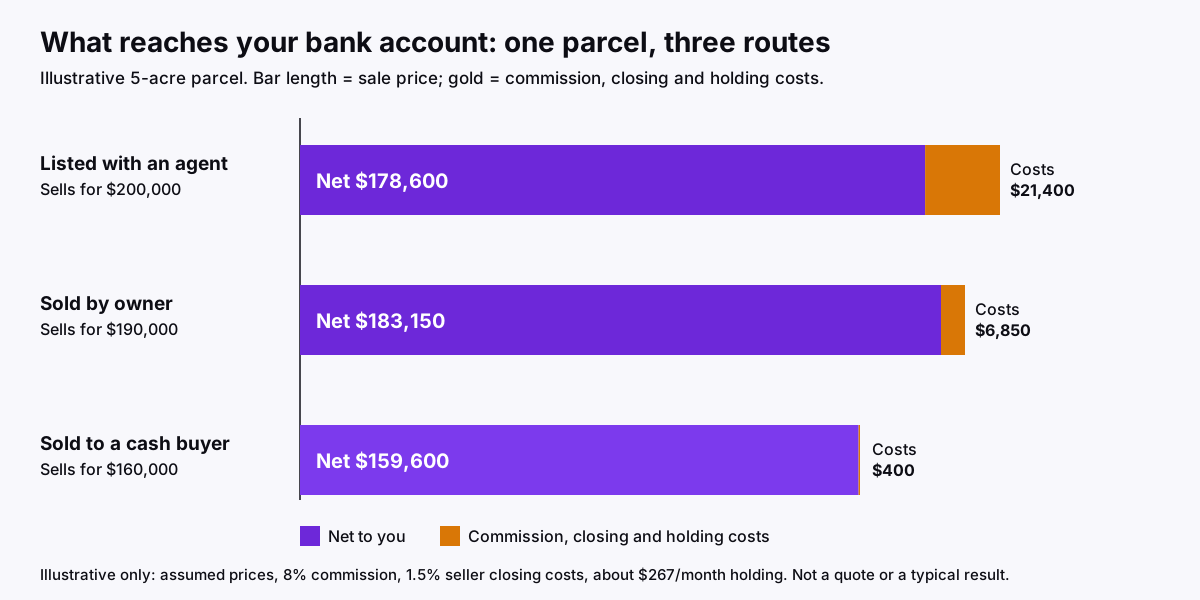
In this example, selling it yourself nets the most, by $4,550 over the agent and $23,550 over the cash sale. That gap is real and you should weigh it. But notice what the example assumes: that the listed and by-owner sales actually close. Land contracts often fall apart in due diligence, because that is when the soil, survey and title answers arrive, and each failed contract restarts the clock and the holding costs. If the first buyer's perc test fails in month eight, the by-owner net is no longer $183,150; it is a parcel that has been off the market for two months with a documented soil problem.
Run your own version. The inputs that swing it most are the price you can realiztically get, how long it will take, and how likely the first contract is to survive due diligence.
Selling land yourself is very doable, especially if you already know the likely buyer (a neighbor, a local builder, the farmer who leases it). The steps below are the same ones an agent would follow; you are just doing them.
Get a copy of your recorded deed from the county recorder or register of deeds, and pull the parcel record from the county property appraiser or assessor's website. You want the legal description, the parcel number, the acreage the county has on file, the current assessed value and tax bill, and any recorded easements. If you inherited the land, confirm the title is actually in your name (or the estate's) before you market it; our guide to selling inherited land covers the probate side.
This is the step that separates a strong price from a discounted one. Answer these before a buyer asks:
Put the answers on one page with the parcel map. A buyer who can see power at the road, a sensible soil profile and no flood zone on page one writes a stronger offer than one who has to find out for themselves. If any answer is a problem, you are better off knowing now; see what makes land buildable.
Price per acre from nearby sales of similar land is the core method, adjusted for size, access, utilities and usability. Larger parcels sell for less per acre than small ones, so a 2-acre sale is a poor comp for 40 acres. County sales records and an agent's sold-land data from the MLS are the best sources; online estimates for vacant land are unreliable because so few parcels sell. The full method, including the residual approach builders use, is in how much is my land worth.
Land buyers shop differently from home buyers. Put a clear sign on the road frontage with a phone number. List on the large land-listing websites and in local classifieds. Tell adjoining owners directly; neighbors are often the buyer who will pay the most, because your land is worth more to them than to anyone else. Call local builders if the parcel is buildable and close to town; if it is large enough to split, read selling land to a developer first. Every listing should carry your one-page fact sheet, good photos of the frontage and the land, and a map pin.
Do not sell land on a handshake or a one-page template. The contract should state the price and earnest money, the legal description, the length of the buyer's due-diligence (or feasibility) period and exactly what the buyer may do during it (survey, soil tests, environmental review), what happens to the earnest money if they walk, who pays which closing costs, the type of deed you will give, and the closing date. A due-diligence period is normal for land and protects both sides: the buyer gets time to confirm what they are buying, and you get a date after which the deposit usually becomes non-refundable. Have a real estate attorney draft or review it; this is the cheapest insurance in the whole sale.
Choose a title company or a closing attorney, depending on how closings work in your state. They search title, clear old liens, prepare the settlement statement, record the deed and handle the money. Do not accept or send closing funds by any route other than the one the closing agent confirms by phone at a number you found yourself.
Deed names and the protections they carry vary by state, and estates often convey with an executor's or personal representative's deed. Your closing agent will tell you what is customary where the land sits.
The part of a land sale you cannot control is finding the buyer. The part you can control is how fast the rest goes once you have one. The chart below uses the same illustrative parcel as above.
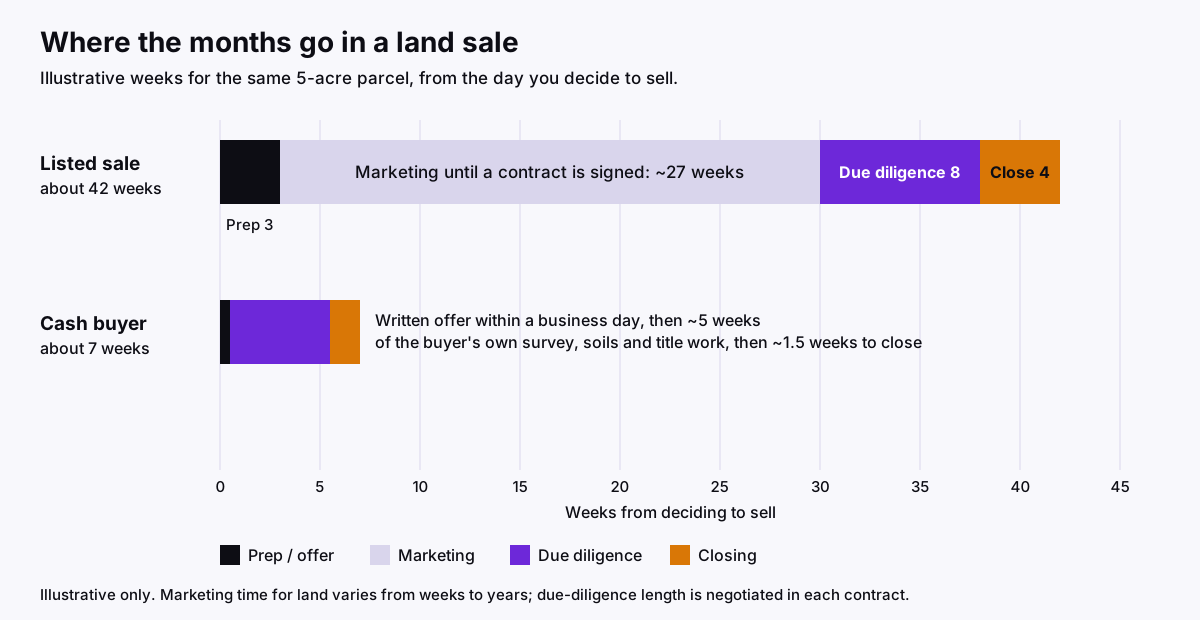
In the listed sale, about 3 weeks go to preparing the facts and pricing, about 27 weeks to marketing until a contract is signed, 8 weeks to the buyer's due diligence, and 4 weeks to close: 42 weeks in total. The cash-buyer route in the example takes about 7 weeks: a few days to send the parcel and receive a written offer, about 5 weeks of the buyer's own due diligence, and roughly a week and a half to close. Marketing time for land varies enormously; a buildable lot in a growing county can go under contract in weeks, and remote acreage can sit for years.
You do not need every item to start. You need to know which ones exist, because a buyer's title company will find the rest and a surprise at that stage costs time or price.
Because land is hard to finance, offering to finance the buyer yourself widens your buyer pool. The buyer puts money down, you record a note and a mortgage or deed of trust, and they pay you monthly. Owners who do this often get a higher price than they would for cash, plus interest.
The trade-offs are real:
Avoid land contracts (contracts for deed) that leave title with you until the last payment unless an attorney in your state has explained exactly how default and forfeiture work there. A recorded note and mortgage or deed of trust is usually cleaner for both sides.
Most failed land contracts die for one of a short list of reasons. Knowing them lets you fix them before a buyer finds them.
Teardown lots have their own list (demolition permits, utility disconnects, asbestos surveys on older homes); see selling a teardown lot.
If speed matters more than the last dollar, the fastest route is a buyer who does not need a lender and who does their own due diligence. That usually means a builder or a direct land buyer. To sell land fast through any route, the same three things help: have the parcel facts ready, price it at what comps support rather than what you hope, and answer questions the same day.
A cash buyer is often the right call when:
It is usually the wrong call when your land is a clean, buildable lot in a busy market and you have the time to list it. In that case, list it, or sell it yourself, and use a cash offer as a floor to compare against.
Restar Acquisitions is a family-owned principal buyer, not a real estate agent. We buy raw land, infill lots and teardown houses bought for the lot, for cash, to build luxury homes on. We concentrate on eight fast-growing counties, including Williamson County, Tennessee, Collin County, Texas, St. Johns County, Florida and Hamilton County, Indiana. The full list is on the land hub. We also review land outside them and tell you plainly if it is a pass.
What makes a parcel interesting to us: legal road access, buildable (public sewer or soils that support septic), outside the floodway, within reach of the county's job centers and strong school districts, and features luxury buyers pay for, such as views, mature trees, water frontage or privacy. That ranges from a single infill lot to acreage that can be divided into a handful of estate lots.
How it works: you send the address or parcel number on our sell my land page. Within one business day we reply with a written offer or the specific questions we need answered, after reviewing the parcel, zoning, flood maps, utilities and land comps. The contract includes a due-diligence period for survey, soil or perc work and title, which we pay for. We close at a title company or closing attorney. There is no commission and we cover standard closing costs.
Our offer will usually be lower than what a patient, well-marketed listing could bring. What you get in exchange is a buyer who does not need a lender, pays for its own due diligence and gives you a date. If your parcel would clearly do better listed, we will say so. This guide is educational only, not legal or tax advice; talk to a real estate attorney and a tax adviser about your situation. When you want a number to compare, send us the parcel.
Send the address or parcel number on our sell my land page. We reply within one business day with a written offer or the questions we need answered.
No obligation. We reply within one business day with a written offer or the questions we need answered. We call or email; we do not text.
Keep reading: How Much Is My Land Worth? Three Methods, With Real Math · Is My Land Buildable? A Seller's Checklist Before You Price It · Selling Land to a Developer: How Builders Price It and What to Ask · Selling a Teardown: How to Sell a House for Its Land Value
Where we buy: Williamson County, TN · Collin County, TX · Comal County, TX · St. Johns County, FL · Delaware County, OH · Hamilton County, IN · Forsyth County, GA · Washington County, UT
