If new custom homes are replacing old ones on your street, your house may be worth more as a lot than as a home. Builders price a teardown from the land up: what a new house will sell for, minus construction, demolition and profit. To sell a house for land value, compare that builder number with an as-is listing before spending anything on renovation.

Own land in one of our eight build markets? Get a written cash offer within one business day.
Get a land offer →Educational only. This explains how these situations generally work. It is not legal, tax or financial advice, and the rules differ by state — talk to an attorney or CPA about your own situation before you act on any of it.
“Teardown” is not an insult to the house. It means the market values the dirt under it more than the structure on it. You can usually tell from your own street and your own tax card:
We see this pattern in the counties we concentrate on: Brentwood and Franklin in Williamson County, Tennessee, where the typical single-family home value is $945,000 and values are up 31.7% over five years (Restar data, Zillow ZHVI, Aug-2026); Carmel in Hamilton County, Indiana; Powell in Delaware County, Ohio; and Ponte Vedra in St. Johns County, Florida. Those are county-wide figures. The established pockets where teardowns happen usually sit above the county typical value, because that is why builders want in.
A builder does not look at your kitchen. They work backwards from the house they plan to build. This is called residual land value, and every builder runs some version of it. An illustrative example with assumed numbers, for the same street used in the comparison further down:
| Step | Illustrative amount |
|---|---|
| Expected sale price of the new home on this street | $2,600,000 |
| Less construction cost | −$1,400,000 |
| Less builder profit and overhead (15% of price) | −$390,000 |
| Less sales commission, construction financing and closing costs | −$150,000 |
| Less demolition, asbestos survey and abatement, utility disconnects, permits | −$60,000 |
| Maximum the builder can pay for the lot | $600,000 |
For context, the National Association of Home Builders’ 2024 Cost of Constructing a Home survey found that, on average nationally, the finished lot was 13.7% of a new home’s sales price, construction was 64.4% and builder profit was 11.0%. A national average hides a wide range, and established neighborhoods where land is scarce are exactly where the lot is the hard part to find. That is why a builder prices your specific street, not a percentage.
Three items in that table deserve a closer look because they are where teardown offers differ:
Selling a house for lot value on the open market runs into a structural problem: the people who normally buy houses are buying the house.
This cuts both ways. In a neighborhood where the house is still very livable and the lot premium is modest, a retail buyer can outbid a builder easily, because the retail buyer is not paying for demolition or new construction. Teardown pricing only wins where the land has clearly outrun the house.
The instinct is to update the kitchen and bathrooms and list it. In a teardown neighborhood that is usually the weakest option, for three reasons:
Renovation can make sense where the neighborhood is not turning over, the house has good bones and the update is modest. The worked example below shows why it tends to lose where builders are active.
Illustrative example with assumed numbers, before any mortgage payoff. The house is a 1968 ranch on a large lot in a street with recent new builds. Every figure is an assumption to show the arithmetic, not a quote or a typical result.
| Sell to a builder or cash buyer | List as-is with an agent | Renovate, then list | |
|---|---|---|---|
| Sale price | $600,000 | $665,000 | $820,000 |
| Renovation | $0 | $0 | −$180,000 |
| Commission (5.5%) | $0 | −$36,575 | −$45,100 |
| Seller closing costs | −$2,000 | −$6,650 (1%) | −$8,200 (1%) |
| Inspection credits / concessions | $0 | −$10,000 | −$5,000 |
| Holding costs at $2,500 a month | $0 (closes in ~30–45 days) | −$10,000 (4 months) | −$20,000 (8 months) |
| Net to seller | $598,000 | $601,775 | $561,700 |
| Main risk | Lower headline price | Buyer financing, appraisal and inspection fallout | Budget overruns; the buyer may be a builder anyway |
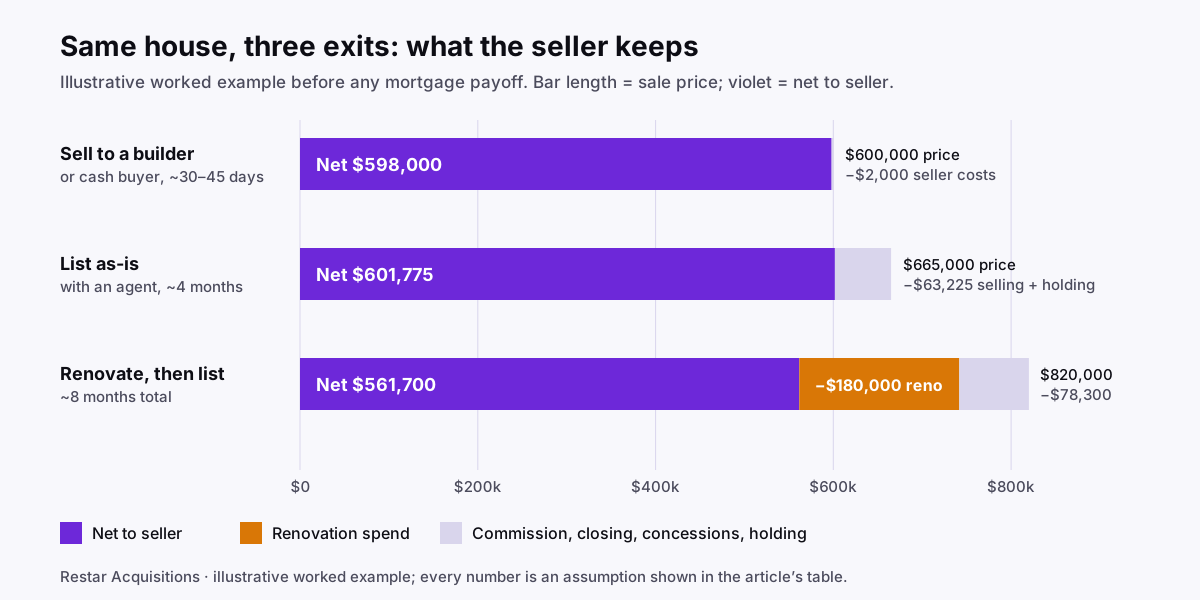
The arithmetic, line by line: list as-is = $665,000 − $36,575 − $6,650 − $10,000 − $10,000 = $601,775. Renovate = $820,000 − $180,000 − $45,100 − $8,200 − $5,000 − $20,000 = $561,700. The renovation added $155,000 to the sale price ($820,000 versus $665,000) and cost $180,000 plus four more months of carrying costs.
Read the result honestly. In this example listing as-is nets about $3,800 more than the builder sale, but only if the house sells in four months without a failed appraisal or a buyer walking after inspection. In this example that $665,000 buyer is a family buying the house as it stands, not a builder. On a street where several builders compete for lots, marketing the listing to them can also push the price above any single builder’s offer. The direct builder sale gives up a little price for a known number, no showings and a closing date you can plan around. Renovating is the only path in this example that clearly loses.
Change the assumptions and the answer changes. If your lot is worth more to builders than your house is to families, the builder number can be the highest one. If your house is well kept and the lot is ordinary, listing will usually win. How much is my land worth walks through valuing the lot on its own.
Normal house comps mislead here. You want two different kinds of sales:
Also look for vacant lot sales in the same neighborhood, and adjust for size, frontage and slope. A listing agent with MLS access can pull most of this quickly; ask specifically for sales where the buyer was a builder.
Restar Acquisitions is a family-owned principal buyer. We buy raw land, infill lots and teardown houses bought for the lot, for cash, to build homes on, concentrating on eight high-income counties including Williamson TN, Hamilton IN, Delaware OH and St. Johns FL. We are a buyer, not an agent, so we do not list your house or represent you.
How it works: send the address on our sell my land page. We review the parcel, zoning, flood maps, utilities and land comps and reply within one business day with a written offer or the specific questions we need answered. The contract includes a due-diligence period for survey, title and any soil work, which we pay for. You close at a title company or closing attorney; no commission, and we cover standard closing costs. You do not clean out, repair or fix the inspection items; the house is coming down.
Our number is a builder’s number, so it is based on the lot, and it will often be below what a patient listing could bring. Get a listing agent’s opinion too and compare the nets, the way the table above does. If the house is not a teardown, we will say so, and our as-is house buying page or a conventional listing may fit better. For the broader picture, see selling land to a developer.
This guide is educational only, not legal, tax or appraisal advice. Zoning, demolition and asbestos rules are local, so confirm them with your city or county before you rely on them.
Send us the address. We reply within one business day with a written offer based on the lot, or a straight answer if it is not a teardown, through our sell my land page.
No obligation. We reply within one business day with a written offer or the questions we need answered. We call or email; we do not text.
Keep reading: How to Sell Land: By Owner, With an Agent, or to a Cash Buyer · How Much Is My Land Worth? Three Methods, With Real Math · Is My Land Buildable? A Seller's Checklist Before You Price It · Selling Land to a Developer: How Builders Price It and What to Ask
Where we buy: Williamson County, TN · Collin County, TX · Comal County, TX · St. Johns County, FL · Delaware County, OH · Hamilton County, IN · Forsyth County, GA · Washington County, UT
