Raw land, infill lots and teardowns in Delaware County, Ohio, bought for cash by a builder who builds luxury homes here. Written offer, or our questions, within one business day.
Including Powell, Lewis Center, Delaware, Sunbury, Galena, Liberty Township, Orange Township.
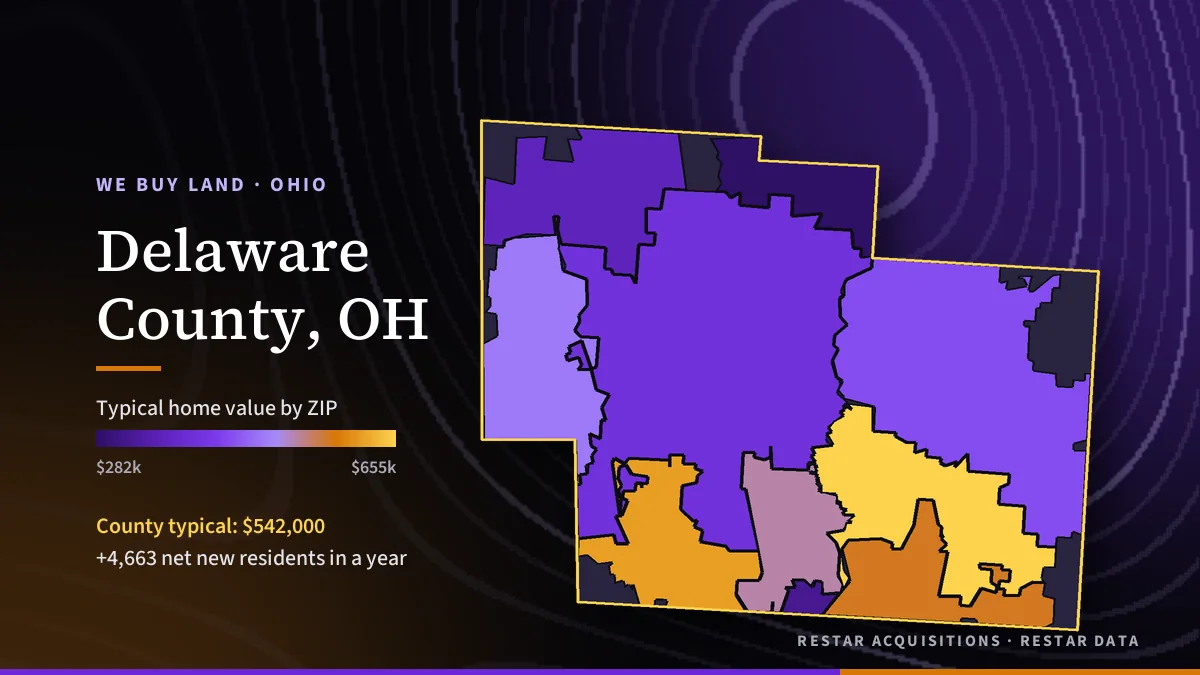
ReStar data: population 2024, net migration year to July 2025, typical single-family value (Zillow ZHVI) August 2026, household income ACS 2024, single-family permits July 2026.
We buy land for cash across Delaware County, Ohio: raw acreage, infill lots and teardowns in Powell, Lewis Center, Delaware, Sunbury and the rest of the county. Send the address or parcel number and you get a written offer, or our questions, within one business day. There is no commission, we cover standard closing costs and we pay for our own survey and soil work. What your land is worth depends mostly on the ZIP it is in and how buildable it is, and both are laid out below.
One difference from most cash land buyers you will find for Delaware County: they buy vacant land to resell it, often to someone like us. We build on it, so we price your acreage or lot from the home that will stand on it, not from a resale discount.
The highest-income county in Ohio in ReStar's data, at a median household income near $133,500, just north of Columbus. Values are up about 24% in five years and the county issued 337 single-family permits in July 2026, more than Williamson County TN.
Land is worth what the homes built on it can sell for, less what it costs to build them. So the quickest honest read on land value in Delaware County is the value of the homes around it, ZIP by ZIP. Across the 10 ZIP codes centered in the county, the typical single-family home ranges from $282k in 43003 (Ashley) to $655k in 43021 (Galena). The fastest-rising over the last year is 43003 (Ashley), at +4.8%.
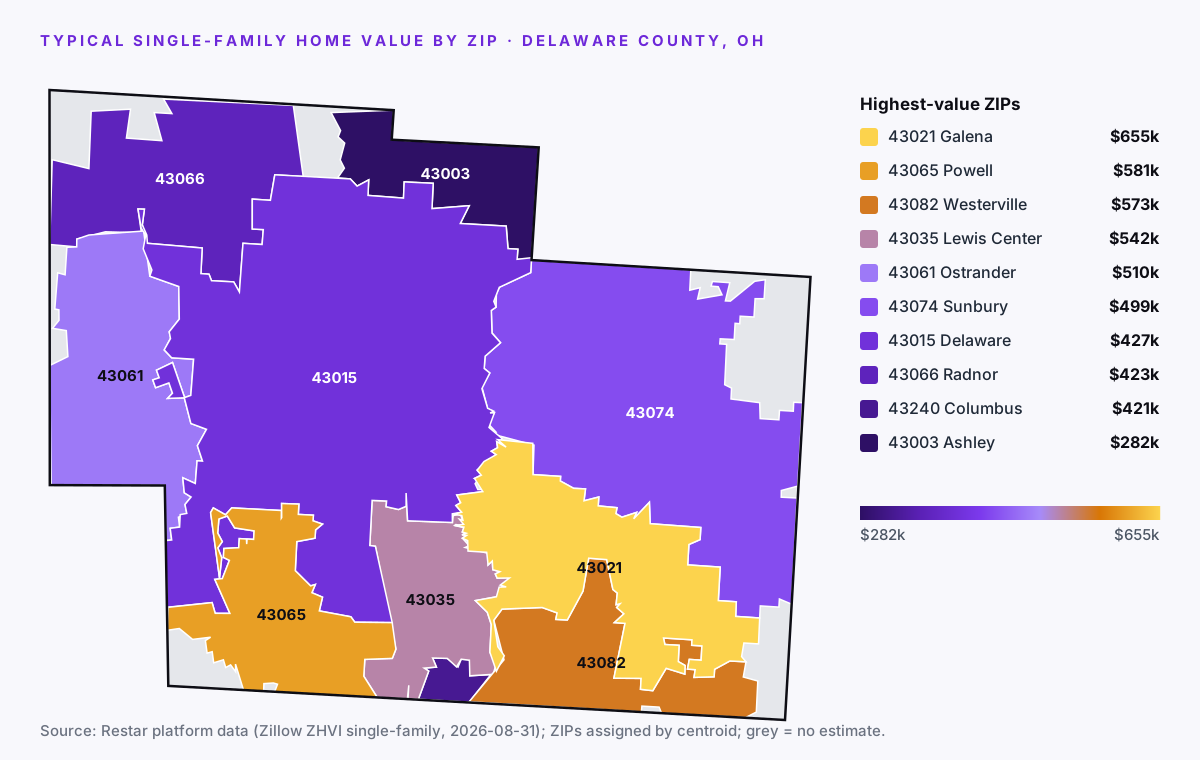
The last column is a benchmark, not an offer. The National Association of Home Builders' 2024 cost survey found the finished lot averaged 13.7% of a new home's sales price nationally. Apply that share to the typical home in each ZIP and you get a rough ceiling on what a builder budgets for a finished lot there, one that already has road access, utilities and approvals. Raw land sells below it by whatever it costs to get there, which is why a parcel with sewer at the road and a parcel that needs a septic system can draw very different offers in the same ZIP.
| Town | ZIP | Typical home | 1-yr | 5-yr | Finished-lot benchmark (13.7%) |
|---|---|---|---|---|---|
| Galena | 43021 | $655k | +1.8% | +26.8% | $90k |
| Powell | 43065 | $581k | +0.1% | +22.6% | $80k |
| Westerville | 43082 | $573k | +1.6% | +25.2% | $79k |
| Lewis Center | 43035 | $542k | +0.0% | +24.3% | $74k |
| Ostrander | 43061 | $510k | +2.0% | +25.8% | $70k |
| Sunbury | 43074 | $499k | +1.7% | +26.0% | $68k |
| Delaware | 43015 | $427k | +0.4% | +23.7% | $58k |
| Radnor | 43066 | $423k | +2.6% | +22.3% | $58k |
| Columbus | 43240 | $421k | +1.9% | +30.9% | $58k |
| Ashley | 43003 | $282k | +4.8% | +13.3% | $39k |
ReStar platform data: Zillow Home Value Index, single-family, 2026-08-31. ZIPs assigned to the county by their center point; a ZIP that straddles a county line is listed where most of it sits. Town is the USPS place name.
Farmland and wooded acreage in the townships north and east of Powell and Lewis Center, toward Sunbury and Galena, and larger lots in Liberty and Orange townships where estate homes are being built along the Sawmill Parkway corridor.
Our full buy box is on the sell my land page. It is loose on purpose: send the parcel even if it misses a line, and we will tell you straight if it is a pass.
Two parcels the same size, a mile apart, can be worth very different amounts because of rules that never show up in a listing. These are the ones we check first in Delaware County.
Sewer decides what Delaware County land is worth. The Delaware County Regional Sewer District says capacity is not reserved until the requirements for an extension or permit are met, and tap and surcharge fees are paid before connection. A parcel inside the sewer service area can carry more homes than one that has to rely on septic, so we check the district's service area first.
Source: Delaware County Regional Sewer District
Delaware County has no single county zoning code for the countryside: of its 18 townships, 15 write and administer their own zoning resolutions, and Delaware County administers zoning for Marlboro, Radnor and Thompson townships. Subdivisions in unincorporated areas go through the Delaware County Regional Planning Commission; its 'No-Plat' lot-split process covers lots of 5 acres or less (up to four splits a year from an original tract), while lots larger than 5 acres with enough road frontage do not need Regional Planning approval to be recorded and conveyed. A no-plat split application needs sign-off from the township or county zoning officer, the health department or sanitary engineer, and the County Engineer (or ODOT on a state route).
Source: regionalplanning.co.delaware.oh.us
CAUV taxes land devoted exclusively to commercial agriculture (10+ acres, or under 10 acres with at least $2,500 average yearly gross farm income over three years) at its farming value instead of market value; owners apply through the County Auditor. If the land is converted to a non-agricultural use, or the owner fails to re-file, the county auditor levies a recoupment charge equal to the tax savings for the three tax years immediately before the conversion, and the land goes back to being taxed at full market value. ORC 5713.34 makes the recoupment a lien on the converted land; the Delaware County Auditor states that CAUV follows the land and the new owner, and the charge does not become a lien until the use changes. The statute does not mention interest. Who pays between seller and buyer is not set by statute and is negotiated in the purchase contract (except that public entities and entities with eminent-domain power cannot shift the charge back to the seller).
If your land is taxed at a farm or open-space value, raise it at the start. Who pays any rollback is a term of the contract, and it belongs in the price conversation, not at the closing table.
Source: codes.ohio.gov · auditor.co.delaware.oh.us
In Ohio the taxable (assessed) value of real property is 35% of the auditor's appraised market value; farmland enrolled in CAUV is appraised at its agricultural use value instead, while any homesite and buildings stay at market value.
Source: auditor.co.delaware.oh.us
Delaware County property values are being updated in the 2026 triennial valuation update; proposed values are posted now and final values certified by the State are expected on the Auditor's website in mid-to-late December 2026. (auditor.co.delaware.oh.us)
Under the Delaware County Auditor's transfer and conveyance standards, any transfer that splits off a parcel of five acres or less, or leaves a remaining parcel of five acres or less, needs approval from the appropriate planning authority before the Auditor will accept it; the Auditor will not decide whether a split is exempt. (engineer.co.delaware.oh.us)
A new CAUV owner must file an initial CAUV application with the County Auditor between the first Monday in January and the first Monday in March, with a one-time $25 fee; land must have been in commercial agricultural use for the three prior years to qualify. (auditor.co.delaware.oh.us)
We start from the house we would build and work backward. Take a home that would sell at the county's typical value of $542,000. At the national 13.7% lot share, the finished lot behind it is budgeted at about $74k. If the land already has a paved road, water and sewer or an approved septic site, most of that budget can go to the land. If a driveway has to be cut, power brought in and a septic system engineered, those costs come out first, and so does the time it takes to get approvals. That is the whole reason two owners in the same ZIP can get very different numbers, and why we would rather tell you which line is costing you than just quote a figure.
The full method, with the arithmetic and what happens when build costs move, is in how much is my land worth. If you want to take the unknowns off the table before you sell to anyone, start with is my land buildable.
Tell us where it is. We reply within one business day with a written offer or the questions we need answered, and we cover standard closing costs.
No obligation. We reply within one business day with a written offer or the questions we need answered. We call or email; we do not text.
Ohio is generally treated as a title/escrow-closing state rather than an attorney-closing state: licensed title insurance agents handle settlement, closing and escrow funds. Ohio law (ORC 3953.32) requires title insurers to offer closing protection that covers theft or failure to properly disburse settlement, closing or escrow funds by their title agents.
| Cost | Selling to us | Listing the land |
|---|---|---|
| Agent commission | None | Negotiated with your agent; land listings often carry a higher percentage than houses |
| Standard closing costs | We cover them | Seller's share per local custom and the contract |
| Deed transfer or recording tax | Follows state custom; set out in the contract | Ohio charges a real property conveyance fee collected by the county auditor: a mandatory state fee of $1 per $1,000 of value (ORC 319.54(G)(3)) plus an optional county 'permissive' fee of up to $3 per $1,000 (ORC 322.02), for a combined maximum of $4 per $1,000; there is also a $0.50 per-parcel transfer fee (ORC 319.54(G)(2)). The Ohio Department of Taxation's county table lists Delaware County's permissive rate at $2.00 per $1,000 for calendar year 2019 (about $3 per $1,000 in total) in the state's most recent published table; the County Auditor can confirm today's rate. Who pays it is set in the purchase contract. |
| Survey, soil or perc tests | We pay for our own | Often requested from the seller |
| Farm-use rollback, if any | Negotiated in the contract | Negotiated in the contract |
| Liens, back taxes, mortgage payoff | Paid from your proceeds | Paid from your proceeds |
Sources: transfer tax · closing practice
Where to check the facts yourself, most of it free. These are the same sources we use.
Send the address or parcel number to a buyer who pays cash and does not need a lender: we reply within one business day with a written offer or our questions, and the due-diligence period is written into the contract. Listing can bring more if the parcel is clearly buildable and you have months to wait.
Farmland and wooded acreage in the townships north and east of Powell and Lewis Center, toward Sunbury and Galena, and larger lots in Liberty and Orange townships where estate homes are being built along the Sawmill Parkway corridor.
It depends on the ZIP and on how buildable the parcel is. Typical home values in Delaware County range from $282k to $655k by ZIP, and at the national 13.7% lot share that implies finished-lot budgets from about $39k to $90k. Raw land sells below a finished lot by the cost of access, utilities and approvals.
No. We make a written offer from public records, maps and land sales, and do the survey, soil and title work ourselves during the due-diligence period, at our cost.
Yes. CAUV taxes land devoted exclusively to commercial agriculture (10+ acres, or under 10 acres with at least $2,500 average yearly gross farm income over three years) at its farming value instead of market value; owners apply through the County Auditor. If the land is converted to a non-agricultural use, or the owner fails to re-file, the county auditor levies a recoupment charge equal to the tax savings for the three tax years immediately before the conversion, and the land goes back to being taxed at full market value. ORC 5713.34 makes the recoupment a lien on the converted land; the Delaware County Auditor states that CAUV follows the land and the new owner, and the charge does not become a lien until the use changes. The statute does not mention interest. Who pays between seller and buyer is not set by statute and is negotiated in the purchase contract (except that public entities and entities with eminent-domain power cannot shift the charge back to the seller). Who pays is agreed in the contract, so raise it before you agree a price.
Ohio charges a real property conveyance fee collected by the county auditor: a mandatory state fee of $1 per $1,000 of value (ORC 319.54(G)(3)) plus an optional county 'permissive' fee of up to $3 per $1,000 (ORC 322.02), for a combined maximum of $4 per $1,000; there is also a $0.50 per-parcel transfer fee (ORC 319.54(G)(2)). The Ohio Department of Taxation's county table lists Delaware County's permissive rate at $2.00 per $1,000 for calendar year 2019 (about $3 per $1,000 in total) in the state's most recent published table; the County Auditor can confirm today's rate. Who pays it is set in the purchase contract.
Yes to all three. Back taxes and liens are paid from the proceeds at closing, we work with the executor or every heir on title, and a landlocked parcel is priced around the easement work rather than turned down.
Other counties where we buy land: Williamson County, TN · Collin County, TX · Comal County, TX · St. Johns County, FL · Hamilton County, IN · Forsyth County, GA · Washington County, UT
Guides for landowners: How to Sell Land: By Owner, With an Agent, or to a Cash Buyer · How Much Is My Land Worth? Three Methods, With Real Math · Is My Land Buildable? A Seller's Checklist Before You Price It · Selling Land to a Developer: How Builders Price It and What to Ask · Selling a Teardown: How to Sell a House for Its Land Value · Selling Inherited Land: Taxes, Title and Your Real Options
