Selling a house in Maryland involves one thing that exists almost nowhere else in the country and routinely stops a closing dead: ground rent. A great many Baltimore rowhouses sit on a leasehold whose owner may be an estate that dissolved decades ago, and title will not clear until that interest is found, redeemed or assumed. On top of that, Maryland runs an aggressive annual tax sale that a Baltimore homeowner can be caught by over an unpaid water bill, and it lets sellers do something most states do not — formally decline to make any representation about the condition of the house at all.

Step 1 of 5
Send the address and we will tell you what it is worth as-is, ground rent and all.
You’ll talk to Trevor McAmis, Owner & Acquisitions Lead
(313) 710-6129
Takes about two minutes. Or call (313) 710-6129 — we answer.
Educational only. This explains how these situations generally work. It is not legal, tax or financial advice, and the rules differ by state — talk to an attorney or CPA about your own situation before you act on any of it.
Selling a house in Maryland means clearing any ground rent before title will pass, splitting a transfer tax that totals 2% of the price in Baltimore City, and choosing whether to disclose or disclaim the condition. If back taxes or water bills have built up, the annual tax sale may matter more.
This is educational information, not legal or tax advice. Maryland rules vary by county and change from year to year — confirm current figures with the relevant agency and talk to a Maryland attorney about your own situation.
If you own a Baltimore rowhouse, this section is probably why you are here.
What it is. Under a ground lease, you own the house but hold the land on a long, renewable lease — typically 99 years — and someone else holds the reversion. You pay them an annual ground rent, usually somewhere between $50 and $150, generally billed twice a year. It is a colonial-era arrangement that survives at scale in Baltimore and almost nowhere else in the United States.
Why it matters when you sell. A ground rent is an interest in your title. Most mortgage lenders and title companies will require it to be redeemed at or before closing, or expressly assumed with proper documentation. Until it is resolved, title does not clear and the sale does not close. It is one of the most common reasons a Baltimore contract with a financed buyer falls apart.
What it costs to redeem. Maryland fixes the redemption price by formula: the annual ground rent divided by a capitalisation rate set by when the lease was created.
| Lease created | Capitalisation rate | Redemption on $120/year |
|---|---|---|
| 2 July 1982 to present | 12% | $1,000 |
| 6 April 1888 – 1 July 1982 | 6% | $2,000 |
| 8 April 1884 – 5 April 1888 | 4% | $3,000 |
| Before 9 April 1884 | Negotiable; may not be redeemable at all | — |
So a $120 annual ground rent on a lease written in 1956 redeems for $2,000 — $120 divided by 6%. Note the counter-intuitive result: older leases cost more to redeem, because the lower capitalisation rate implies a more valuable income stream. Most Baltimore rowhouse ground rents fall in the 6% band.
The registration rule that works in your favour. Maryland requires ground rents to be registered with the State Department of Assessments and Taxation in order to be collected. An unregistered ground rent cannot legally be collected while it stays unregistered. The SDAT ground rent registry is where you check whether yours is registered and who holds it.
The real-world problem is not the money, it is the person. $2,000 is manageable. Finding the holder often is not. Ground rents were bought, sold, bequeathed and forgotten for a century; the record owner is frequently a dissolved company or an estate closed in the 1970s. Maryland provides a statutory route to redeem when the holder cannot be located, but it takes time — and time is exactly what a seller under contract does not have.
Practical advice: find out on day one. Before you list, before you accept an offer, check the registry and your deed and establish whether the property is ground rent or fee simple. If there is a ground rent, start the redemption immediately. Sellers who discover it three weeks before closing lose the buyer.
For us it is routine — we buy leasehold rowhouses regularly and it does not break our closing — but that is a reason it is not a disaster, not a reason to sell cheaply. Our Baltimore market page covers how we handle it.
Maryland's tax sale system catches Baltimore homeowners who are not in mortgage trouble at all, and the reason is that unpaid water bills and other municipal charges count toward the lien total.
How it works. Baltimore City holds an annual tax sale, typically in May. If the qualifying liens against your property exceed the threshold, the city sells a tax lien certificate on it to a bidder. You do not lose the house at the sale — you retain a right of redemption — but the certificate holder can eventually foreclose that right, and in the meantime interest and their legal fees accrue against you.
| Item | Baltimore City |
|---|---|
| Threshold, owner-occupied | $1,000 or more in combined city liens |
| Threshold, non-owner-occupied | $750 |
| Redemption interest, owner-occupied (2026 sale) | 10% |
| Redemption interest, non-owner-occupied (2026 sale) | 18% |
| What counts toward the total | Property taxes, water and sewer charges, and other municipal liens |
Read the last row again. A homeowner who is current on the mortgage and current on property taxes can still be sold into tax sale over an accumulated water bill. It is one of the most criticised features of the system and one of the least understood by the people it happens to.
Get help before the sale, not after. Baltimore City runs a Tax Sale Coordination and Prevention Services office whose entire purpose is keeping owner-occupied homes off the list, and Maryland has a State Tax Sale Ombudsman who helps homeowners with payment plans, exemptions and redemption. Both are free. The city also publishes the tax sale process in detail.
Selling is not the first answer here. If the balance is a few thousand dollars, a payment plan or a hardship exemption keeps the house and costs you nothing. Sell because selling is right for you, not because a lien notice frightened you. Our guide to selling a house with delinquent property taxes works through when a sale genuinely becomes the better route.
Maryland's disclosure form is called the Residential Property Disclosure and Disclaimer Statement, and the second word is a real choice.
Disclaiming does not mean you can hide things. Even a seller who disclaims must still disclose known material latent defects — problems not reasonably observable that could pose a danger or affect the property's use. What disclaiming removes is the obligation to affirmatively inventory the condition of a house you may know nothing about.
Who this is genuinely useful for: a personal representative selling an inherited house they never lived in, an out-of-state owner, a landlord who never occupied the property, or anyone selling a house that has been vacant for years. Completing a detailed condition questionnaire about a house you do not know is a liability trap, and Maryland — unlike New York, which removed its opt-out in March 2024 — gives you a lawful alternative.
Talk to your attorney about which election fits. Disclaiming can slightly soften a retail buyer's confidence, so it is a trade, not a free option.
Maryland's transaction taxes are high, and Baltimore City's are among the highest in the country.
| Item | Rate | On a $190,000 sale |
|---|---|---|
| State transfer tax | 0.5% | $950 |
| Baltimore City transfer tax | 1.5% | $2,850 |
| Transfer tax total | 2.0% | $3,800 |
| Recordation tax | Charged per $500 of value — additional | Varies |
Maryland's default is a 50/50 split between buyer and seller unless the contract says otherwise, so in the worked example below the seller carries about $1,900 of transfer tax. Compare that with Texas, which has no real estate transfer tax at all — on the same sale a Texas seller pays $0. That difference is real money and it belongs in any net-proceeds comparison. Baltimore City publishes its recordation tax rules; confirm current rates before relying on a figure, because they move.
One more for out-of-state sellers. Maryland withholds income tax at closing from nonresident sellers — a percentage of the sale price collected by the settlement agent and credited when you file a Maryland return. It is not an extra tax, but it is cash you do not receive on closing day, and heirs living out of state are regularly blindsided by it. Confirm the current rate with the Comptroller of Maryland before you build a budget around your net.
Our guide to seller closing costs itemises the whole settlement statement, state by state.
Maryland's foreclosure process gives you defined, usable steps, and the first one is a document you should keep.
Maryland's Department of Housing and Community Development publishes a foreclosure mediation FAQ, and the Office of Financial Regulation maintains residential foreclosure information and procedures. Both are free and neither requires a paid intermediary.
Use the mediation. It is a supervised negotiation with the servicer, and modifications, forbearance and repayment plans all come out of it. Selling is one option among several, and it should be the one you choose after mediation has failed rather than instead of attending. If someone is charging you an up-front fee to save your home, the Maryland Attorney General's Consumer Protection Division is where that gets reported.
Across the Baltimore properties in our records the median year built is 1920 and the median size is about 930 square feet — a classic city rowhouse. Take one worth $190,000 fully repaired, needing $45,000 of work: roof, systems, plaster, kitchen and bath, and the lead remediation that pre-1978 stock generally requires.
The cash figure uses the four-term build-up from how cash home buyers calculate offers:
| Term | Amount |
|---|---|
| After-repair value | $190,000 |
| Repairs | −$45,000 |
| Resale and holding — commission $10,450, seller closing $3,300, purchase closing $1,600, five months' carry $5,750 | −$21,100 |
| Margin | −$24,000 |
| Illustrative cash figure | $99,900 |
A worked illustration on one hypothetical property. Not a quote, not a prediction about your house, and not a fixed formula we apply.
| Line | List it retail | Sell as-is for cash |
|---|---|---|
| Sale price | $190,000 | $99,900 |
| Repairs funded first | −$45,000 | $0 |
| Agent commission (5.5%) | −$10,450 | $0 |
| Seller closing costs — incl. ~$1,900 transfer tax share | −$3,300 | $0 — we cover standard closing costs |
| Holding while it sells | −$5,750 (5 months at $1,150) | −$800 (3 weeks) |
| You keep | $125,500 | $99,100 |
Listing wins by $26,400. If you can fund $45,000 of repairs on a Baltimore rowhouse and wait five months, list it. That is the higher-netting route and we would say so.
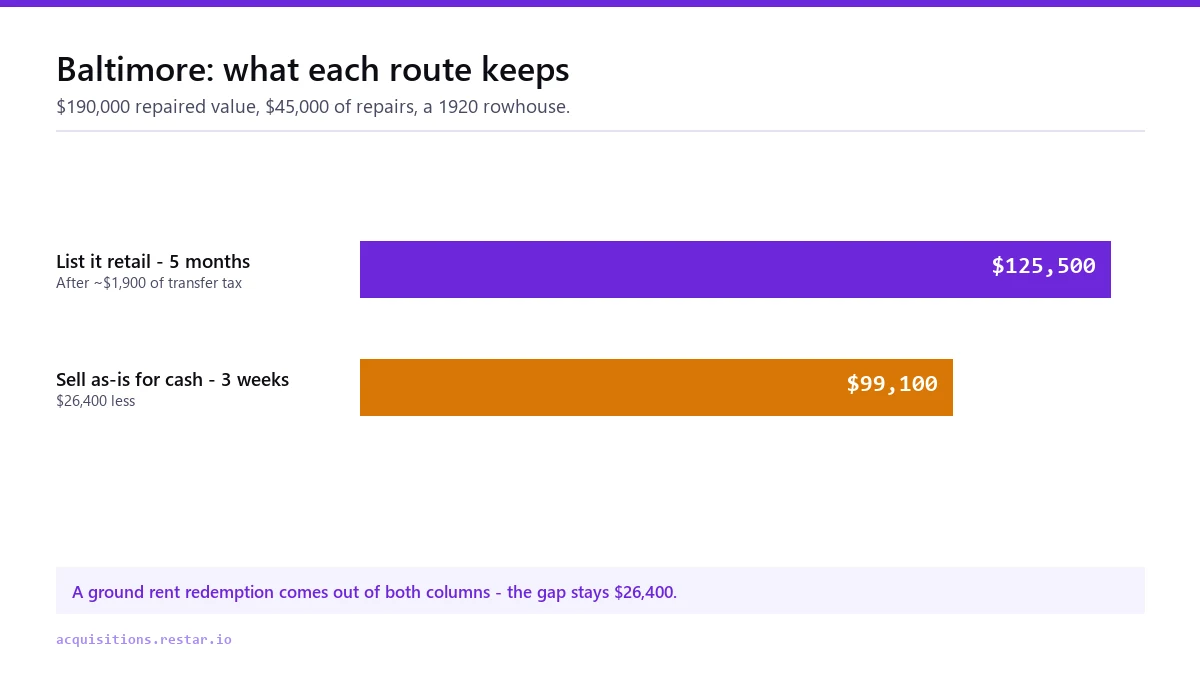
And here is what ground rent does to that comparison: nothing. A $2,000 redemption comes out of both columns identically, so the gap stays $26,400 and the ranking never changes. Ground rent makes you $2,000 poorer whichever way you sell; it does not make a cash sale smarter. That is the same structure we set out in selling a house with a lien on it — what an encumbrance changes is not which route pays more, but whether the lower-priced route can still clear what is owed.
Where a cash sale genuinely earns its discount in Baltimore:
Outside those, take the $26,400.
We buy across 18 Baltimore ZIP codes, as-is, including rowhouses with unredeemed ground rent, properties with accumulated water and city liens, and houses that will not clear a mortgage underwriter. Written offer within 24 hours, no obligation.
The honest conclusion below is that a Baltimore rowhouse someone can afford to repair nets more on the open market — by about $26,000 in the worked example — and we will tell you when that is your situation. Our figure is most useful as the second number in a comparison, or when a tax sale date, a title problem or the condition means a retail listing is not genuinely on the table. Send us the property here.
All guides · We buy houses in Baltimore · Selling with a lien
Step 1 of 5
No obligation, no fees, no repairs. We respond the same day.
You’ll talk to Trevor McAmis, Owner & Acquisitions Lead
(313) 710-6129
Takes about two minutes. Or call (313) 710-6129 — we answer.