Seller closing costs are the most reliably misunderstood number in a house sale, and the misunderstanding runs in a specific direction. Sellers are encouraged to think of them as a leak to be plugged — nine percent of the price, gone — and any route that eliminates them therefore looks like a win. But closing costs are a percentage of the price you get, and the fastest way to reduce them to zero is to accept a much lower price. On the worked example below, a seller who eliminates $22,580 of closing costs ends up $23,870 worse off. This page itemises every line and then does the arithmetic that most closing cost articles carefully avoid.

Step 1 of 5
Send the address and we will put a written figure and a full cost breakdown in front of you.
You’ll talk to Trevor McAmis, Owner & Acquisitions Lead
(313) 710-6129
Takes about two minutes. Or call (313) 710-6129 — we answer.
Educational only. This explains how these situations generally work. It is not legal, tax or financial advice, and the rules differ by state — talk to an attorney or CPA about your own situation before you act on any of it.
Seller closing costs typically run 8% to 10% of the sale price on a listed sale, and commission is most of it — about $22,580 on a $250,000 sale. What matters is not the size of that number but which price it is being subtracted from.
This is educational information, not legal or tax advice. Rates and customary allocations vary by state, county and contract — confirm current figures locally and talk to an attorney or CPA about your own sale.
This is the whole seller side of a settlement statement on a conventional listed sale. The percentages people quote hide most of these.
| Line | Amount | What it is |
|---|---|---|
| Listing agent commission (2.5%) | $6,250 | Your own agent's compensation |
| Buyer agent compensation (2.5%) | $6,250 | Now negotiated separately — see below |
| Owner's title policy and settlement fee | $1,900 | Customarily the seller's in most states; varies |
| Transfer and recordation taxes | $1,000 | Wildly variable — $0 to $5,000 on this sale |
| Attorney fee | $1,500 | Required in practice in NY and GA; common in MD |
| Prorated property taxes | $900 | Your share of the tax year up to closing |
| Post-inspection concessions and repair credits | $3,500 | The invisible closing cost |
| Home warranty for the buyer | $550 | Common ask in a balanced market |
| HOA resale certificate and transfer fee | $300 | Where an association exists |
| Per-diem mortgage interest to payoff | $180 | Interest accrues to the day funds arrive |
| Recording, wire, courier, notary | $250 | Small and unavoidable |
| Total | $22,580 | 9.0% of the price |
Two lines deserve attention because sellers consistently forget them.
Concessions. The $3,500 is not a fee anyone quotes you. It is what happens after the inspection, when the buyer asks for a credit against the roof or the furnace. It is a genuine, routine cost of selling a house that needs work, and it does not appear on any net sheet before you are under contract.
Prorations are not always a cost. Depending on whether your state bills property tax in arrears or in advance, proration can debit or credit you. Ohio and Michigan sellers, for instance, frequently owe a substantial tax proration at closing; a seller who prepaid gets money back. Ask your closer which way it runs before you plan around a net figure.
The CFPB's guide to the Closing Disclosure explains how to read the settlement document itself, line by line.
The commission rules changed on 17 August 2024, and the change is more procedural than financial. It is worth being precise, because there is a great deal of confident nonsense about this.
What changed: offers of compensation to buyer brokers can no longer be published in the MLS, and agents must have a signed written agreement with a buyer before touring homes. Buyer-agent compensation is now negotiated separately rather than assumed.
What did not change: most of the money. Listing-side commissions still commonly run 2.5% to 3%, and national average total commission remains close to 5.7%. Sellers who expected the settlement to halve their costs have mostly been disappointed.
What it means for you in practice:
The National Association of Realtors publishes its own settlement FAQs. Read them as a party's account of its own settlement, but the mechanics are accurately described.
Every other line on the table above is roughly similar across the country. Transfer taxes are not — they range from nothing at all to several thousand dollars on the same sale, which is why a single national closing cost percentage is close to useless.
Commonly quoted state-level base rates in the eleven states we buy in:
| State | Approximate state-level rate | On $250,000 |
|---|---|---|
| Texas | None | $0 |
| Indiana | None | $0 |
| Arizona | None — barred by a 2008 constitutional amendment | $0 |
| Alabama | $0.50 per $500 (0.10%) | $250 |
| Georgia | $1.00 per $1,000 (0.10%) | $250 |
| Ohio | $1.00 per $1,000, plus county permissive | $250 plus county |
| North Carolina | $1.00 per $500 (0.20%) | $500 |
| New York | $2.00 per $500 (0.40%) | $1,000 |
| Florida | $0.70 per $100 documentary stamp (0.70%) | $1,750 |
| Michigan | 0.75% state plus 0.11% county | $2,150 |
| Maryland — Baltimore City | 0.5% state plus 1.5% city, plus recordation | $5,000 plus recordation |
Approximate base rates for orientation only. County and municipal add-ons, exemptions and customary buyer/seller allocation all vary, and rates change — confirm current figures with the relevant authority before relying on them.
A Baltimore City seller and a Texas seller are not in the same business. On an identical $250,000 sale the transfer tax line is $5,000 in one and zero in the other, and Maryland's default is a 50/50 split with the buyer unless the contract says otherwise. Our guides to selling a house in Maryland and selling a house in Texas work through each.
Primary sources are worth going to directly: the New York State transfer tax rules, the Florida documentary stamp tax, and Baltimore City's recordation tax.
Here is the part that matters, and almost nobody writes it down.
The same $250,000 house, needing $30,000 of work. The cash figure is built with the four terms from how cash home buyers calculate offers: $250,000 after-repair value, minus $30,000 of repairs, minus $25,050 of resale and holding costs, minus a $27,000 margin — about $167,950.
A worked illustration on one hypothetical property. Not a quote, not a prediction about your house, and not a fixed formula we apply.
| Line | List it retail | Sell as-is for cash |
|---|---|---|
| Sale price | $250,000 | $167,950 |
| Repairs funded first | −$30,000 | $0 |
| Seller closing costs | −$22,580 | $0 — we cover standard closing costs |
| Holding while it sells | −$6,500 (5 months at $1,300) | −$900 (3 weeks) |
| You keep | $190,920 | $167,050 |
Listing wins by $23,870, and the decomposition is the whole point of this page:
| What the cash route saves you | Amount |
|---|---|
| Closing costs eliminated | $22,580 |
| Repairs you never fund | $30,000 |
| Holding costs avoided | $5,600 |
| Total saved | $58,180 |
| What it costs you in price | −$82,050 |
| Net effect | −$23,870 |
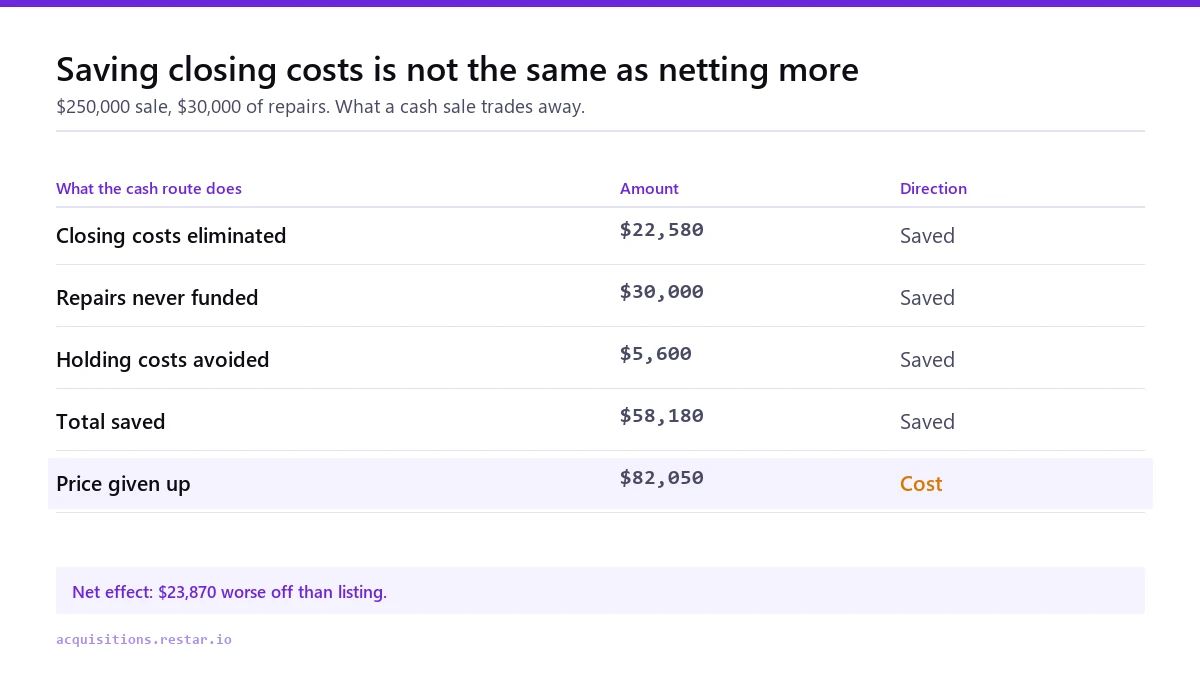
Eliminating $22,580 of closing costs while giving up $82,050 of price is not a saving. This is the single most common way sellers are misled, and it is done by telling the truth selectively: every individual claim in a “no commissions, no fees, no closing costs” pitch is accurate. The claim that is missing is the price.
So the correct way to use a closing cost figure is as a subtraction from a specific price, never on its own. Ask any buyer for the net, not the discount. Our guide to cash offer vs listing net proceeds runs the full side-by-side.
We say this on nearly every page of this site, so it should be defined precisely rather than left as a slogan.
What it covers: the settlement or escrow fee, the title search and owner's policy, recording fees, and the transaction charges that would ordinarily be allocated to the seller — including transfer tax where custom puts it on the seller. On the table above, that is the $22,580 column going to zero. There is also no commission, because there is no agent in the transaction.
What it does not cover, and cannot:
The distinction is simple: we pay the costs of doing the transaction; you settle what you owe. Anyone implying that a cash purchase makes your debts disappear is describing something that does not exist. What a sale does is convert the house into money, and the debts attached to the house come off the top — which is exactly why they subtract identically from a retail sale and a cash sale, and never change which route pays more. That structure is set out in selling a house with a lien on it.
Practical, in rough order of how much they are worth.
And on the tax side: selling a home you have lived in may qualify for the capital gains exclusion, and closing costs and improvements affect your basis. The IRS sets this out in Publication 523, Selling Your Home. Inherited property is treated differently again — see our guide to capital gains on inherited property. Talk to a CPA rather than relying on either page for your own return.
The point of this page is that a closing cost figure is meaningless on its own — it only matters next to the price it is attached to. If you want the comparison done properly on your house, we will give you a written cash figure within 24 hours with the comparable sales behind it, and you can put it against an agent's net sheet.
On the worked example here, listing nets $23,870 more even after $22,580 of closing costs. If that is your situation we will say so. Send us the property here.
All guides · Cash offer vs listing net · How cash offers are calculated
Step 1 of 5
No obligation, no fees, no repairs. We respond the same day.
You’ll talk to Trevor McAmis, Owner & Acquisitions Lead
(313) 710-6129
Takes about two minutes. Or call (313) 710-6129 — we answer.