Selling a house in New York works differently from almost anywhere else in our footprint, and the differences are procedural rather than cosmetic. New York is an attorney state, so a signed contract is not binding until the lawyers have finished with it. It is a judicial foreclosure state, which makes it one of the slowest in the country to take a house — a fact that should stop a lot of panic sales. And in Rochester, where we buy, a change in state public health law is pulling thousands of properties into a stricter lead inspection cycle with a hard deadline of 1 October 2026.

Step 1 of 5
Send the address and we will tell you what it is worth as-is and what the timeline looks like.
You’ll talk to Trevor McAmis, Owner & Acquisitions Lead
(313) 710-6129
Takes about two minutes. Or call (313) 710-6129 — we answer.
Educational only. This explains how these situations generally work. It is not legal, tax or financial advice, and the rules differ by state — talk to an attorney or CPA about your own situation before you act on any of it.
Selling a house in New York means an attorney-run closing, a mandatory disclosure statement that no longer has a $500 buy-out, and a state transfer tax of $2 per $500 paid by the seller. Expect a longer timeline than most states — and if you are behind on payments, far more time than you think.
This is educational information, not legal or tax advice. New York practice varies by county and the rules below change — talk to a New York real estate attorney about your own transaction.
In most of the country a real estate agent fills in a form contract and a title company closes it. In New York, lawyers do both. Buyer and seller each retain their own attorney, and the attorney drafts or reviews the contract, handles the title work, and runs the closing.
The practical consequences for a seller are three:
None of this is a bad thing — a seller with a lawyer is a protected seller. But it does mean that “we can close in seven days” needs checking against a real New York calendar, including ours. Ask any buyer promising speed in New York exactly which attorney is doing the closing.
This is the single most out-of-date thing in New York seller content, and it will cost someone money.
For years, New York sellers had a choice: complete the Property Condition Disclosure Statement, or hand the buyer a $500 credit at closing and skip it. Nearly everyone took the $500 option, and most articles on selling a house in New York still describe it as if it exists.
It does not. As of 20 March 2024, the $500 credit option was removed. Sellers of one- to four-family residential property must now complete and deliver the Property Condition Disclosure Statement to the buyer before the contract of sale is signed. The form was also expanded — from 49 questions to 56 — with seven new questions covering flood history, flood insurance, whether the property sits in a FEMA-designated flood hazard area, and any federal disaster assistance received.
What this means for you:
Selling as-is does not remove the disclosure duty. Any buyer who tells you that as-is means you do not have to fill in the form is wrong, and you should treat everything else they say accordingly.
New York's transfer tax is straightforward outside New York City, and it is the seller's to pay.
| Item | Rate | On a $250,000 sale |
|---|---|---|
| NYS real estate transfer tax | $2 per $500 of consideration (0.4%) | $1,000 |
| Seller's attorney | Flat fee, typically | $1,500 |
| Title, recording and miscellaneous | Varies | $1,300 |
| Seller closing costs before commission | $3,800 |
The New York State Department of Taxation and Finance publishes the real estate transfer tax rules. Note that additional transfer taxes apply in New York City and to higher-value properties, and that if you are a New York nonresident selling New York property, the state requires an estimated income tax payment at closing — the nonresident filing rules set out how that works. Out-of-state heirs selling an inherited Rochester house are caught by this routinely and it surprises them at the closing table.
For the full itemisation of what comes out of a sale, see our guide to seller closing costs.
New York is a judicial foreclosure state, and it is one of the slowest in the country. A lender cannot simply schedule a sale; it has to sue you, and you get to show up. Two protections in particular are worth knowing before anyone convinces you to sell in a hurry.
The 90-day notice. Under RPAPL 1304, a lender must send a specific pre-foreclosure notice at least 90 days before starting a foreclosure action, and it can only be sent once in a 12-month period. Courts treat compliance as a condition precedent — a failure to comply properly has resulted in foreclosure complaints being dismissed. The New York Department of Financial Services explains the 90-day pre-foreclosure notice requirement.
The mandatory settlement conference. Under CPLR 3408, once a residential foreclosure is filed the court must hold a settlement conference, generally within 60 days of the filing, and both sides are required to negotiate in good faith toward a resolution. This is a real, court-supervised opportunity to reach a loan modification or another workout, and it is free. DFS explains what to expect at a foreclosure settlement conference.
Why this matters more than it sounds. Add the 90-day notice, the federal 120-day pre-suit period, the filing, the settlement conference and the litigation that follows, and a New York foreclosure commonly runs well over a year and often considerably longer. That is time to modify the loan, cure the arrears, or list the house properly and capture its full value.
So if you are two payments behind in Rochester and someone is pressing you to accept a cash offer this week because you are “about to lose the house”, they are not describing New York. Go to the settlement conference first. Our guide to selling a house in foreclosure covers the point at which a sale genuinely does become the better option — and it is later than most people are told.
Rochester is our New York market, and it has a specific character that the state-level rules do not capture.
The housing stock is old. Across the Rochester properties in our records the median year built is 1920, on a median footprint of about 1,614 square feet. Practically every house we look at predates 1978, which means the federal lead-based paint disclosure applies to essentially every sale, and it means roof age, original electrical and heating systems are the items that most often break a retail contract after inspection. Median time on market in our Rochester records is 14 days — the market is not slow; the inspection is what stalls sales here.
The taxes are high. Monroe County carries among the highest effective property tax rates in the country. On a $250,000 house that commonly means $600 to $700 a month in property tax alone, before insurance, utilities or upkeep. On a vacant or inherited house, that tax bill is the clock you are actually racing, not the mortgage. Our guide to holding costs of a vacant house works through what that adds up to.
And the Certificate of Occupancy regime is tightening. This is the genuinely new thing, and it lands on landlords.
Rochester has required a renewable Certificate of Occupancy for rental property since long before this, with lead inspection folded into the C of O process under the city's 2005 lead ordinance. What changed is New York State Public Health Law 1377, which took effect on 3 November 2025 and created a statewide rental registry with new inspection and repair obligations. Rochester is implementing it through the C of O, which now doubles as the lead safety certificate the state law requires.
The 2026 changes, per the City of Rochester:
| Property | What changes |
|---|---|
| 1–2 unit rentals in the lead high-risk area, built pre-1980 | Inspection cycle moves from every 6 years to every 3 years, with proactive lead dust wipe testing |
| 6+ unit rentals | Dust wipes now collected from every unit, not only where deteriorated paint is visible |
| Owner-occupied two-unit properties | No longer exempt — the owner's own unit interior stays exempt, but other units and shared spaces require inspection |
| High-risk area itself | Roughly 5,800 properties newly added |
| Deadline | Active Certificate of Occupancy required by 1 October 2026 |
The city's page on the 2026 changes to inspection requirements and its Certificate of Occupancy guidance are the authoritative sources, and both are worth reading in full if you own rental property in the city.
Two honest points about this. First, it applies to rental property, not to owner-occupied homes — if you live in your Rochester house and are selling it, none of the above is your problem. Second, it is not a catastrophe: dust wipe testing and remediation on a small property is a manageable cost, and the ordinance exists because lead poisoning in Rochester children was a genuine public health failure. Rochester's lead programme is studied nationally because it worked.
But it is a real cost and a real deadline, and for a small landlord already tired of the property it is often the thing that decides matters. That is a legitimate reason to sell. It is not a reason to sell cheaply, and anyone using the October deadline to pressure you is misusing it. Our page on being a tired landlord and our guide to selling a rental property with tenants cover the rest of that decision, including what happens to your tenants.
A house worth $250,000 repaired — below the Monroe County median, which passed $308,500 in mid-2026 — needing $34,000 of work. Old stock, so the list is the usual Rochester list: roof, furnace, knob-and-tube remediation, kitchen and bath, flooring and paint.
The cash figure uses the four-term build-up from how cash home buyers calculate offers:
| Term | Amount |
|---|---|
| After-repair value | $250,000 |
| Repairs | −$34,000 |
| Resale and holding — commission $13,750, seller closing $3,800, purchase closing $1,900, five months' carry $9,000 | −$28,450 |
| Margin | −$27,000 |
| Illustrative cash figure | $160,550 |
A worked illustration on one hypothetical property. Not a quote, not a prediction about your house, and not a fixed formula we apply.
| Line | List it retail | Sell as-is for cash |
|---|---|---|
| Sale price | $250,000 | $160,550 |
| Repairs funded first | −$34,000 | $0 |
| Agent commission (5.5%) | −$13,750 | $0 |
| Seller closing costs — incl. $1,000 NYS transfer tax and attorney | −$3,800 | $0 — we cover standard closing costs |
| Holding while it sells | −$9,000 (5 months at $1,800) | −$1,250 (3 weeks) |
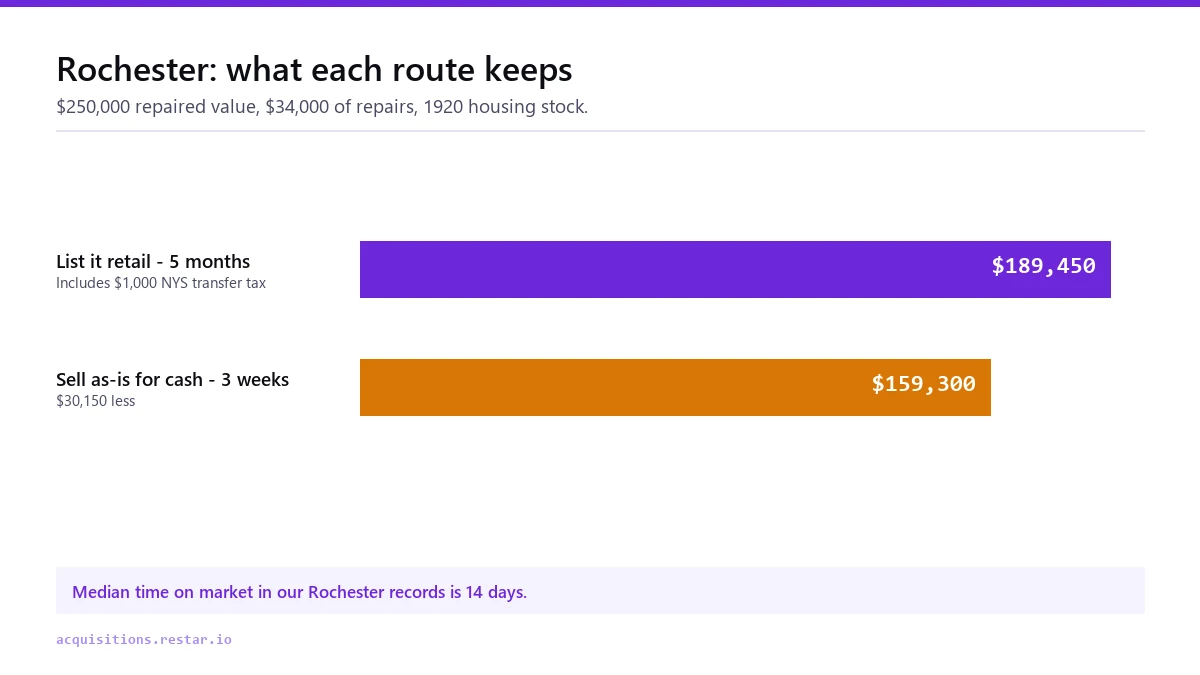
| You keep | $189,450 | $159,300 |
Listing wins by $30,150. On a Rochester house that is financeable, insurable and can wait, list it — and with a 14-day median time on market in our own records, the waiting risk here is smaller than in most of our footprint.
Where the cash route earns its discount in New York specifically:
Outside those, take the $30,150.
We buy in Rochester and across Monroe County, as-is, including houses that would not pass a Certificate of Occupancy inspection and rentals whose owners have run out of appetite for the compliance cycle. Written offer within 24 hours, no obligation.
The honest conclusion on this page is that a sound, financeable Rochester house nets more on the open market — by about $30,000 in the worked example — and if that is your situation we will tell you so. Our figure is most useful as the other half of the comparison, or when the condition, the tenants or a deadline mean a retail listing is not really available. Send us the property here.
All guides · We buy houses in Rochester · Tired of being a landlord
Step 1 of 5
No obligation, no fees, no repairs. We respond the same day.
You’ll talk to Trevor McAmis, Owner & Acquisitions Lead
(313) 710-6129
Takes about two minutes. Or call (313) 710-6129 — we answer.