Selling a house with a lien on it is allowed, routine, and mostly a bookkeeping problem. A lien does not stop the sale — it changes who gets the money at closing, and in what order. That distinction matters more than almost anything else written on this subject, because the thing most sellers panic about is not the thing that goes wrong. The real risks are narrower and more specific: liens that exceed your equity, liens nobody can produce a payoff letter for, and interest that keeps running while you work it out.

Step 1 of 5
Send the address. We will pull title and tell you what is actually recorded against it.
You’ll talk to Trevor McAmis, Owner & Acquisitions Lead
(313) 710-6129
Takes about two minutes. Or call (313) 710-6129 — we answer.
Educational only. This explains how these situations generally work. It is not legal, tax or financial advice, and the rules differ by state — talk to an attorney or CPA about your own situation before you act on any of it.
You can sell a house with a lien on it. The lien is paid from your sale proceeds at closing, in priority order, before anything reaches you. If the proceeds cover every lien, the sale closes normally and you keep the remainder. If they do not, you must bring cash, negotiate a release, or not sell.
This is educational information, not legal or tax advice. Talk to an attorney or a CPA about your situation, particularly on tax liens, judgments and estate matters.
That is the entire mechanism. Everything below is detail on how each type behaves, which ones negotiate, and which ones genuinely end deals.
A lien is a recorded claim against a specific property, securing a debt. Two things follow from the word recorded.
First, it is public, and the title company will find it. There is no version of a sale in which an unknown recorded lien quietly does not matter — the buyer's title insurer will not issue a policy over it, so the closing agent will require it paid or released. Sellers sometimes hope a small judgment has been forgotten. It has not been forgotten. It has been indexed.
Second, it attaches to the property, not only to you. That is why it survives a sale unless it is cleared, and why no buyer will take the house subject to it.
The practical consequence is calmer than it sounds. To a closing agent, selling a house with a lien on it is routine work. They order payoff figures, pay each lienholder from the settlement statement, and record the releases. Your job is to disclose everything you know about early, so that nobody discovers a $22,000 encumbrance three days before closing.
They do not all act alike, and the differences determine how much room you have to negotiate.
| Lien | How it arises | Negotiable? |
|---|---|---|
| Mortgage / deed of trust | You granted it at closing | Rarely below balance, except in an approved short sale |
| Property tax lien | Automatically, by statute, when taxes go delinquent | Almost never on principal; some states allow payment plans |
| Federal tax lien (IRS) | Filed after assessment and unpaid demand | Yes — by discharge or subordination, see below |
| Judgment lien | A creditor wins a lawsuit and records the judgment | Often, and sometimes steeply |
| Mechanic's / construction lien | An unpaid contractor records against the work | Often, especially where the work is disputed |
| HOA assessment lien | Unpaid dues, usually automatic under the declaration | Sometimes on fees and interest, rarely on principal |
| Code enforcement lien | Municipal fines for violations | Frequently — many cities run a mitigation process |
| Medicaid estate recovery | State claim against a deceased recipient's estate | Hardship waivers exist in most states |
Two rows there are worth pausing on, because they are where sellers most often find real money.
Judgment liens frequently settle for less than face value. A credit-card judgment that has sat unsatisfied for six years has, from the creditor's side, been earning nothing collectable. A payoff offered through a closing agent, with a date certain attached, is often accepted at a discount. This is a conversation for an attorney rather than something to negotiate yourself — but it is real, and it routinely moves thousands of dollars.
Code enforcement liens are often reducible once the violation is cured. Many municipalities will mitigate accrued daily fines substantially after the underlying condition is fixed, because the fines existed to compel the fix. If your lien is mostly accumulated fines rather than principal, ask. Our page on selling a house with code violations covers that path.
Priority decides who gets paid first, and therefore who absorbs the loss when there is not enough to go around.
The general rule is first in time, first in right — the earlier a lien is recorded, the better its position. Several statutory exceptions outrank the recording date entirely:
That relation-back rule on mechanic's liens is the one that surprises people. A lien recorded last month can take its priority from the date the contractor first delivered materials, potentially ahead of a loan you closed in between.
For you as the seller, priority matters in exactly one situation: when the proceeds will not cover everything. If they will, the order is irrelevant, everyone is paid, and you keep the balance. If they will not, the junior lienholders are the ones with a reason to accept less, because their alternative is frequently nothing at all.
Take a house worth $220,000 repaired, in as-is condition needing roughly $18,000 of work. Recorded against it:
| Encumbrance | Balance |
|---|---|
| First mortgage | $79,000 |
| IRS lien | $17,500 |
| Contractor's lien (roof, disputed) | $11,000 |
| Credit-card judgment | $7,400 |
| HOA assessments | $3,100 |
| Total recorded | $118,000 |
The cash figure below is built with the same four-term formula we publish in how cash home buyers calculate offers: after-repair value, minus repairs, minus the buyer's resale and holding costs, minus their margin. On this house that is $220,000 − $18,000 − $23,100 − $26,000, or about $153,000.
These figures are a worked illustration on one hypothetical property, used to show how the arithmetic fits together. They are not a quote, not a prediction about your house, and not a fixed formula we apply — repairs, market conditions and risk differ on every property.
Now both routes, worked the same way:
| Line | List it retail | Sell as-is for cash |
|---|---|---|
| Sale price | $220,000 | $153,000 |
| Repairs you fund first | −$18,000 | $0 |
| Agent commission (5.5%) | −$12,100 | $0 |
| Seller closing costs | −$3,740 | $0 — we cover standard closing costs |
| Buyer concessions | −$3,000 | $0 |
| Holding costs | −$7,000 (4 months) | −$1,300 (3 weeks) |
| Liens paid at closing | −$118,000 | −$118,000 |
| You keep | $58,160 | $33,700 |
Listing nets $24,460 more. That is the honest answer on these numbers, and it is not close. The retail route captures a sale price $67,000 higher, and spends $43,840 to do it — repairs, commission, closing costs, concessions and four months of carry — against $1,300 on the cash side. A $67,000 price advantage, less $42,540 of extra cost, leaves the $24,460 you actually keep.
Now the part that is genuinely specific to liens, and that we have not seen explained anywhere else. The $24,460 gap does not move when the liens change. The lien total is subtracted identically from both columns, so it never alters which route pays more. Raise the liens, lower them, add another judgment — the gap between the two routes stays $24,460.
What the lien load changes is something else entirely: whether the lower-priced route can still close at all.
| Total liens recorded | Retail net | Cash net |
|---|---|---|
| $118,000 | $58,160 | $33,700 |
| $140,000 | $36,160 | $11,700 |
| $151,700 | $24,460 | $0 — break-even |
| $160,000 | $16,160 | Cannot close — the offer no longer covers the liens |
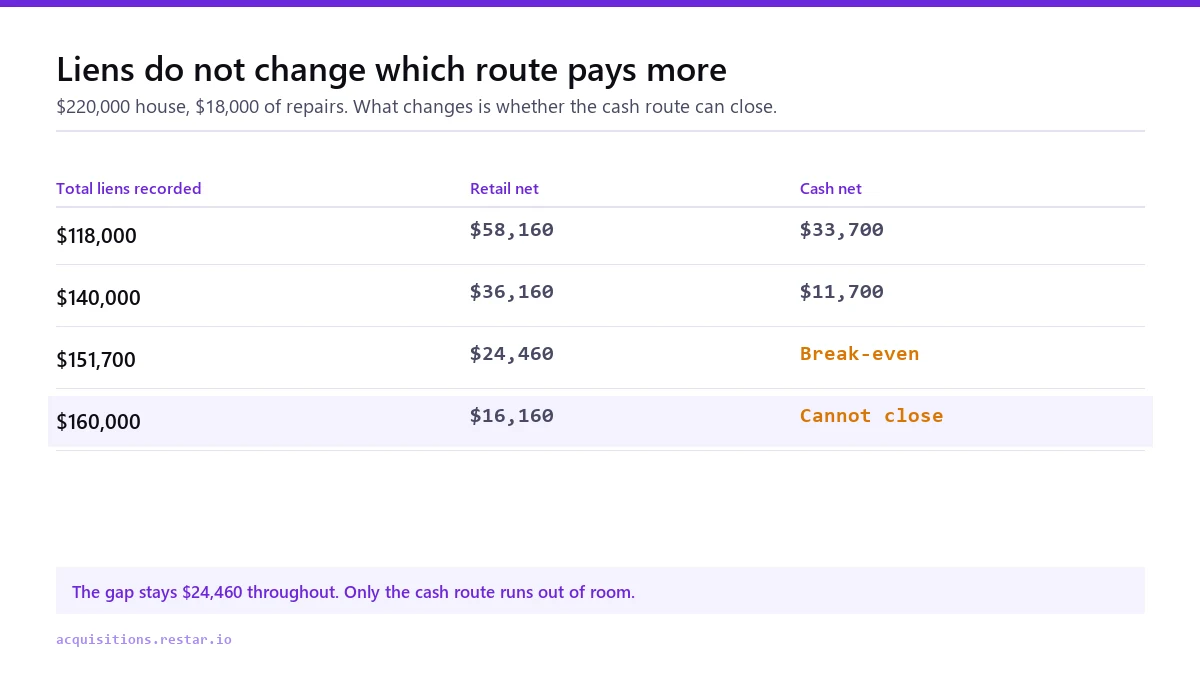
Because a cash offer is lower, it runs out of room first. At around $151,700 of recorded liens the cash route nets you nothing, and above that it cannot close without you bringing money to the table — while a retail sale still works all the way up to about $176,000. That is the reverse of what most sellers assume, and it is the single most useful thing to know if your liens are large relative to the house.
And look at what the retail column requires: $18,000 in cash, spent before closing, by someone whose house already carries five liens. If you have that money, list the house — you net $24,460 more and we would say so on the phone. If you do not have it, the $220,000 column is not an option you actually possess, and the real comparison is between a lower certain number and doing nothing while interest runs on every line in the first table.
An IRS lien is the one most often handled wrongly, because sellers assume it must be paid in full before any sale. Usually it must — but not always, and the exception has a name and a deadline.
If the sale will pay the IRS everything it is owed, the closing agent simply pays it and the lien is released. If it will not, you apply for a certificate of discharge, which removes the lien from that particular property so the sale can close, while the underlying tax debt continues to exist.
Forty-five days is the number to plan the whole sale around. A discharge application started two weeks before a scheduled closing will not be ready, and the closing will move. If there is an IRS lien on your house, that application belongs among the first things you do rather than the last.
A federal tax lien also self-releases when the collection period expires, generally ten years from assessment, subject to events that extend it. Occasionally a lien clouding a title is long expired and simply never had its release recorded. Ask the closing agent to check the assessment date before assuming you still owe it.
Not the lien itself. These:
1. Total liens exceed what the house will sell for. Then no ordinary sale closes, because clear title cannot be conveyed. The routes out are a short sale approved by the senior lender, negotiated releases from junior lienholders, or bringing cash to the table. All three take time, and all three are conversations for an attorney.
2. Nobody can produce a payoff. The creditor dissolved, was acquired twice, or sold the debt and the servicer's records are gone. The lien is still recorded and still blocks title. Clearing it can require a quiet title action — months, plus legal fees. This failure mode has nothing to do with how much you owe, which is exactly why an early title search matters so much.
3. The clock. Judgments accrue statutory interest. Tax liens accrue penalties. HOA balances accrue late fees and attorney costs. Every month spent deciding is a month those numbers grow, and on a property where liens sit close to the value, that is the difference between a sale that closes and one that no longer can.
The fix for all three is the same, and it is unglamorous. If you are selling a house with a lien on it, order a title search before you do anything else. Not after you have an offer in hand — before. A title company or real estate attorney will run one for a modest fee, and it converts a vague dread into a list with numbers and dates on it.
List it if your equity clearly covers what is recorded and the house can be financed. A retail buyer's closing agent clears precisely the same liens ours does, the process is no harder for you, and you keep more. In the worked example above listing wins by $24,460, and we published that number because it is what the arithmetic says.
A direct as-is sale earns its lower price in narrower circumstances:
Before deciding either way, the arithmetic for both routes is worked line by line in our cash offer vs listing net-proceeds guide, and the monthly cost of waiting is broken down in what it costs to hold a vacant house.
One thing worth saying plainly, because sellers with liens get targeted for it. Be careful with anyone who offers to "take over" your liens, or who asks for money up front to clear title. Liens are paid at closing, out of proceeds, by a licensed closing agent. Advance-fee arrangements are the pattern the Consumer Financial Protection Bureau describes in its foreclosure relief scam guidance, and it works the same way here.
If your equity comfortably covers what is recorded and the house is financeable, list it. A retail buyer's title company clears exactly the same liens, and you will very likely net more. We would tell you that.
Where we are useful is the harder version: liens close to or above the equity, a lien nobody can produce a payoff for, or repairs you cannot fund while interest accrues on five balances at once. Send the address and we will send a written offer within 24 hours with the comparable sales it came from. No cost, no obligation. Start at tell us about the property.
Step 1 of 5
No obligation, no fees, no repairs. We respond the same day.
You’ll talk to Trevor McAmis, Owner & Acquisitions Lead
(313) 710-6129
Takes about two minutes. Or call (313) 710-6129 — we answer.