Selling a house with delinquent property taxes is not only possible, it is routine — the unpaid taxes are simply paid out of the sale proceeds at closing, the same way a mortgage is. What is not routine is what happens if you do nothing, and in June 2026 the Supreme Court decided a case that makes the cost of doing nothing much clearer than it was.

Step 1 of 5
Send the address and we will tell you what it is worth and what your options are.
You’ll talk to Trevor McAmis, Owner & Acquisitions Lead
(313) 710-6129
Takes about two minutes. Or call (313) 710-6129 — we answer.
Educational only. This explains how these situations generally work. It is not legal, tax or financial advice, and the rules differ by state — talk to an attorney or CPA about your own situation before you act on any of it.
This page covers the mechanics: who gets paid first, how long you actually have, what you lose in a tax foreclosure, and the arithmetic on each route.
This is educational information, not legal or tax advice. Deadlines and remedies vary significantly by state and county. Talk to an attorney, a CPA, or your county treasurer about your own situation.
Yes. Delinquent property taxes are a lien against the property, not a bar to selling it. At closing, the title company or closing attorney pays the county from your proceeds and the buyer receives clear title. You do not need to pay the taxes off in advance — you need enough equity to cover them.
The question that matters is not whether you can sell. It is whether you sell before or after the county forecloses, because those two outcomes are worth wildly different amounts.
This is the mechanic that surprises people, and it explains everything that follows.
A property tax lien is generally a first-priority lien. It sits ahead of the mortgage, ahead of a home equity line, ahead of judgment liens and contractor liens. The bank that lent $150,000 on the house is behind the county that is owed $6,000.
Two consequences follow:
There is no national answer. The two states where we buy the most run on very different clocks, and they illustrate the range.
Michigan runs delinquent property taxes through forfeiture and foreclosure under the General Property Tax Act, and the dates are fixed rather than discretionary.
| Stage | When | What happens |
|---|---|---|
| Delinquency | March 1, year 1 | Unpaid taxes return as delinquent to the county treasurer |
| Forfeiture | March 1, year 2 | Property is forfeited to the county treasurer; additional fees attach |
| Foreclosure judgment | around March, year 3 | Circuit court enters judgment foreclosing the property |
| Redemption ends | March 31, year 3 | Right of redemption expires; title vests absolutely in the county |
Interest accrues at an additional 0.5% per month, non-compounded, computed from the March 1 preceding forfeiture, under MCL 211.78g. Michigan's Treasury publishes the full forfeiture and foreclosure timeline.
The March 31 date is the one to write down. After it passes, you no longer own the house, and nothing you do afterwards restores your title.
Ohio counties may sell tax lien certificates to private investors or foreclose directly, and timelines vary by county rather than running on one statewide calendar.
The provision worth knowing is Ohio Revised Code 323.31. An owner-occupant of residential property with no existing tax lien certificate or foreclosure judgment against it is entitled to at least one opportunity to enter a written delinquent tax contract with the county treasurer, payable over up to five years. While that contract is valid and current, a tax certificate on the property cannot be sold.
That is a statutory right, not a favour. If you are an Ohio owner-occupant and nobody has mentioned it to you, call the county treasurer and ask for it by name.
Until recently, several states kept the entire proceeds of a tax sale, including everything above the tax debt. In Tyler v. Hennepin County, 598 U.S. 631 (2023), the Supreme Court held that unconstitutional: Geraldine Tyler owed about $15,000, the county sold her condominium for $40,000 and kept the $25,000 difference, and the Court ruled that keeping the surplus violated the Takings Clause. You can read the opinion in Tyler v. Hennepin County directly.
Many people stopped reading there and concluded that a tax foreclosure now leaves them whole. It does not, and the June 2026 decision in Pung v. Isabella County settled the point against homeowners.
The Pung family owed $2,241.93 in property taxes on a Michigan home assessed at $194,400 for tax purposes. The county foreclosed and sold it at public auction for $76,008. The question was what "just compensation" means: the auction price, or what the property was actually worth?
The Court held it is the auction sale price, not fair market value, at least where the sale is fairly conducted. So the family recovers the surplus over the tax debt — roughly $73,766 — and has no constitutional claim to the roughly $118,392 gap between the auction result and the assessed value.
Read that as a seller. A tax bill of about $2,242 ended with a family losing well over a hundred thousand dollars of value they cannot recover, and the Supreme Court has now confirmed there is no remedy for it.
This is the entire argument for acting early. Not urgency, not pressure — arithmetic. Any sale you arrange yourself, to anyone, on the open market or otherwise, will almost certainly beat a county auction, because a county auction is a forced sale to a thin pool of bidders on a courthouse schedule.
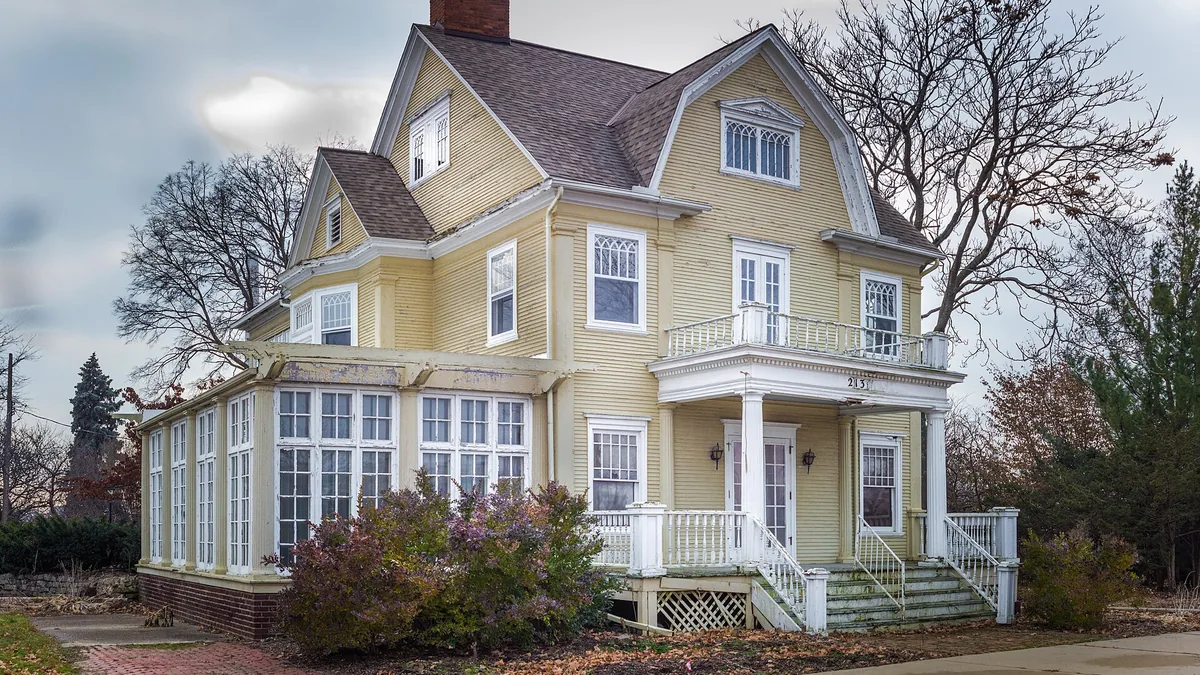
Take a Detroit-area house: $155,000 if fully repaired, $95,000 as-is, no mortgage (common where the property was inherited), and $11,500 in delinquent taxes, interest and fees.
| Repair and list | List as-is | Sell as-is for cash | |
|---|---|---|---|
| Gross price | $155,000 | $99,000 | $95,000 |
| Repairs | −$38,000 | $0 | $0 |
| Agent commission (5.5%) | −$8,525 | −$5,445 | $0 |
| Seller closing costs | −$2,325 | −$1,485 | −$1,000 |
| Buyer concessions | −$2,500 | −$3,000 | $0 |
| Holding costs | −$3,600 (6 mo) | −$2,400 (4 mo) | −$450 (3 wk) |
| Delinquent taxes at closing | −$12,900 | −$12,400 | −$11,600 |
| Net to you | $87,150 | $74,270 | $81,950 |
Three honest conclusions from that table:
Repairing and listing wins, by about $5,200 over the cash sale — if you can fund $38,000 of repairs. Most people who are three years behind on property taxes cannot, which is the whole reason this situation exists. If you can, do that.
Listing as-is is the worst of the three, by a wide margin. It nets about $7,700 less than a direct cash sale, because an as-is listing reaches essentially the same investor buyers while adding a $5,445 commission and four more months of accruing tax interest. Paying a commission to reach the buyer you could have reached directly is the most expensive mistake on this page.
Doing nothing is not on the table as a strategy. The fourth route ends in a county auction, and Pung is what that looks like.
Note the taxes line rising across the columns. At 0.5% per month in Michigan, an $11,500 balance grows by roughly $690 a year in interest alone. Time is not neutral here.
Selling is not the first answer, and anyone who tells you it is has an interest in the outcome.
If one of those solves it, you keep the house and this page has done its job.
Selling generally makes sense when the arithmetic has stopped working rather than merely being uncomfortable:
Where the property is also in mortgage default, both clocks run at once and they are independent of each other. See selling a house in foreclosure for how that timeline interacts with this one, and our Michigan state guide for the transfer taxes and disclosure rules that apply on the way out.
Your first call should be the county treasurer, to get two facts in writing: the exact payoff figure today, and your actual foreclosure or redemption deadline. Everything else depends on those two numbers, and both are free to obtain.
If the arithmetic points to selling, we will look at the property and send a written offer within 24 hours, with the comparable sales we used attached. If a payment plan or an exemption is the better answer for you, we will tell you that instead — it costs us nothing to say so and it is usually true. You can tell us about the property here.
Step 1 of 5
No obligation, no fees, no repairs. We respond the same day.
You’ll talk to Trevor McAmis, Owner & Acquisitions Lead
(313) 710-6129
Takes about two minutes. Or call (313) 710-6129 — we answer.