Almost every "we buy houses" site explains its offer as though it were a judgement call. It is not. How cash home buyers calculate offers comes down to a formula with four terms, and once you can see the terms you can check anyone's number — including ours.

Step 1 of 5
Send the address and we will show you the numbers behind ours.
You’ll talk to Trevor McAmis, Owner & Acquisitions Lead
(313) 710-6129
Takes about two minutes. Or call (313) 710-6129 — we answer.
Educational only. This explains how these situations generally work. It is not legal, tax or financial advice, and the rules differ by state — talk to an attorney or CPA about your own situation before you act on any of it.
This page works that arithmetic all the way to a figure, then compares what you would net on each of your realistic routes. Some of it is unflattering to how this industry sells itself, which is the point.
This is educational information, not an offer and not financial advice. The numbers below are a worked illustration on one hypothetical property, used to show how the arithmetic fits together. They are not a quote, not a prediction about your house, and not a fixed formula we apply — repair costs, market conditions and risk differ on every property, so the result differs too. Talk to an attorney or CPA about your own situation.
Offer = After-Repair Value − Repair Costs − Resale and Holding Costs − Buyer's Profit Margin
That is the whole thing. Every legitimate cash buyer is solving that equation, whether or not they show you the terms. A buyer who will not break their number into those four pieces is not doing different maths — they are declining to show it.
Here is what each term means:
Take a house in Akron, Ohio, where our recorded sales show a median of $165,000. Assume this one is a tired but structurally sound three-bedroom that needs a full cosmetic refresh, a roof and mechanicals.
Set by comparable sales of repaired houses in the same ZIP with similar size and age. This number is checkable — ask for the comps.
| Item | Cost |
|---|---|
| Roof | $9,500 |
| Furnace and A/C | $7,000 |
| Kitchen and bathrooms | $8,000 |
| Flooring, paint, fixtures | $5,500 |
| Cleanout and landscaping | $2,000 |
| Total | $32,000 |
These are the buyer's costs, not yours, but they come out of the offer, so you should see them.
| Item | Cost |
|---|---|
| Agent commission on resale (5.5% of $165,000) | $9,075 |
| Seller closing costs on resale (~1%) | $1,650 |
| Purchase closing costs | $1,800 |
| Holding costs, 5 months — taxes, insurance, utilities, interest | $6,500 |
| Total | $19,025 |
Closing costs are not a made-up line. The Consumer Financial Protection Bureau's guide to closing sets out what appears on a settlement statement and who customarily pays each item, and it is worth reading before you accept any offer, cash or financed.
Note the commission. The cash buyer pays an agent when they resell — you just do not pay one when you sell to them. It has not vanished from the transaction; it has moved.
On a project of this size, tying up roughly $124,000 of capital for five months with real risk of the repair budget being wrong. If that number strikes you as large, it is worth knowing that it is also the number that absorbs the loss when a $32,000 repair estimate turns out to be $45,000.
Margin is the term that varies most between buyers and between properties. A low-repair house in a fast-selling area carries less risk and less holding time than a gut rehab in a slow one, and the margin should reflect that. Any buyer applying one fixed percentage to every house — including a fixed share of after-repair value — is not pricing your property, they are pricing their habit.
$165,000 − $32,000 − $19,025 − $22,000 = $91,975
Call it $92,000.
You will see the 70% rule quoted everywhere: offer no more than 70% of ARV minus repairs.
On this house: (0.70 × $165,000) − $32,000 = $83,500.
That is $8,475 lower than the itemised build-up. The 70% rule is a mental shortcut that bakes in a fixed margin regardless of the actual project, and it is systematically wrong in both directions:
If someone quotes you an offer and justifies it with "that's the 70% rule," they are describing a habit, not a calculation. Ask for the four terms.
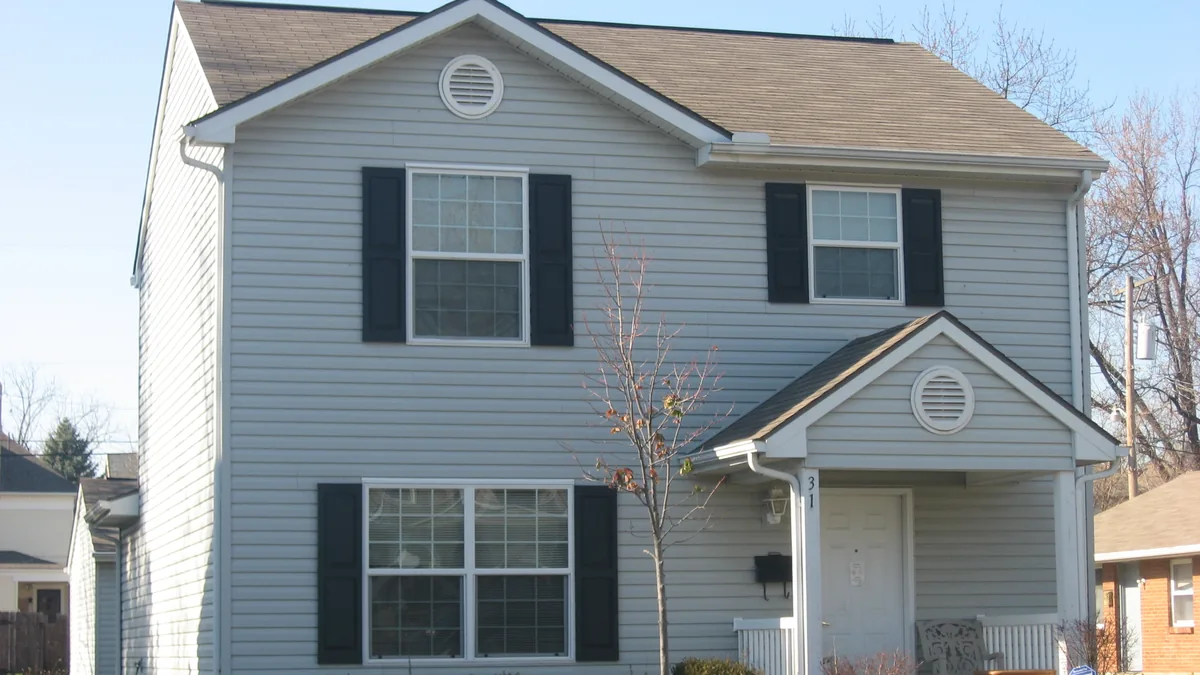
This is the comparison that matters, and the one most sites skip. Same Akron house, three routes.
| Repair and list | List as-is | Sell as-is for cash | |
|---|---|---|---|
| Gross price | $165,000 | $105,000 | $92,000 |
| Repairs you fund | −$32,000 | $0 | $0 |
| Agent commission (5.5%) | −$9,075 | −$5,775 | $0 |
| Seller closing costs | −$2,475 | −$1,575 | −$800 |
| Buyer concessions after inspection | −$2,000 | −$3,000 | $0 |
| Holding costs | −$4,400 (4 mo) | −$4,400 (4 mo) | −$300 (3 wk) |
| Net to you | $115,050 | $90,250 | $90,900 |
Three honest conclusions.
Repairing and listing nets about $24,150 more than selling for cash. That is not a small gap and we are not going to dress it up. If you can fund $32,000 of repairs, manage the work, and wait four to six months, that is the right decision and you should do it. The reason people do not is almost always that they have neither the $32,000 nor the months.
Listing as-is nets essentially the same as a direct cash sale — $90,250 against $90,900, a difference of $650. This surprises people, and the mechanism is simple: an as-is listing reaches the same investor buyers a cash sale reaches, then adds a $5,775 commission and four months of carrying costs. You pay a commission to reach a buyer you could have reached directly.
The gap is the price of certainty and speed. Roughly $24,150 on this house buys you: no repair spend, no showings, no financing contingency, no appraisal, and a closing date you choose. Whether that is worth it depends entirely on whether you have the cash and the time. For plenty of people it is not worth it, and they should list.
These are the levers, and several are in your control.
Raise the number:
Lower the number:
The arithmetic above describes an honest buyer. Some are not, and the common tactics are worth naming plainly.
The one to watch for is the retrade: a buyer offers a high number to get your signature, then reduces it after an "inspection," close to your closing date, when you have already committed and have less room to walk. A high offer that falls 15% at week three nets you less than a realistic offer that closes.
If you are behind on payments, be especially careful. Distressed sellers are the specific target of foreclosure-rescue and equity-stripping schemes, and the CFPB's guidance on spotting and avoiding foreclosure relief scams describes the patterns. A free HUD-approved counsellor, found through the CFPB housing counsellor directory, will review an offer with you at no cost.
Ask any cash buyer these five questions and write down the answers:
The most useful thing you can do before accepting any offer is to establish two numbers: what your house is worth repaired, and what the repairs would actually cost. With those, the formula on this page lets you evaluate any offer you receive, from anyone.
If you want ours, we will look at the property and send a written offer within 24 hours, with the comparable sales we used attached — and if the arithmetic says you would do better listing it, we will tell you that instead. You can tell us about the property here, or read our cash offer vs listing net-proceeds guide for the comparison worked in more detail.
Step 1 of 5
No obligation, no fees, no repairs. We respond the same day.
You’ll talk to Trevor McAmis, Owner & Acquisitions Lead
(313) 710-6129
Takes about two minutes. Or call (313) 710-6129 — we answer.