Selling a house with fire damage turns on one number that most sellers never have explained to them: the recoverable depreciation. A replacement cost policy does not hand you the full repair estimate up front. It pays the depreciated value first and holds the rest back until the work is actually done — which means that the moment you decide to sell instead of rebuild, a large part of your own claim quietly stops being yours. On the worked example below that withheld portion is $20,900, and it is the single biggest reason selling as-is nets less than most people expect.

Step 1 of 5
Send the address and the adjuster's estimate and we will tell you what the property is worth as-is.
You’ll talk to Trevor McAmis, Owner & Acquisitions Lead
(313) 710-6129
Takes about two minutes. Or call (313) 710-6129 — we answer.
Educational only. This explains how these situations generally work. It is not legal, tax or financial advice, and the rules differ by state — talk to an attorney or CPA about your own situation before you act on any of it.
Selling a house with fire damage works before or after repairs, but selling first usually means forfeiting the recoverable depreciation your insurer holds back until the work is done — $20,900 on the worked example — and accepting a buyer's margin on top. Together that costs $55,300.
This is educational information, not legal, insurance or tax advice. Policy wording differs by carrier and state, and so do the rules on assigning claim benefits — have an attorney review any assignment, and consider a licensed public adjuster before you accept a settlement figure.
Three mechanics decide almost everything, and none of them are obvious.
1. The cheque is not yours alone if there is a mortgage. Your servicer is named on the policy as mortgagee or loss payee, which means the insurer issues the payment to you and the lender jointly. You endorse it and send it to the servicer, who holds the funds and releases them in draws as inspections confirm the work is progressing. You cannot simply bank a fire claim and decide later. Where the sale pays the mortgage off in full, remaining claim funds come back to you.
2. A replacement cost policy pays in two parts. The insurer first pays actual cash value — the cost to replace, minus depreciation for age and condition — less your deductible. The withheld portion is the recoverable depreciation, and it is released only when you prove the repairs were completed. Sell without rebuilding and, in most policies, you never collect it.
3. An open claim can often travel with the house. Most states permit a post-loss assignment of claim benefits, so a buyer can step into your position and pursue the remainder of the claim. This is genuinely useful and genuinely technical: rules vary by state, some carriers resist, and the price should reflect what is being assigned. Have an attorney review the assignment before signing anything.
Put those together and the picture changes. The question is not “what is my house worth damaged?” It is “what is my house worth damaged, plus the part of the claim I actually get to keep?” Those are very different numbers.
The Insurance Information Institute's guide to filing a homeowners claim sets out the claim process from a neutral source, and the U.S. Fire Administration's after-a-fire guidance covers the immediate steps around securing the property and obtaining the fire report.
A house worth $260,000 fully repaired. Fire damage with an agreed repair estimate of $95,000, a $2,500 deductible, and depreciation withheld at 22% of the estimate. Assume the loan is paid off at closing so the claim funds are genuinely available to compare.
What the policy pays, both ways:
| Claim component | If you rebuild | If you sell as-is |
|---|---|---|
| Replacement cost estimate | $95,000 | $95,000 |
| Depreciation withheld (22%) | −$20,900 | −$20,900 |
| Deductible | −$2,500 | −$2,500 |
| Recoverable depreciation released on completion | +$20,900 | $0 |
| Insurance you actually keep | $92,500 | $71,600 |
That $20,900 gap is the cost of not rebuilding, and it is charged before any buyer has quoted you anything.
Now the cash figure, built with the four terms we publish in how cash home buyers calculate offers. Fire work carries more risk than a cosmetic rehab — hidden structural and smoke damage, permitting, longer timelines — so the margin is higher than it would be on a tired but sound house:
| Term | Amount |
|---|---|
| After-repair value | $260,000 |
| Repairs | −$95,000 |
| Resale and holding — commission $14,300, seller closing $2,600, purchase closing $1,900, eight months' carry $9,200 | −$28,000 |
| Margin | −$33,000 |
| Illustrative cash figure | $104,000 |
A worked illustration on one hypothetical property. Not a quote, not a prediction about your house, and not a fixed formula we apply.
And the two routes side by side:
| Line | Rebuild, then list | Sell as-is for cash |
|---|---|---|
| Sale price | $260,000 | $104,000 |
| Insurance kept | +$92,500 | +$71,600 |
| Rebuild cost | −$95,000 | $0 |
| Agent commission (5.5%) | −$14,300 | $0 |
| Seller closing costs | −$3,900 | $0 — we cover standard closing costs |
| Holding while it happens | −$9,200 (8 months) | −$800 (3 weeks) |
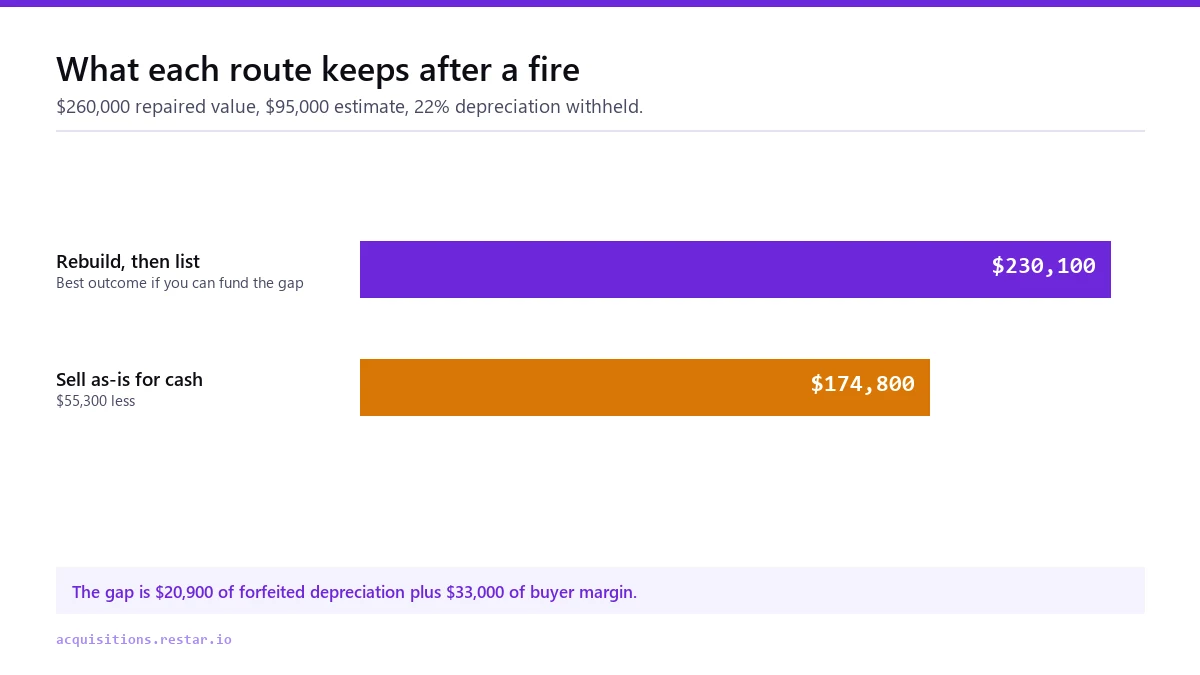
| You keep | $230,100 | $174,800 |
Rebuilding and listing wins by $55,300. The gap is almost entirely two things: $20,900 of recoverable depreciation you forfeit by not doing the work, and $33,000 of buyer margin for taking on a fire rehab, with about $1,400 of smaller differences making up the rest.
Note what the cash route does not save you: the carry. The buyer's own eight months of holding is already deducted inside that $104,000. You are not avoiding the time cost of a fire rehab by selling — you are paying someone else's version of it.
The table above is the base case, and it says rebuild. Here is what has to be true before selling a house with fire damage as-is becomes the better decision — and these are common enough that plenty of people reading this are in one of them.
You cannot fund the gap. This is the big one. The insurer pays $71,600 first; the job costs $95,000. Somebody has to carry the difference until the draws catch up, and contractors on fire work usually want a deposit before the second cheque exists. If you do not have that cash and cannot borrow it, the retail column is not a route you have.
The claim is denied, underpaid or disputed. If the carrier is arguing cause, alleging a policy breach, or has written an estimate a contractor laughs at, the $92,500 in the table is hypothetical. Get a licensed public adjuster or an attorney involved before you conclude the claim is what the first letter says it is — and if the dispute is going to run for a year, a sale with an assigned claim may be the cleaner exit. Your state insurance department, reachable through the NAIC consumer hub, handles complaints about claim handling.
The real repair cost is much higher than the estimate. Fire damage hides. Smoke gets into framing and ductwork, water from suppression causes its own damage, and opening walls reveals wiring that no longer meets code. If a second independent bid comes back at $140,000 rather than $95,000, the retail column loses $45,000 and the comparison genuinely changes.
The mortgage is the problem. If the servicer will not release funds for anything but a supervised rebuild, and you have no intention of rebuilding, the money is effectively frozen. Meanwhile payments continue on a house nobody can live in.
Nobody is available to run it. A fire rebuild is a construction project with an insurance claim attached. If the owner has died, the heirs are in three states, or the owner is elderly or unwell, the honest question is not which route nets more on paper but which route someone can actually execute.
The house is a total loss. Where the structure is gone, you are selling land with debris on it, and the calculation is a different one entirely — land value, minus demolition, plus whatever the policy pays. Some states have valued policy laws that fix the payout on a total loss; ask your adjuster directly whether yours applies.
Disclosure is not optional, and repairing does not erase it. Fire damage is material. Most states require it to be disclosed to a buyer even after repairs are complete, and in many the duty survives indefinitely. Selling to a cash buyer does not remove the obligation — it just means the buyer already knows. Do not let anyone imply otherwise.
Vacancy will affect the rest of your cover. A fire-damaged house is an empty house, and standard policies commonly restrict coverage after 30 to 60 consecutive vacant days, typically dropping vandalism, theft and water damage. Tell the carrier the property is vacant, in writing, and get the right form. Our guide to holding costs of a vacant house covers the vacancy clause and what an empty house runs each month.
Secure it, or the loss will grow. Board-up, fencing and a tarped roof are usually covered as part of the claim and are the cheapest money you will spend. An open fire-damaged house attracts copper theft and squatters, and both make everything downstream worse.
Code upgrades may not be covered. Rebuilding to current code often costs more than restoring what was there. Ordinance-or-law coverage pays for that gap, and plenty of policies carry little or none. Check the limit before you commit to a rebuild budget.
Keep the fire report and the full claim file. Any serious buyer will want the fire marshal's report, the adjuster's estimate, the scope of work and the payment history. Having them assembled shortens diligence and protects your price; not having them invites a discount.
Beware anyone who turns up unsolicited. Fires generate a small industry of door-knockers — contractors wanting an assignment of benefits signed on the spot, buyers pressing for a same-day decision. Nothing here needs deciding today, and a company that says otherwise is telling you something useful about itself. Our page on damaged and distressed property sets out how we handle these purchases.
You cannot make this decision with one number. If you have the adjuster's estimate and a contractor's bid, the missing figure is what the house is worth in the condition it is in today — and we will put that in writing within 24 hours, with the comparable sales behind it and no obligation.
The honest conclusion on this page is that where the claim is fairly paid and you can manage a rebuild, rebuilding usually nets more. Plenty of people take our figure, compare it, and rebuild. That is a good outcome and we would rather you did that than sell cheaply because nobody showed you the arithmetic. Send us the property here.
All guides · Damaged and distressed property · How cash offers are calculated
Step 1 of 5
No obligation, no fees, no repairs. We respond the same day.
You’ll talk to Trevor McAmis, Owner & Acquisitions Lead
(313) 710-6129
Takes about two minutes. Or call (313) 710-6129 — we answer.