Selling a house with a reverse mortgage is not the same problem as selling a normal inherited house, and the difference is a clock. From the moment the last borrower dies, the loan becomes due and payable and the servicer starts counting. Most families lose two or three months finding out that a reverse mortgage even exists, another one getting probate authority, and then discover that the balance has been compounding for fifteen years and may be larger than the house is worth. The good news is that the federal rules are far more protective than almost anyone realises — and in the worst case, the right move costs the heirs nothing.

Step 1 of 5
Send the address and the payoff figure and we will tell you whether a sale can even clear the loan.
You’ll talk to Trevor McAmis, Owner & Acquisitions Lead
(313) 710-6129
Takes about two minutes. Or call (313) 710-6129 — we answer.
Educational only. This explains how these situations generally work. It is not legal, tax or financial advice, and the rules differ by state — talk to an attorney or CPA about your own situation before you act on any of it.
Selling a house with a reverse mortgage starts a clock: the loan becomes due and payable when the last borrower dies, and heirs have 30 days from the servicer's notice to respond, commonly extendable to six months. If the balance exceeds the value, heirs owe nothing beyond 95% of the appraised value.
This is educational information, not legal, tax or financial advice. Reverse mortgage servicing is unusually procedural and the deadlines are real — talk to an attorney and to a HUD-approved housing counsellor about your own situation before you make a decision.
Almost every mistake families make with a reverse mortgage comes from not knowing which step they are on. The sequence is fixed.
1. The loan becomes due and payable. Not when the estate is settled, not when probate opens — on the death of the last surviving borrower or eligible non-borrowing spouse. Interest and mortgage insurance premiums keep accruing after death, so the balance you are quoted in month one is not the balance you will pay in month six.
2. The servicer sends a due-and-payable notice. The Consumer Financial Protection Bureau states that heirs then have 30 days to buy, sell, or turn the home over to the lender. That 30 days is a deadline to respond, not to complete a sale. Responding is cheap; ignoring it is expensive.
3. The timeline can be extended. The CFPB notes the timeline “might be possible” to extend up to six months so heirs can sell or arrange their own financing. Extensions are not automatic and not a formality — servicers generally want evidence that a sale is genuinely being pursued: a listing agreement, a signed contract, a payoff request. Ask early and document everything.
4. Somebody has to have authority to sell. This is the step that quietly eats the clock. The estate cannot convey the house until a personal representative is appointed, and in a contested or paperwork-heavy estate that alone can take two or three months. Start probate on day one, in parallel with everything else, not after you have decided what to do.
5. If nothing happens, the servicer forecloses. Foreclosure does not take the equity — any surplus after the payoff and costs belongs to the estate. What it takes is control, time and fees, and it lands the family in a court process instead of a sale they chose.
The practical lesson is that the reverse mortgage clock and the probate clock run at the same time and neither waits for the other. Our guide to selling an inherited house covers the probate half in detail.
This is the paragraph to read twice, because it changes what the honest advice is.
A HECM is non-recourse. The house is the security, and the borrower's estate and heirs are not personally on the hook for a shortfall. The CFPB puts it plainly: if the loan balance is more than the value of the home, heirs will not have to pay more than 95 percent of the appraised value, and the remaining balance is covered by the FHA mortgage insurance the borrower paid for over the life of the loan.
Read what that means in practice. On a house appraised at $240,000 carrying a balance of $268,000:
| Figure | Amount |
|---|---|
| Appraised value | $240,000 |
| Loan balance | $268,000 |
| Shortfall | $28,000 |
| Most the heirs can be required to pay | $228,000 — 95% of appraised value |
| Covered by FHA mortgage insurance | $40,000 |
| Owed by the heirs personally | $0 |
The mortgage insurance premiums the borrower paid for years were buying exactly this. Families routinely do not claim the protection because nobody tells them it exists, and instead spend months trying to solve a problem that federal insurance has already solved.
Two things follow from the 95% rule that matter enormously and are almost never spelled out:
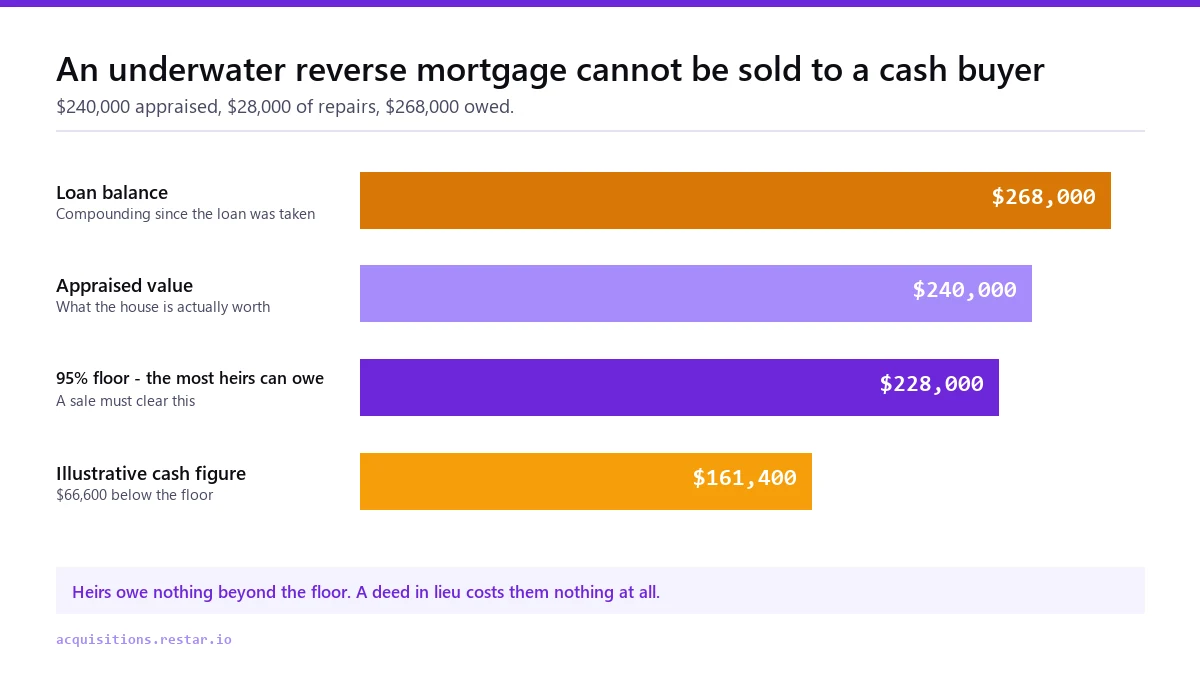
So on an underwater reverse mortgage, we are not the answer, and no cash buyer is. Here is the arithmetic, using the four-term build-up we publish in how cash home buyers calculate offers, on that same $240,000 house needing $28,000 of work:
| Term | Amount |
|---|---|
| After-repair value | $240,000 |
| Repairs — roof $9,000, HVAC $6,500, kitchen and bath $7,000, flooring and paint $4,000, cleanout $1,500 | −$28,000 |
| Resale and holding — commission $13,200, seller closing $2,400, purchase closing $1,800, five months' carry $7,200 | −$24,600 |
| Margin | −$26,000 |
| Illustrative cash figure | $161,400 |
A worked illustration on one hypothetical property. Not a quote, not a prediction about your house, and not a fixed formula we apply — repairs, market and risk differ on every property.
$161,400 against a $228,000 floor. The cash route is $66,600 short and simply cannot close. Neither can most retail sales at that value. The routes that actually exist are the 95% payoff if an heir wants to keep the house, or a deed in lieu if nobody does. Any company that tells an underwater HECM family it can solve this with a fast cash purchase is either not checking the payoff or not telling them the truth.
Now the other case, which is the more common one. Same house, appraised at $240,000, needing $28,000 of work, but the reverse mortgage balance is $118,000. There is genuine equity here and the question is how much of it the estate keeps.
| Line | List it retail | Sell as-is for cash |
|---|---|---|
| Sale price | $240,000 | $161,400 |
| Repairs funded first | −$28,000 | $0 |
| Agent commission (5.5%) | −$13,200 | $0 |
| Seller closing costs | −$3,600 | $0 — we cover standard closing costs |
| Holding while it sells | −$4,900 (5 months at $980) | −$680 (3 weeks) |
| Reverse mortgage payoff | −$118,000 | −$118,000 |
| Estate keeps | $72,300 | $42,720 |
Listing wins by $29,580. That is not close, and it is the answer we would give a family in this position: if the estate can fund $28,000 of repairs, has a personal representative in place, and can absorb five months, list it with an agent.
Notice what the payoff does and does not do. It subtracts $118,000 from both columns identically, so it never changes which route pays more. A reverse mortgage balance makes the estate poorer; it does not make a cash sale smarter. That is the same structure we set out in selling a house with a lien on it — what a large balance changes is not the ranking but whether the lower-priced route can clear the debt at all.
So what is the cash route actually for here? Not price. Certainty and date. It is worth considering when:
Outside those, take the $29,580. We would rather tell you that than take a house cheaply from a family who had a better option and did not know it.
Nobody tells the servicer. The loan does not pause while an estate organises itself, and an unreturned call becomes a default status that is harder to unwind than it was to prevent. Notify the servicer of the death in writing, in week one, even if you have decided nothing.
The house goes vacant and uninsurable. Reverse mortgage properties are almost always vacant after death, and standard policies commonly restrict coverage after 30 to 60 consecutive vacant days — typically dropping vandalism, theft and water damage. The servicer may force-place coverage and add it to the balance. Our guide to holding costs of a vacant house works through the vacancy clause and what an empty house costs each month.
Taxes and insurance stop being paid. A HECM requires the borrower to keep taxes and insurance current, and unpaid property taxes can put the house into a tax sale that runs on its own timetable entirely separate from the reverse mortgage. See selling a house with delinquent property taxes for how that clock works.
An heir keeps living there without authority. A family member occupying the house is not a borrower and does not inherit the loan terms. Occupancy does not extend the clock, and it complicates a later sale.
Somebody pays the full balance when the 95% rule applied. An heir who wants to keep an underwater house should be paying 95% of appraised value, not the balance. Establish which number applies before anyone writes a cheque, and get the appraisal ordered properly through the servicer.
The family pays an up-front fee to a “reverse mortgage rescue” outfit. Nothing on this page requires a paid intermediary. HUD-approved housing counselling is free, and the counsellors deal with HECM servicers routinely. Start there before paying anyone.
For background on the programme itself, HUD publishes the Home Equity Conversion Mortgage rules, and the CFPB's resources for older adults cover reverse mortgages from a neutral position.
The order matters more than the speed when selling a house with a reverse mortgage.
If it turns out there is equity and the estate can manage a listing, list it. If the clock or the condition rules that out, get a written figure and a date. And if the house is underwater, take the protection the borrower already paid for — it is worth more than anything a buyer can offer you.
That is the question that decides everything else on this page, and it is answerable in a day. Send us the address and the payoff figure from the servicer and we will tell you plainly whether a cash sale can clear the loan — including when the answer is no, which on an underwater HECM it usually is.
If there is real equity, listing with an agent will almost always net the estate more, and we will say so. What we can add is a written figure within 24 hours and a closing date the estate can hold to, which is worth something when a servicer's clock is running. Send us the property here.
All guides · Selling an inherited house · Inherited property
Step 1 of 5
No obligation, no fees, no repairs. We respond the same day.
You’ll talk to Trevor McAmis, Owner & Acquisitions Lead
(313) 710-6129
Takes about two minutes. Or call (313) 710-6129 — we answer.