Selling a house in Texas is unusually cheap, and losing one here is unusually fast, and both facts come from the same place. There is no state income tax and the constitution flatly forbids a transfer tax, so the cost of conveying a house here is among the lowest anywhere. The money is collected through property taxes instead — which are high, which is why Texas has a foreclosure process that can go from first notice to sold in about six weeks.

Step 1 of 5
Send the address and we will tell you what it is worth and what your options are.
You’ll talk to Trevor McAmis, Owner & Acquisitions Lead
(313) 710-6129
Takes about two minutes. Or call (313) 710-6129 — we answer.
Educational only. This explains how these situations generally work. It is not legal, tax or financial advice, and the rules differ by state — talk to an attorney or CPA about your own situation before you act on any of it.
The short version before the detail.
This is educational information, not legal or tax advice. Talk to a Texas attorney or a CPA about your situation, particularly on foreclosure, probate, homestead or property tax matters.
Selling a house in Texas is cheap, and losing one is fast. Foreclosure is non-judicial — 20 days to cure, 21 days' notice, then the first Tuesday. Transfer tax is constitutionally banned. Property taxes are high, funding both a tax-lien industry and a deferral right few owners know about. A seller's disclosure is mandatory.
Each of those has a specific consequence for your timeline and your net, and the exemptions on that last one catch more estates and divorces than people expect.
Texas uses a deed of trust with a power of sale. No court hearing is required, no judge signs off, and nobody sues you. The trustee simply follows a statutory sequence.
Under Texas Property Code section 51.002:
| Stage | Requirement |
|---|---|
| Notice of default | For a debt secured by your residence, the mortgage servicer must serve written notice by certified mail giving you at least 20 days to cure before any notice of sale is given |
| Notice of sale | Given at least 21 days before the sale, by posting at the courthouse door, filing a copy with the county clerk, and serving each debtor by certified mail |
| Sale | First Tuesday of the month, between 10:00 a.m. and 4:00 p.m., at the courthouse or an area the commissioners court has designated |
| Calendar quirk | If the first Tuesday falls on 1 January or 4 July, the sale moves to the first Wednesday |
Add those together: 41 days is the statutory minimum from the default notice to a completed sale, and in practice the first-Tuesday alignment usually makes it six to ten weeks. Federal servicing rules still apply first, so a servicer generally cannot make that first move until you are more than 120 days delinquent, per the Consumer Financial Protection Bureau.
But compare the back end of the process with Florida, where a lender must file a lawsuit and win a judgment before anything is sold. A Texas homeowner who receives a notice of sale has weeks. A Florida homeowner in the same position frequently has the better part of a year. If you are behind on a Texas mortgage, the notice of default is not an opening letter in a long correspondence. It is close to the last stop.
Our foreclosure guide covers what still works at that point — reinstatement, loan modification, forbearance, and a sale that closes before the sale date.
If the foreclosure sale does not cover the debt, the lender can sue you for the shortfall. Texas Property Code section 51.003 sets the terms, and one of them is a trap.
The suit must be brought within two years of the foreclosure sale. And anyone defending a deficiency claim may ask the court to determine the property's fair market value as of the sale date. If the court finds fair market value was higher than the foreclosure price, the borrower gets an offset for the difference, less surviving liens.
Here is the part that costs people money. If nobody requests that determination, or nobody puts competent evidence of value in front of the court, the statute says the foreclosure sale price is used to compute the deficiency.
Foreclosure sales routinely produce prices well under market. So the difference between a homeowner who asks for a fair market value finding and one who does not can be tens of thousands of dollars on the identical house — and it turns entirely on whether the request was made. If you are facing a deficiency suit in Texas, this is the first thing to raise with an attorney.
Most states charge you to convey a house. Texas cannot.
Article VIII, section 29 of the Texas Constitution, added by the voters on 3 November 2015, provides that after 1 January 2016 no law may be enacted imposing a transfer tax on a transaction conveying fee simple title to real property. Certain things are carved out — general business taxes measured by business activity, mineral production taxes, taxes on the issuance of title insurance, and rate changes to taxes already in existence on that date — but the deed transfer tax itself is off the table permanently.
That is a genuine and unusual saving, and it is worth seeing next to states where we also buy:
| State | Seller-paid transfer tax | On a $300,000 sale |
|---|---|---|
| Texas | None — constitutionally prohibited | $0 |
| Georgia | $1 per $1,000 (0.1%) | $300 |
| North Carolina | $1 per $500 (0.2%) | $600 |
| Florida | $0.70 per $100 (0.7%) | $2,100 |
| Michigan | $4.30 per $500 (~0.86%) | $2,580 |
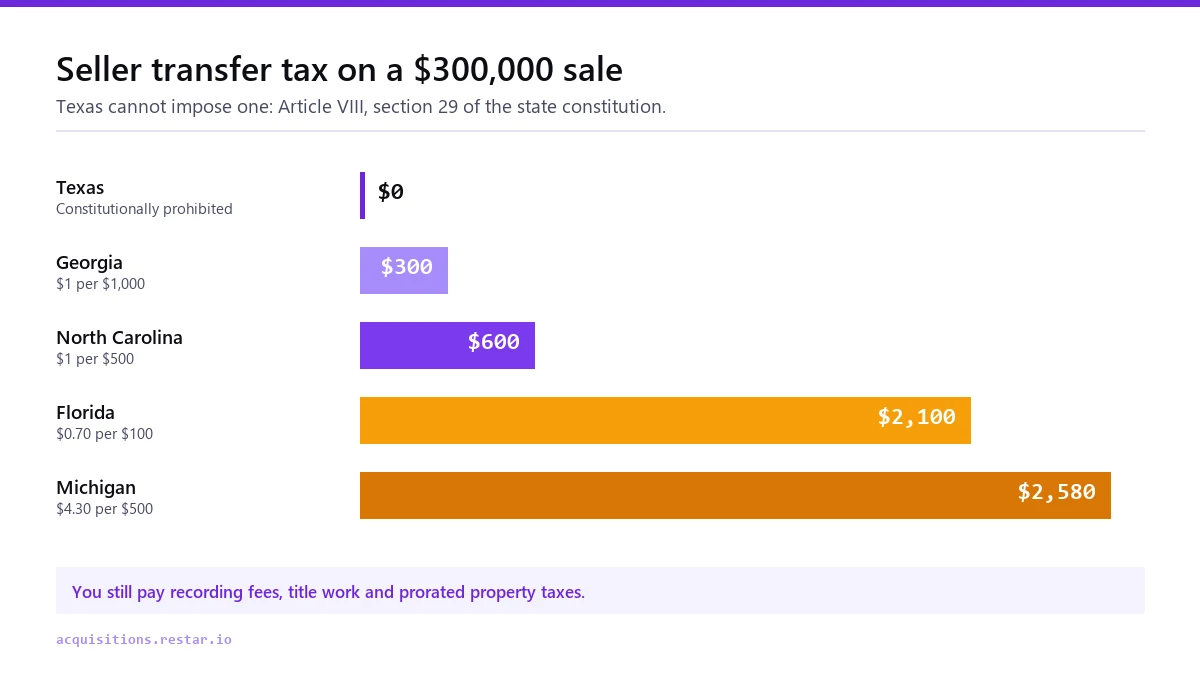
You will still pay recording fees, title work, and your share of prorated taxes. But the percentage-of-price levy that Michigan and Florida sellers absorb simply does not exist here.
Texas collects through property tax instead, and the rates are among the highest in the country. That is the largest recurring cost of selling a house in Texas slowly. For a seller it shows up in three places: your monthly carrying cost while the house sits, a large prorated adjustment at closing, and a delinquency that compounds faster than most states.
Take a $300,000 house at a combined rate of 2.1% — an illustration rather than your rate, which depends on your county, city, school and special districts and is printed on your appraisal district notice:
| Line | Annual | Monthly |
|---|---|---|
| Property tax at 2.1% | $6,300 | $525 |
| The same house in a 1.4% state | $4,200 | $350 |
| Texas premium | $2,100 | $175 |
That $175 a month is why time on market costs more here than in most places, and why the arithmetic in our guide to holding costs on a vacant house is heavier for a Texas property than an identical one elsewhere.
The protection: tax deferral for older and disabled homeowners. Under Texas Tax Code section 33.06, an individual who is 65 or older, disabled, or a qualifying disabled veteran may file an affidavit to defer collection of property taxes on their residence homestead. During the deferral, interest runs at 5% a year instead of the ordinary delinquency rate, and — this is the important part — a taxing unit may not file suit to collect and the property may not be sold at a tax foreclosure sale.
That is a genuine statutory right, and it is badly under-used. If you are 65 or older and behind on Texas property taxes on the home you live in, ask your county tax office about a deferral affidavit before you consider selling under pressure. It does not erase the debt, and it accrues against the eventual sale or estate. But it stops the clock, and stopping the clock is often the whole problem.
The hazard: transferred tax liens. Texas Tax Code section 32.06 permits a third party to pay your delinquent property taxes and take an assignment of the taxing unit's lien. Because that lien is superior to your mortgage, the transferee moves ahead of your lender — and these loans carry their own rates, fees and foreclosure rights. Companies advertising to pay off delinquent Texas property taxes are usually offering this.
It is lawful and occasionally the right answer. It is also a way to convert a county debt with a statutory deferral option into a private loan secured by a first-priority lien. Ask about section 33.06 deferral before you sign a section 32.06 tax loan, and read our guide to selling a house with delinquent property taxes first.
Texas Property Code section 5.008 requires a seller of residential property of not more than one dwelling unit to give the buyer a written notice of the property's condition, on or before the effective date of the contract. If the contract is signed without it, the buyer may terminate for any reason within seven days after receiving the notice.
That termination right is why late disclosure is more than a technicality — it hands your buyer a free option to walk, days before closing.
The statute exempts a specific list of transfers, and several of them describe people who read this page:
The estate exemption is the one worth flagging. An executor selling a house they never lived in is generally not required to complete the notice — which makes sense, since they have no knowledge to disclose. It does not license concealing what you do know, and most Texas estate sales still provide a disclosure marked to show the seller has never occupied the property. See selling an inherited house for the wider process.
Texas also adopted the Uniform Partition of Heirs' Property Act as Property Code Chapter 23A in 2017, which gives co-owners a 45-day right to buy out any cotenant demanding a sale, at appraised value. If the heirs are not aligned, read when heirs cannot agree to sell before anyone files anything.
Texas is not one market, and our two are nothing like each other or like the rest of our footprint.
| Market | Median year built | Median size | Character |
|---|---|---|---|
| Forney (Kaufman County) | 2020 | 1,955 sq ft | DFW exurb, new construction |
| Killeen (Bell County) | 2009 | 1,922 sq ft | Military market serving Fort Hood |
We do not publish a median sale price for either market, because we do not have enough recorded sales in our own data to state one honestly. What the data does support is the age and size of the stock, and that turns out to be the most important thing about selling a house in Texas in these two places.
Forney's median house in our deals was built in 2020 — the newest of any market we buy in, anywhere. For contrast, our Lansing median is 1910 and our Baltimore, Cleveland and Rochester medians are all 1920. The typical Forney house we look at is 110 years newer than the typical Lansing one.
That single fact rewrites the usual advice about selling a house in Texas. Most of what makes a house unsellable to a financed buyer — a failed roof, galvanised supply lines, knob-and-tube wiring, a furnace past its life — barely exists in a house built in 2020. In Forney, condition is almost never the reason a sale fails. The reasons here are the calendar and the equity: a posted first-Tuesday sale date, or an owner who bought recently, has not held the house long enough to build equity, and finds that price minus commission minus closing costs does not clear the loan.
If that is your situation, a cash offer is not the answer either — no buyer at any speed can pay you more than the house is worth. The conversation to have is with your servicer about a short sale or a modification, and our net-proceeds guide will show you where you actually stand before you have it.
Killeen is a military market, and it moves on orders rather than on the economy. The post it serves was renamed Fort Cavazos in 2023 and renamed back to Fort Hood in July 2025, this time honouring Colonel Robert B. Hood — worth knowing simply because so much online content about the area is now out of date. Practically, a Killeen seller is often selling because of a permanent change of station: a fixed date, set by somebody else, with no flexibility. That is a genuine timeline problem rather than a condition problem, and it is one of the few cases where certainty of closing is worth real money.
Straightforwardly: if your Texas house is financeable and no sale date has been posted, list it with an agent. There is no transfer tax to absorb, and in both our Texas markets the housing stock is new enough that a retail buyer can get a loan on it. A listing will very likely net you more, and we would tell you that before we made you an offer.
A cash sale earns its lower price in these situations:
For the arithmetic on both routes side by side, our cash offer vs listing net-proceeds guide works it line by line, and how cash home buyers calculate offers publishes the formula behind our number.
If your Texas house is financeable and no sale date has been posted, list it with an agent. The housing stock in both our Texas markets is unusually new, which means condition rarely rules out a retail buyer here, and a listing will very likely net you more than we will pay. We would say so.
Where a cash sale earns its lower price in Texas is the calendar. A posted first-Tuesday sale gives a financed buyer no room to close, and a transferred tax lien can move faster still. Send the address and we will send a written offer within 24 hours with the comparable sales attached. No cost, no obligation. Start on our Texas page or tell us about the property here.
Step 1 of 5
No obligation, no fees, no repairs. We respond the same day.
You’ll talk to Trevor McAmis, Owner & Acquisitions Lead
(313) 710-6129
Takes about two minutes. Or call (313) 710-6129 — we answer.