Every market page publishes the numbers behind its offer. See the math
Home › Guides › Selling a House With an Open Insurance Claim: Who Keeps the Money?
Guide
Selling a House With an Open Insurance Claim: Who Keeps the Money?
The tree came through the roof in April. The adjuster came out in May. A check arrived that was smaller than the contractor's estimate, and it was made out to you and your mortgage company jointly, so you could not even deposit it. Now you would rather sell the house than manage a rebuild you did not ask for. Selling a house with an open insurance claim is entirely possible, and the question everybody asks at this point is the right one: if I sell now, who keeps the insurance money? The answer depends on three things most sellers have never heard of, and one of them can quietly cost you five figures.
Takes about two minutes. Or call
(313) 710-6129 — we answer.
Educational only. This explains how these situations generally work. It is not legal, tax or financial advice, and the rules differ by state — talk to an attorney or CPA about your own situation before you act on any of it.
Selling a house with an open insurance claim: the short answer
You can sell with a claim open, and you normally keep the money already paid to you. What you forfeit by selling without repairing is the recoverable depreciation the insurer is holding back, which is often a quarter of the claim or more.
General information, not legal, tax or insurance advice. Policy wording controls, and it varies between insurers and states. Read your own policy and talk to an attorney or a licensed public adjuster about your situation.
Why the first check was smaller than the estimate
This is the piece that confuses almost everyone, and understanding it changes the whole decision about selling a house with an open insurance claim.
Most homeowner policies are written on a replacement cost basis, which sounds like the insurer pays what it costs to rebuild. They do, eventually. But they pay it in two stages. The first payment is actual cash value — replacement cost minus depreciation for the age and wear of what was damaged. The difference between the two, called recoverable depreciation, is held back until you actually complete the repair and send in the invoices proving you did.
Work it through on a real scope. A storm takes the roof and drives water into the ceilings. The contractor's estimate comes to $38,500, of which $22,000 is the roof itself. The roof was twelve years old on a twenty-five year life, so the insurer depreciates it by about 48%, or $10,560. The policy has a 2% wind and hail deductible on $310,000 of dwelling coverage, which is $6,200.
Contractor scope (replacement cost)
$38,500
Less recoverable depreciation on the roof
−$10,560
Less your deductible
−$6,200
First check (actual cash value)
$21,740
So the check is $21,740 against $38,500 of damage. Nothing has gone wrong — that is the policy working as written. If you complete the repairs and invoice them, the insurer releases the $10,560, bringing you to $32,300, and your true out-of-pocket cost is the $6,200 deductible.
If you sell the house without repairing it, that $10,560 generally stays with the insurer. Recoverable depreciation is recoverable only by actually doing the work. This is the single most expensive thing sellers do not know, and it belongs in the arithmetic before you decide anything.
Why you cannot just cash the check
If there is a mortgage on the house, the check almost certainly arrived with your servicer's name on it too. That is the mortgagee clause doing its job: the lender has a security interest in the building, and the insurance proceeds are proceeds of their collateral.
What happens next depends on the size of the claim. Small claims are typically endorsed over to you with little ceremony. Larger ones go into a loss draft account, where the servicer holds the funds and releases them in stages as an inspector confirms the work is progressing. You front each stage, or your contractor does, and get reimbursed.
The consequence at closing matters enormously and is widely missed: if the servicer is still holding insurance funds when you sell, those funds usually go toward your payoff rather than to you. They reduce what you owe. That is not the same as money in your pocket, and if you have significant equity it is close to a wash, but if you were counting on the claim check as your moving money you need to know which of the two is happening. Ask the servicer directly, in writing, what happens to the loss draft balance on a payoff. Our guide to the mortgage payoff statement explains what to look for.
One related trap: if the damage caused your policy to lapse or be non-renewed, the servicer may buy force-placed insurance and add the premium to your balance. It is expensive, it covers the lender rather than you, and federal mortgage servicing rules set out what the servicer has to tell you before charging you for it. Keep the policy alive until closing.
Can you assign the claim to the buyer?
Sometimes, and it is worth asking, but do not build a plan on it.
Most policies bar assignment of the policy without the insurer's consent. Assignment of a claim after the loss has occurred is treated more favorably in many states, on the reasoning that the risk has already happened and cannot be increased by a change of owner. But several states have restricted post-loss assignment of benefits sharply in recent years after abuse in the contractor market — Florida in particular has legislated on this repeatedly.
In practice, most cash purchases of damaged houses do not bother. The buyer prices the property net of the repairs and the seller keeps whatever has already been paid. That is cleaner, it does not depend on an insurer's cooperation, and it does not leave you waiting on somebody else's claim to be settled after you have moved out.
Whatever you agree, put it in the purchase contract in plain words: who keeps payments already received, who keeps any future payment on this claim, and who is responsible for pursuing or closing it. A contract that is silent about an open claim is a dispute waiting to happen. And tell the buyer the claim exists — concealing a known open claim and the damage behind it is exactly the kind of thing that unwinds a closed sale.
What each route actually nets
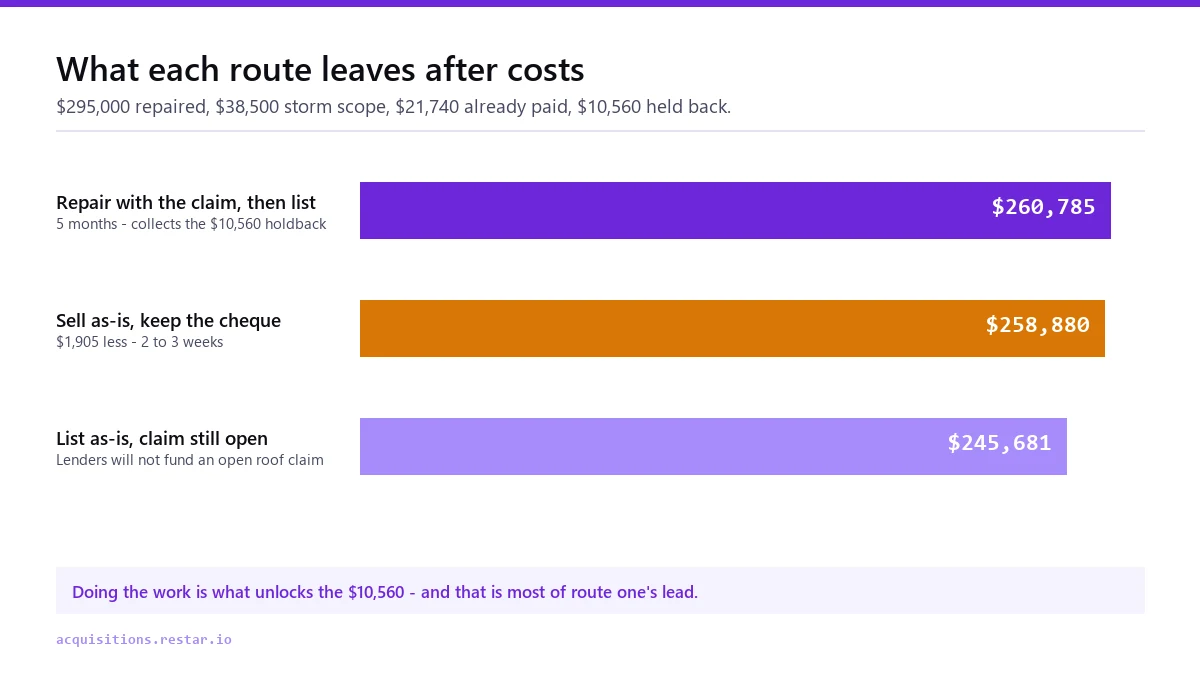
Here is the same storm-damaged house, worth $295,000 repaired, carrying about $1,150 a month, with the $38,500 scope and the $21,740 check already in hand.
What each route leaves after costsRestar Acquisitions · worked example from this page
Route
What happens to the claim
Net
Time
Repair with the claim, then list
Full $32,300 collected; you pay the $6,200 deductible
$260,785
~5 months
Sell as-is for cash, keep the check
Keep $21,740; forfeit $10,560
$258,880
2 to 3 weeks
List as-is with the claim open
Keep $21,740; forfeit $10,560
$245,681
~4.5 months
Repairing and then listing nets the most — $1,905 more than selling as-is for cash. That is the honest comparison and it is a narrower gap than most sellers expect, for one reason: the recovered depreciation. Doing the work is what unlocks the $10,560, and that $10,560 is most of what makes route one win.
The route that loses badly is the middle option that sounds most reasonable: listing the house as-is with the claim still open. It pays a full commission on a discounted price, absorbs four and a half months of carrying costs, and runs into a problem the other two do not.
Most lenders will not fund a purchase of a house with an open roof or structural claim. An appraiser who sees an unrepaired hole writes the appraisal subject to repairs, and the loan will not close until the repairs are done. That removes financed buyers from your pool and leaves you selling to the same cash buyers you could have gone to directly, except now with a commission on top and months gone. It is the worst of both structures, and it is the most common thing sellers try first.
The tax side, briefly
Insurance proceeds are not automatically tax free, and this surprises people.
The general shape, set out in IRS Publication 547, is that if what you receive for the loss exceeds your adjusted basis in the damaged property, the excess can be a taxable gain. Most ordinary claims on a long-held primary residence do not get anywhere near that, and the primary-residence exclusion in Publication 523 covers a great deal more. But large claims on rentals, or on properties with a low basis, genuinely can produce a gain.
There are also involuntary conversion rules that can let you defer gain by reinvesting in similar property within a set period. Whether that helps depends entirely on your numbers.
Educational only, and this is exactly the kind of question a CPA answers cheaply and a search engine answers badly. If your claim is large or the property is an investment, ask one before you close.
What to do before you decide
Get the full adjuster's worksheet, not the summary. Ask for the line-item estimate showing replacement cost, depreciation and deductible separately. You cannot evaluate any of this without seeing the recoverable depreciation figure.
Ask the servicer what happens to the loss draft balance on a payoff. In writing. This determines whether the money reaches you or your lender.
Get one independent repair bid. Adjuster scopes are sometimes light. A second number tells you whether the claim actually covers the work.
Ask whether the claim can be reopened or supplemented. If the contractor finds more damage once work starts, most policies allow a supplement. Selling generally ends that possibility.
Keep the policy in force and the house secured. Tarp the roof, keep the utilities on. Insurers can deny parts of a claim for damage that got worse because the property was not protected after the loss.
Consider a licensed public adjuster for a large or disputed claim. They work for you rather than the insurer and typically take a percentage. Your state insurance department licenses them and takes complaints.
Alternatives to consider
Repair with the claim and list. The highest net here, and the right answer if you can manage a rebuild and wait five months. It is the only route that collects the withheld depreciation.
Repair only the part that blocks financing. Sometimes fixing the roof alone, and leaving cosmetic damage, is enough to bring financed buyers back. Far cheaper than a full restoration.
List it with an agent after the work is done, not before. Waiting for the repairs is usually better than listing into a lender problem.
Rent it out once repaired, if the claim funds the work and you would rather hold. See renting versus selling.
Sell as-is for cash and keep the check already paid. Sensible where the damage is large, the deductible is painful, or nobody has the appetite to run a rebuild.
Wait for the claim to settle before listing. An open claim is a negotiating weakness. A settled one is just a repair estimate.
Can you sell a house with an open insurance claim?
Yes. Selling a house with an open insurance claim does not require the claim to be closed first, though it narrows your buyer pool because most lenders will not finance a house with unrepaired roof or structural damage. The important decisions are who keeps money already paid, who keeps any future payment, and whether your servicer is holding funds. All three should be written into the purchase contract.
Who keeps the insurance money when the house sells?
Whatever the contract says, which is why it needs to say something. By default you keep payments already released to you, since they compensate you for a loss you suffered while you owned it. Money still held by your mortgage servicer in a loss draft account usually goes toward your payoff instead of to you. Confirm that with the servicer in writing before closing.
What is recoverable depreciation and do I lose it if I sell?
It is the part of a replacement cost claim the insurer holds back until repairs are completed and invoiced. It is the difference between replacement cost and actual cash value. If you sell without doing the work you generally forfeit it, and it is frequently a quarter or more of the claim, so it belongs in your comparison of selling now against repairing first.
Can I assign my insurance claim to the buyer?
Sometimes, with the insurer's consent, and post-loss assignment is treated more favorably than assigning the policy itself. But several states have restricted assignment of benefits sharply, Florida especially. Most cash purchases avoid the question entirely by pricing the house net of repairs and letting the seller keep what has already been paid.
Will a lender finance a house with an open claim?
Usually not until the damage is repaired. An appraiser who sees unrepaired damage typically writes the appraisal subject to completion of repairs, and the loan cannot close until they are done. This is why listing a visibly damaged house as-is often performs worse than either repairing first or selling to a cash buyer.
Do I have to tell the buyer about the claim?
Yes, and you should want to. Most states require disclosure of known material defects, and a recent claim and its underlying damage are usually squarely within that. Concealing it risks the sale being unwound after closing and a claim against you personally. Disclose it in writing and provide the adjuster's estimate.
A written as-is offer costs you nothing and gives you the one figure the repair-and-list route has to beat. Sometimes it does, as it did on this page. Then you will know.
Send us the property and the adjuster's worksheet at sell my house fast. Bring the recoverable depreciation figure with you — it changes the comparison more than anything else on this page.
Every offer on this site is underwritten by a person, not a form. If the
numbers do not work for you, say so and I will tell you what would.
Also from Restar
Want the data behind all of this?
Restar Acquisitions is the acquisitions arm of Restar — a housing-market analytics
platform tracking 180+ metrics across every U.S. market, with composite scores and 12-month
price forecasts. The numbers on this page come from the same work.