Every market page publishes the numbers behind its offer. See the math
Home › Guides › Selling a House With Mold: Disclosure, Cost and Options
Guide
Selling a House With Mold: Disclosure, Cost and Options
Selling a house with mold sits in an odd place: the remediation is often less expensive than sellers fear, and the effect on the sale is often worse than they expect. The reason is that buyers, lenders and insurers do not react to the mold itself. They react to the water that caused it, and to the possibility that it is still coming in. This page covers what you have to tell buyers, what the work genuinely costs, why the test kit is usually the wrong first purchase, and which route leaves you with the most money.
Takes about two minutes. Or call
(313) 710-6129 — we answer.
Educational only. This explains how these situations generally work. It is not legal, tax or financial advice, and the rules differ by state — talk to an attorney or CPA about your own situation before you act on any of it.
Selling a house with mold: the short answer
You can sell a house with mold in any state, provided you disclose what you know. Fixing the water source and remediating typically nets the most. The route that reliably costs you is listing it visible and unremediated, which invites both a discount and a concession.
General information, not legal, medical or environmental advice. Disclosure duties and mold-specific statutes vary by state, and health effects vary by person. Talk to a real estate attorney about your disclosure obligations and a qualified contractor about your building.
Mold is a symptom. The water is the defect
Everything about selling a house with mold depends on this distinction, and getting it backwards is the most common and most expensive mistake in this whole area.
The Environmental Protection Agency's position, set out in A Brief Guide to Mold, Moisture and Your Home, is that mold growth requires moisture and that controlling moisture is what controls mold. Kill the visible growth and leave the leak, and it returns — commonly within weeks, and usually in the same wall.
Buyers and their inspectors know this, which is why the question at a showing is never really “is there mold.” It is “where did the water come from, and has it been stopped.” A seller who can answer that with a roof invoice, a plumbing repair and a remediation report is in a completely different negotiating position from one who cleaned a wall with bleach and repainted. The second seller is, correctly, assumed to be hiding something.
So the first spend is diagnostic, not cosmetic. Find the source: roof, flashing, a supply or drain line, grading and downspouts pushing water at the foundation, an unvented bathroom, a failed window seal, condensation on cold surfaces from poor ventilation. Fix that, and the mold becomes a finite cleanup with an end date instead of a recurring one.
What you have to disclose
Two things to separate when selling a house with mold, because sellers routinely conflate them.
There is no federal mold disclosure law. The federal disclosure regime for housing covers lead-based paint, through the pre-1978 real estate disclosure rule, and that regime does not extend to mold. Sellers sometimes take this to mean mold need not be mentioned. That inference is wrong and it is where the litigation comes from.
State law is what binds you, and nearly every state requires a seller to disclose known material defects affecting the value or desirability of the property. Active or historic water intrusion, and mold growth resulting from it, is a material defect in any ordinary reading. Some states go further with mold-specific disclosure requirements or statutory forms; a handful are caveat emptor with narrow exceptions that generally still prohibit active concealment. Ask a local real estate attorney which regime applies to you — it is a short and cheap question.
The practical rule that keeps sellers out of trouble is simple and does not depend on knowing your state's exact statute: disclose what you know, in writing, and never conceal or paint over it. Fraudulent concealment survives an as-is clause in essentially every jurisdiction. An as-is sale means the buyer accepts the condition they were told about; it is not a license to hide a known problem, and courts are consistent on the point.
Keep the paper. Invoices, the plumber's report, the remediation scope, before and after photographs, the post-remediation verification. A documented and repaired problem is a far easier conversation than an undocumented one, and the same file is what protects you afterwards.
Testing is usually the wrong first purchase
This is worth stating plainly because it saves money. The EPA does not generally recommend sampling for mold where growth is visible, for a practical reason: there are no federal standards or threshold limits for airborne mold, so a spore count has nothing authoritative to be measured against. If you can see it, sampling mostly confirms what you already know at a cost of several hundred dollars.
Where testing genuinely earns its money is narrower: confirming that a suspected hidden problem exists behind a wall before opening it, and post-remediation verification — independent confirmation that the work was done properly. That second one is a document worth having when you sell, because it answers the buyer's real question.
One caution on the report you may already have. An inspector or remediator who both tests and sells the remediation has an obvious conflict. Where a large scope is proposed on the strength of testing, have the sampling done by someone with no stake in the work.
What remediation actually costs
The EPA's threshold in Mold Remediation in Schools and Commercial Buildings is widely used residentially as a rule of thumb: an area under roughly 10 square feet is generally within reach of a careful owner using ordinary precautions; larger areas, contaminated HVAC, or growth from sewage or contaminated water call for professionals. The CDC's material on mold and health covers who should be more cautious — people with asthma, allergies or immune conditions should not be doing this work at all.
The professional number is built from a scope, not a square footage rate alone: containment and negative air, HEPA filtration, removing and disposing of porous material such as drywall, insulation and carpet, treating and drying the cavity, then rebuilding what was removed. The rebuild is a separate cost from the remediation and is frequently larger. Quotes that look cheap usually stop at the point the wall is open.
So there are three numbers, and you want all three before you decide anything: the source repair, the remediation, and the rebuild. A seller comparing a $6,800 remediation quote against a cash offer is comparing the wrong figure, because the house is not saleable at retail with the drywall out.
What it does to your buyer pool
Two mechanisms shrink the audience, and both are worth understanding before you list.
Lenders. An appraiser on an FHA, VA or conventional file is required to note conditions affecting health and safety. Visible mold and active water intrusion are routinely written up as requiring correction, which makes the loan conditional on repairs happening before closing. That is workable if the seller is doing the work anyway. It is a deal-killer if the seller's whole plan was not to.
Insurance. Most homeowners policies exclude mold except where it results from a covered sudden peril, and many that do cover it cap the payout well below the cost of a large remediation. A buyer who cannot bind affordable coverage cannot close, and a house with a documented water-loss history can be harder to insure at all.
The result is that a visible, unremediated mold problem does not just reduce your price. It narrows the field to buyers who do not need a lender's blessing, which is a much smaller and much more price-sensitive group — and that gap is exactly what our guide to cash offer vs listing net proceeds quantifies.
The three routes, with the arithmetic
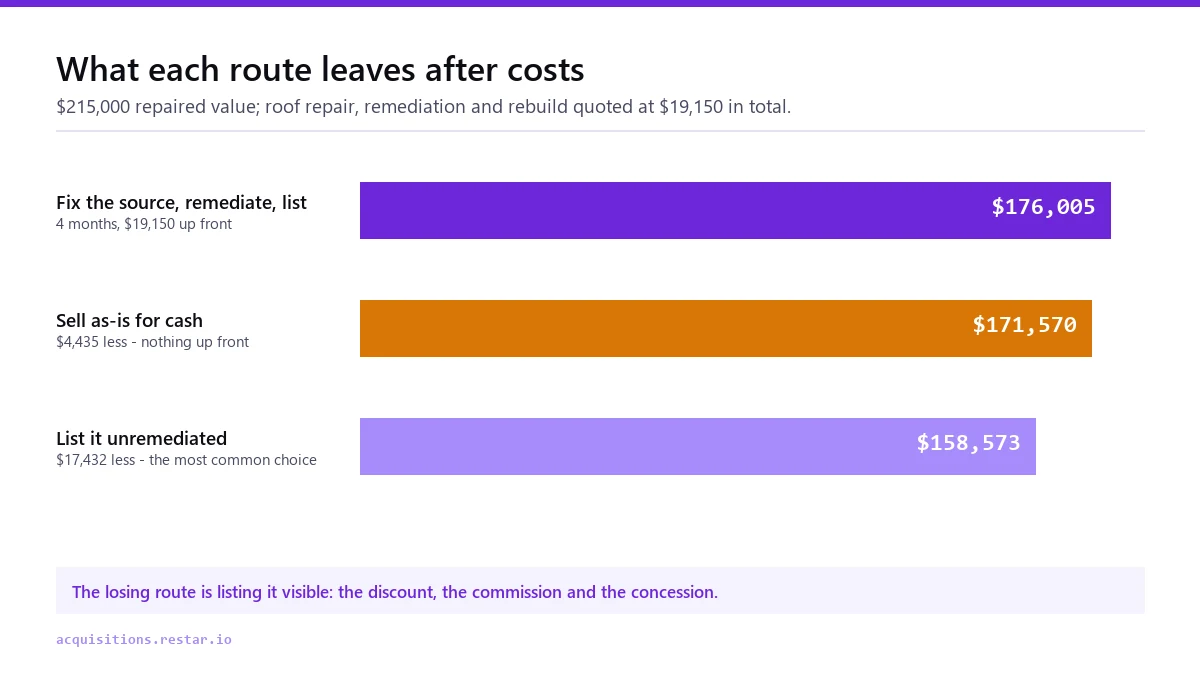
A house with a repaired value of $215,000, no mortgage, carrying costs $860 a month. A roof leak above an upstairs bathroom has been running for about three years, affecting roughly 180 square feet across the bathroom and the adjacent bedroom wall. Quotes: roof repair $4,200, remediation $6,800, rebuild $7,500, post-remediation verification $650 — $19,150 in total.
What each route leaves after costsRestar Acquisitions · worked example from this page
Route
Fix, remediate, list
List it unremediated
Sell as-is for cash
Sale price
$215,000
$181,000
$172,000
Source repair, remediation, rebuild
−$19,150
—
—
Agent commission
−$11,825
−$9,955
—
Seller closing costs
−$2,580
−$2,172
covered
Holding costs
−$3,440
−$4,300
−$430
Buyer concessions
−$2,000
−$6,000
—
Net proceeds
$176,005
$158,573
$171,570
Time and cash needed
4 months, $19,150 up front
5 months, nothing up front
2–3 weeks, nothing up front
An illustration on one hypothetical house, not a quote and not a prediction. Your figures will differ.
Two findings, and the second one matters more than the first.
Fixing it wins by $4,435. Put against the unremediated listing the gap is far wider — $17,432 — because the repaired house sells to financed buyers at retail and does not have to buy its way past an inspection report. If you can fund the work and wait four months, fix it and list it with an agent. That is the recommendation, and it does not send you to us.
The route that actually costs you is the middle column — listing it visible and unremediated. It is what sellers choose when they cannot fund the repair, and it lands $12,997 behind a straight cash sale. You take the discount for the mold, then pay a commission on the reduced price, then hand over a concession because the buyer's inspector wrote it up, then carry the house for five months while financed buyers fall out. It is the worst of both approaches, and it is the most commonly chosen one.
What this means for your decision
Selling a house with mold turns on one figure most sellers never obtain. Get the three quotes first — source, remediation, rebuild. Until you have them you are guessing, and mold is a subject where the guess is usually wildly higher than the quote. Plenty of sellers discover the whole problem is $9,000, not the $40,000 they had imagined, and the decision solves itself. The same test applies to every other defect in the house — see should I repair before selling.
If the total is fundable and you can wait a few months, fix it and list it. If it is not — if the source repair is a full roof or a foundation drainage project, if the house is vacant and uninsurable, if there is a deadline that a four-month renovation does not fit, or if the water is still coming in and cannot be stopped cheaply — then a direct sale is a reasonable choice, and on these numbers it beats an unremediated listing comfortably.
One thing to be careful of either way: do not let a remediation contractor's scope and a buyer's offer be the only two numbers you ever see. Get a second remediation quote and a broker price opinion. It is a week of effort against a five-figure decision.
Alternatives to consider
Fix the source, remediate, then list — the highest-net route whenever it is fundable.
Fix the source only, then list as-is — cheaper, and it lets you tell buyers truthfully that the water is stopped, which is the question they actually care about.
Remediate and offer a credit for the rebuild — removes the health-and-safety flag for the appraiser while leaving cosmetic work to the buyer.
Check your insurance — if the mold followed a sudden covered event such as a burst pipe rather than long-term seepage, some of the cost may be covered. Read the mold sublimit before assuming either way.
Get a second and third remediation quote — the spread on identical scopes in this trade is unusually wide.
Rent it out after remediation — only once the source is genuinely fixed; a landlord with a recurring mold problem has a much bigger problem than a seller does.
Sell as-is for cash — right when the repair is not fundable or the timeline does not fit.
Common questions
Do I have to disclose mold when selling a house?
There is no federal mold disclosure law, but nearly every state requires sellers to disclose known material defects, and water intrusion with resulting mold is a material defect under any ordinary reading. Some states have mold-specific requirements. Disclose what you know in writing, and never conceal or paint over it: fraudulent concealment survives an as-is clause in essentially every state.
Can you sell a house with mold?
Yes, in every state, with disclosure. The practical limit is the buyer pool. Appraisers on FHA, VA and conventional files routinely write up visible mold and active water intrusion as conditions requiring correction, which pushes the house toward cash buyers unless the work is done before closing.
Is it better to remediate mold or sell as-is?
Usually remediate, if you can fund it and wait. In the worked example on this page, spending $19,150 on the source repair, remediation and rebuild netted $4,435 more than a cash sale and $17,432 more than listing the house unremediated. The route that consistently loses is listing the house visible and unremediated, which collects the discount, the commission and a concession all at once.
How much does mold remediation cost?
It depends on the scope, and there are three numbers rather than one: the source repair, the remediation itself, and the rebuild of whatever was removed. The rebuild is often the largest and is frequently left out of quotes. EPA guidance treats areas under roughly 10 square feet as within reach of a careful owner and larger areas as professional work.
Should I get a mold test before selling?
Usually not, if the growth is visible. The EPA does not generally recommend sampling in that case, because there are no federal standards for airborne mold to compare a result against. Testing is worth paying for to confirm a suspected hidden problem before opening a wall, and for post-remediation verification, which is a genuinely useful document to hand a buyer.
Will homeowners insurance pay for mold remediation?
Sometimes, and usually less than people expect. Most policies exclude mold except where it results from a covered sudden peril such as a burst pipe, and many that do cover it apply a sublimit well below the cost of a large remediation. Long-term seepage and deferred maintenance are typically excluded. Read the mold provision before counting on it.
The useful thing to have before you decide is two figures side by side: what a remediation contractor wants, and what the house is worth without the work being done. We will put ours in writing with the reasoning behind it.
Send us the property here. Then get the remediation quote anyway — on the numbers below, fixing it often wins, and you should know that before you sell to anyone.
Every offer on this site is underwritten by a person, not a form. If the
numbers do not work for you, say so and I will tell you what would.
Also from Restar
Want the data behind all of this?
Restar Acquisitions is the acquisitions arm of Restar — a housing-market analytics
platform tracking 180+ metrics across every U.S. market, with composite scores and 12-month
price forecasts. The numbers on this page come from the same work.