The holding costs of a vacant house are the number almost nobody adds up before deciding how to sell one. An empty house is not idle; it is a small business losing money every day. The mortgage is the part people think of, which is why the owners of paid-off inherited houses so often assume there is no clock running at all. There is. It runs at roughly $870 a month on a house with no loan against it, and there is an insurance clause most sellers do not know about that can turn a quiet month into a five-figure loss.
Step 1 of 5
Send the address and we will tell you what it is worth and what waiting is costing you.
You’ll talk to Trevor McAmis, Owner & Acquisitions Lead
(313) 710-6129
Takes about two minutes. Or call (313) 710-6129 — we answer.
Educational only. This explains how these situations generally work. It is not legal, tax or financial advice, and the rules differ by state — talk to an attorney or CPA about your own situation before you act on any of it.
The holding costs of a vacant house typically run $850 to $2,000 a month, or roughly $28 to $65 a day. The mortgage is the largest line where one exists, but taxes, insurance, minimum utilities and upkeep continue regardless, and vacancy makes the insurance both more expensive and more restrictive. Total these before comparing any two ways of selling.
This is educational information, not legal, tax or insurance advice. Check your own policy wording and tax bill — the figures below are illustrations built from typical line items, not a quote.
Here is a mortgaged house, vacant, in a mid-priced market. Every line is one people forget at least half of.
| Line | Monthly | Why it does not stop |
|---|---|---|
| Mortgage principal & interest | $780 | The servicer does not care that nobody lives there |
| Property tax | $310 | Assessed on the property, not on occupancy |
| Insurance (vacant dwelling policy) | $195 | Higher than a standard policy — see below |
| Utilities at minimum | $145 | Power and water must stay on for showings, inspections and to prevent freeze damage |
| Lawn, snow, basic upkeep | $120 | An unmown lawn attracts code enforcement and signals an empty house |
| HOA dues | $60 | Accrue as a lien if unpaid |
| Maintenance reserve | $40 | Something breaks; empty houses deteriorate faster |
| Total | $1,650 | $54.25 a day |
Now the same house with no mortgage at all — the inherited-property case, where families most often assume holding is free:
| Line | Monthly |
|---|---|
| Property tax | $310 |
| Insurance (vacant dwelling policy) | $195 |
| Utilities at minimum | $145 |
| Lawn, snow, basic upkeep | $120 |
| HOA dues | $60 |
| Maintenance reserve | $40 |
| Total | $870 — about $28.60 a day |
A paid-off house costs around $10,440 a year to own while empty. That is the number that changes conversations among heirs, because "there is no mortgage, so there is no rush" is the single most expensive sentence spoken about inherited property. Over the eighteen months a contested estate can easily take, it is more than $15,000 — money that comes out of the same pot everyone is arguing over. Our guide to when heirs cannot agree to sell carries that figure into the partition math.
Where you are matters too. Property taxes are the second-largest line, and they vary by more than a factor of two across states. The same house that costs $310 a month in tax in one market costs $525 in a high-rate Texas county — see selling a house in Texas for that arithmetic.
This is the most important paragraph on this page, and it is the one least likely to appear in any other guide on the subject.
Standard homeowners policies restrict or exclude coverage once a property has been vacant for a set number of consecutive days — commonly 30 to 60, depending on the carrier and the form. Past that point, insurers typically stop covering vandalism, theft and attempted theft, water damage and glass breakage. The insurer may also decline to renew. The Insurance Information Institute explains the vacancy provision and why carriers treat empty homes as a different risk.
Read that list again in the context of an empty house. Vandalism, theft and water damage are close to a complete inventory of what actually happens to empty houses. The coverage that lapses is precisely the coverage the situation calls for.
There is also a distinction that trips people up. Vacant is not the same as unoccupied. A house whose owner is away for the winter with the furniture still in it is generally unoccupied and keeps full coverage. A house cleared out into storage is often treated as vacant from the day the furniture leaves — which is exactly what happens after a death, a divorce or a move-out.
So the common sequence is this. Someone dies in March. The family clears the house in April. In June a supply line fails and runs for a week. The claim is denied, because the policy stopped covering water damage sixty days after the house went vacant, and the family finds out at the moment they need it.
The fix costs money and is worth it. Call your carrier before the house goes empty, tell them plainly that it is vacant, and buy a vacant dwelling policy or a vacancy endorsement. It costs meaningfully more than a standard policy — the $195 in the tables above rather than a typical $120 — and that premium is the cheapest line item on this page relative to what it protects.
Do not simply stop paying the old policy, and do not let it quietly lapse. An uninsured vacant house with a mortgage on it will usually be force-placed by the servicer at a far higher premium, added to your loan balance.
If a carrier refuses to write the property or cancels mid-term, your state insurance department is the place to go next; the National Association of Insurance Commissioners' consumer hub links to every state regulator and explains how to file a complaint.
The tables above are the smooth part of the holding costs of a vacant house. These are the ones that arrive all at once.
Frozen pipes. In any market with a real winter, an unheated vacant house is a burst-pipe claim waiting to happen, and see above for whether it will be covered. Either keep the heat at a minimum setting — a cost — or have the system properly winterised and drained. Half-measures produce the worst outcome.
Code enforcement. Tall grass, an unsecured door, an accumulation of mail. Municipal fines accrue daily and become liens against the property, and they are one of the few costs that can eventually exceed the value of the work required to avoid them. Our page on code violations covers how those liens behave and how often they can be mitigated once cured.
Occupancy by someone else. An empty house that visibly stays empty attracts squatters, and removing them is an eviction — a court process taking weeks or months, during which every line in the table keeps running and you cannot sell.
Deterioration compounding. Empty houses decline faster than lived-in ones. Nobody notices the roof drip, the slow leak under the sink, the mould starting in an unventilated bathroom. A repair bill that was $19,000 in March is not $19,000 in December, and the gap between as-is value and repaired value widens in the wrong direction.
None of these are certainties. All of them are why the honest carrying cost of a vacant house is the monthly figure plus a risk premium, and why the practical advice is to shorten the vacancy rather than to optimise it.
This is where most articles on this subject quietly cheat, so here is the arithmetic in full.
A house worth $240,000 repaired, needing about $19,000 of work, carrying at $1,650 a month. The cash figure uses the four-term formula we publish in how cash home buyers calculate offers — $240,000 after-repair value, minus $19,000 of repairs, minus $25,100 of resale and holding costs, minus a $29,000 margin, or about $167,000, closing in three weeks. Against it, a retail listing taking roughly five months from decision to funded.
A worked illustration on one hypothetical property, not a quote, not a prediction about your house, and not a fixed formula we apply.
| Line | List it retail | Sell as-is for cash |
|---|---|---|
| Sale price | $240,000 | $167,000 |
| Repairs funded first | −$19,000 | $0 |
| Agent commission (5.5%) | −$13,200 | $0 |
| Seller closing costs | −$3,400 | $0 — we cover standard closing costs |
| Buyer concessions | −$3,500 | $0 |
| Holding cost | −$7,012 (4.25 extra months) | −$1,150 (3 weeks) |
| You keep | $193,888 | $165,850 |
Listing wins by $28,038. Not marginally — decisively. And that is the most important thing this page can tell you, because it is the opposite of what a company that buys houses for cash is supposed to say.
Now put the carrying cost against that gap. At $1,650 a month, the listing would have to take about seventeen additional months — nearly two years in total — before carrying costs alone erased its advantage.
| If the listing takes… | Retail net | Versus cash ($165,850) |
|---|---|---|
| 5 months (as modelled) | $193,888 | Listing +$28,038 |
| 11 months | $183,988 | Listing +$18,138 |
| 17 months | $174,088 | Listing +$8,238 |
| 22 months | $165,838 | Break-even |
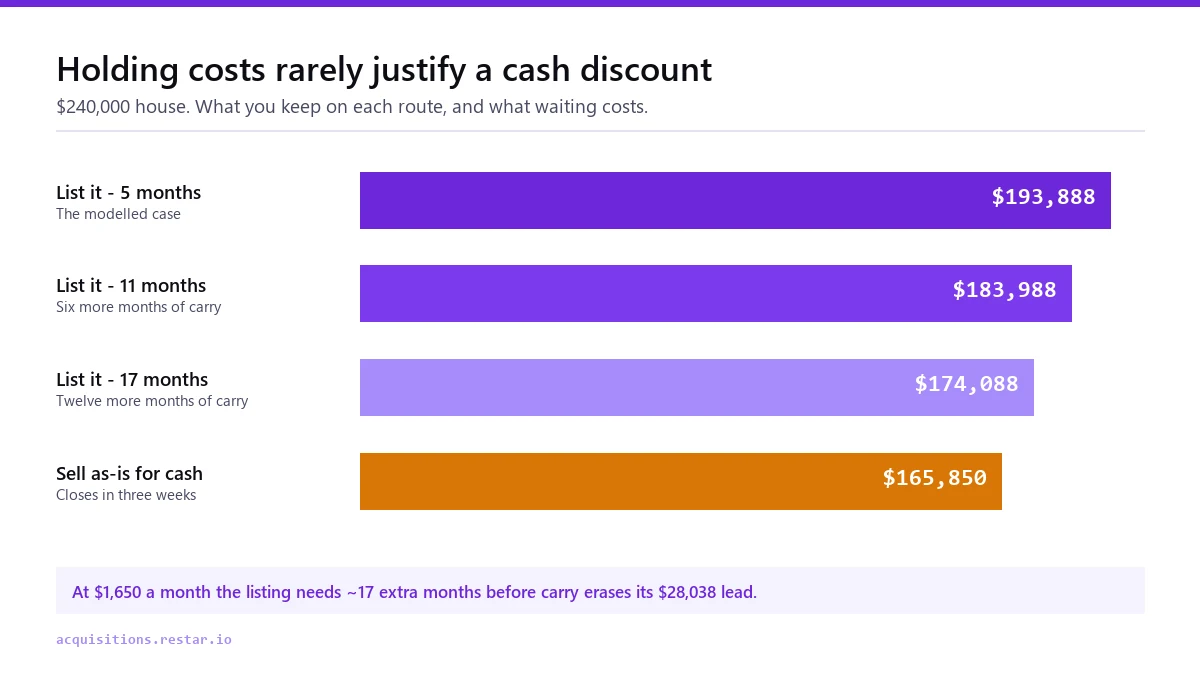
So the honest conclusion is this: holding costs are almost never a good reason on their own to accept a cash discount. The discount is simply much larger than the carry. If you can fund the repairs, get the house insured and financed, and wait a normal amount of time, list it — and the monthly figure is a reason to get on with it, not a reason to sell cheap.
What holding costs actually decide is the cases where the two routes are already close, and those are defined by something other than time:
In those situations the carrying figure stops being an argument about patience and becomes the running cost of a decision you cannot postpone. That is the only honest use for it.
One more thing belongs in the retail column that we have not charged it: a financed buyer can fail underwriting at week ten and put you back at the start, with ten months of carry already spent and the listing gone stale.
The arithmetic points the other way as often as not, and this page would be dishonest without saying so.
Hold and list if:
Shorten the vacancy instead if: a foreclosure or tax sale date is set, the insurance has already lapsed or been declined, liens are accruing interest, winter is coming and the house cannot be heated, or the decision requires agreement among people who do not agree.
The general principle is worth stating plainly, because it is the opposite of what most cash-buyer websites imply. Speed is worth paying for only in proportion to what waiting actually costs you. Work out your monthly number first. If it is $870 and your market is quick, waiting is cheap and you should probably list. If it is $2,000 and the timeline is genuinely uncertain, the discount for a certain close stops looking like a discount and starts looking like a price.
For the full side-by-side on both routes, see cash offer vs listing net proceeds, and how cash home buyers calculate offers for where a cash number comes from. If closing costs are the part you are unsure about, the Consumer Financial Protection Bureau's owning a home guides explain the settlement process from a neutral source.
The honest answer on this page is that in the worked example, listing wins. If the house is financeable, you can fund the repairs, and it will sell in a normal timeframe, list it with an agent. That is the higher-netting route and we would say so.
What we can give you is the other half of the comparison: a written, no-obligation offer within 24 hours with the comparable sales it came from, so you can put a real number against a real listing estimate instead of guessing. Plenty of people use ours and then list. That is a fine outcome. Tell us about the property here.
Step 1 of 5
No obligation, no fees, no repairs. We respond the same day.
You’ll talk to Trevor McAmis, Owner & Acquisitions Lead
(313) 710-6129
Takes about two minutes. Or call (313) 710-6129 — we answer.