Every market page publishes the numbers behind its offer. See the math
Home › Guides › Should I Rent or Sell My House? The Numbers Most People Skip
Guide
Should I Rent or Sell My House? The Numbers Most People Skip
Should I rent or sell my house is usually asked with a number already in mind: the rent is $2,050, the mortgage is $980, so it makes $1,070 a month. That subtraction is wrong, and it is wrong by about sixteen times. This page runs the same house properly, all the way through vacancy, the capital reserve almost nobody sets aside, the tax exclusion that quietly expires three years after you move out, and the equity sitting in the walls doing nothing. The answer in the end is genuinely close, and it does not depend much on money.
Takes about two minutes. Or call
(313) 710-6129 — we answer.
Educational only. This explains how these situations generally work. It is not legal, tax or financial advice, and the rules differ by state — talk to an attorney or CPA about your own situation before you act on any of it.
Should I rent or sell my house: the short answer
Rent minus mortgage is not cash flow. After vacancy, management, a real maintenance reserve, taxes and insurance, a typical single rental clears far less than owners expect. Renting can still win over time, but it usually wins on appreciation and loan paydown, not on monthly income.
General information, not tax advice and not investment advice. The tax rules below are federal and simplified, and state tax is ignored throughout. Talk to a CPA about your own numbers before deciding.
The subtraction that fools everybody
Take a real house: worth $290,000, $110,000 left on a low fixed-rate mortgage, principal and interest of $980 a month, and it would rent for $2,050.
The mental arithmetic says $1,070 a month. Here is the same year done properly.
Gross scheduled rent ($2,050 x 12)
$24,600
Vacancy and turnover at 7%
−$1,722
Property management at 9% of collected rent
−$2,059
Maintenance and capital reserve at 12% of gross
−$2,952
Property tax
−$3,720
Landlord insurance
−$1,620
Operating income before the mortgage
$12,527
Mortgage principal and interest
−$11,760
Annual cash flow
$767
$767 a year. Sixty-four dollars a month. Not $1,070.
The three lines people leave out are the three that matter. Vacancy is not a bad-luck event, it is a certainty averaged over time — the Census Bureau's Housing Vacancy Survey tracks it nationally, and a month between tenants every couple of years is ordinary. Management at 9% is what it costs if you do not want to be the person taking the Sunday call about a water heater; leave it out only if you genuinely intend to do the job yourself, and count that as work. The capital reserve is the one that ends landlords. Roofs, furnaces, water heaters and appliances do not fail annually, so a year without them feels profitable, and then one of them arrives.
A single $6,000 HVAC replacement is 7.8 years of that cash flow. That is the whole risk of a one-property rental in a sentence: you are not diversified, so one ordinary event erases the better part of a decade of income.
What selling puts in your hand today
The same house, sold now, with $9,000 of work to move it from rentable to sellable.
Listing beats our cash offer by $14,793 on this house, and it should. A property in good enough condition to rent is, almost by definition, in good enough condition to list. If you are choosing between renting and selling, you are not in a distressed situation, and the honest advice is to list it. We are not the right buyer for a house like this and we will say so when you call.
Where a cash sale earns its discount is a different set of facts: the house needs work you cannot fund, there is a tenant in place you would rather not inherit to a buyer, you are out of state, or you need a certain closing date. Our guides on selling a rental with tenants in place and cash offer vs listing net proceeds cover those.
The clock nobody tells you about
This is the most valuable paragraph on this page, and the reason the rent-or-sell decision has a deadline attached to it.
If the house was your primary residence, you can generally exclude up to $250,000 of gain from federal tax, or $500,000 filing jointly, provided you owned it and lived in it for two of the five years ending on the date of sale — the tests in IRS Publication 523. Rent it out and the clock starts running down. Once you pass roughly three years of renting, you no longer have two of the last five, and the exclusion is gone.
Worth being precise about a point most articles get wrong: renting the house out after you move out does not reduce the exclusion proportionally. The non-qualified-use rules that shrink the exclusion do not count periods of rental use that come after the last date you used it as your home. What kills the exclusion is running out the two-of-five window, not the renting itself. Depreciation is different — depreciation taken while it was a rental is recaptured and never excluded, no matter what.
Put numbers on it. Sell today and the gain is $66,795 against a basis of $188,000, comfortably inside the exclusion. Federal tax: zero.
Rent it for four years, watch the house appreciate to $310,000, and then sell:
Net sale proceeds after costs
$273,455
Depreciation taken over 4 years ($150,400 / 27.5 x 4)
$21,876
Adjusted basis
$166,124
Total gain
$107,331
Unrecaptured section 1250 at 25%
$5,469
Remaining gain at 15%
$12,818
Total federal tax
$18,287
A $0 tax bill became an $18,287 tax bill, before any state tax, because of a calendar. That is not an argument against renting. It is an argument for knowing what the decision costs, and for either selling inside the window or committing to hold long enough that the rental returns clearly beat the bill. The worst outcome is drifting past year three by accident. See our guides on capital gains when you sell your house and depreciation recapture, and Publication 527 for the rental rules.
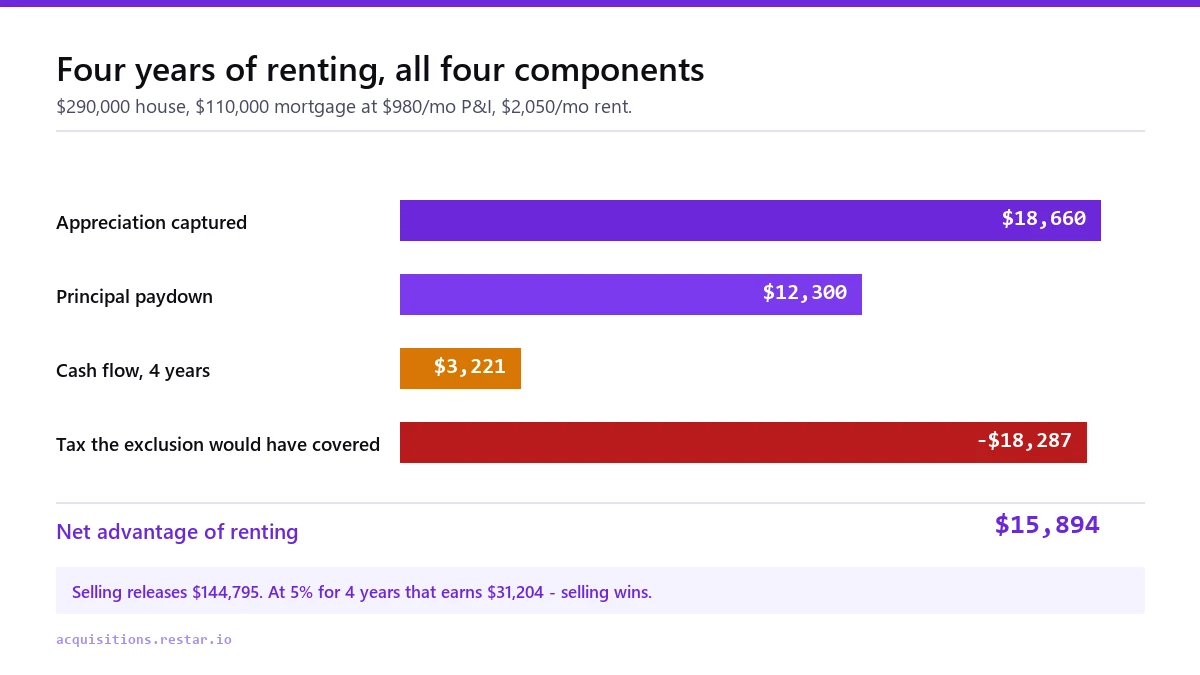
Adding it all up over four years
Four years of renting, all four componentsRestar Acquisitions · worked example from this page
Four years of cash flow, with modest rent growth
$3,221
Four years of principal paydown
$12,300
Appreciation captured in the higher price
$18,660
Less the tax the exclusion would have covered
−$18,287
Net advantage of renting for four years
$15,894
So renting wins by $15,894. Except that this comparison quietly cheats, in the direction that flatters renting, and the cheat is the one nearly every rent-versus-sell article makes.
Selling releases $144,795 of equity that is currently earning nothing where it sits. Invested at 5% over the same four years, that money earns $31,204. Set that against renting's $15,894 and selling comes out $15,310 ahead. At 4% selling is ahead by $8,701; at 6%, by $22,111.
An illustration, not a forecast, and certainly not investment advice. Investment returns vary, nobody can promise them, and we are not licensed to advise on them.
Which is the real conclusion: after four years of work, tenants, risk and a tax bill, the two routes land within a few thousand dollars of each other. Anyone telling you confidently that renting always builds wealth, or that you should always sell and invest, has not run the arithmetic. The financial case is close enough that it should not be what decides it.
So what should decide it
Given the money is nearly a tie, the tiebreakers are the honest deciding factors.
Rent it if:
Your mortgage rate is low and fixed. This is the strongest single argument for holding, and it is the reason the answer changed for millions of owners after 2022. A 3% loan on an appreciating asset is a genuinely valuable thing to own.
The house is in a market you actually believe in, and you have looked at that belief rather than assumed it.
You have cash reserves — six months of the full payment plus a real capex fund. Not the $767.
You live close enough to manage it, or you are content to pay someone who does.
You might move back. Holding costs less than buying back into the same market.
The temperament fits. Some people find a late-night plumbing call annoying; some find it genuinely distressing. That is data.
Sell it if:
The gain is large and the two-of-five window is closing. This can be worth more than several years of returns and it is the closest thing here to a hard deadline.
You would be an absentee landlord in another state with no one you trust nearby.
The house needs capital you do not have. Renting out a property with a fifteen-year-old roof is borrowing against a bill that is already due.
You need the equity for something concrete — a down payment, a debt, a business, care for a parent. Idle equity has a real cost and this page has just measured it.
The rent barely covers the payment. On thin cash flow you are taking landlord risk without landlord income.
You are doing it to avoid deciding. Drifting into being a landlord is the most common version of this choice and the worst.
One thing to check before either: if you rent a house bought with an owner-occupant loan, read the occupancy clause. Most require you to live there for the first year. And tell your insurer — a homeowner policy on a tenanted house can be void when you need it. See tired landlord if you have already tried this and would like to stop.
Alternatives to consider
List it with an agent. The highest net for a rentable house, by $14,793 in the example above.
Rent it for two years, then sell inside the window. Captures some appreciation and paydown while keeping the exclusion. The most underrated option on this list.
Rent to a tenant-buyer or on a lease option. Income now, sale later. Get an attorney: these are heavily regulated in some states and easy to get wrong.
Short or mid-term rental. Higher gross, much higher management load, and local rules that can change. Check the ordinance before the spreadsheet.
Sell to your tenant, if you already have a good one. No commission, no vacancy, no showings.
A 1031 exchange, if it is already an investment property and you want to stay invested without the tax. Strict deadlines; see Publication 544 and use a qualified intermediary.
Sell as-is for cash. The right answer when the repair bill is the reason you are stuck, or a tenant situation has become the problem itself.
Common questions
Should I rent or sell my house?
Financially it is usually closer than either side claims. In the worked example on this page, four years of renting netted $15,894 in cash flow, paydown and appreciation after tax, while selling and investing the released equity at 5% earned $31,204. Since the money is near a tie, the deciding factors are your mortgage rate, your reserves, your distance from the property and your tolerance for the work.
How do I calculate rental cash flow properly?
Start with gross annual rent, then subtract vacancy at around 7%, management at 8 to 10% of collected rent, a maintenance and capital reserve of 10 to 15% of gross, property taxes and landlord insurance. Only then subtract the mortgage. In our example that turned an assumed $1,070 a month into an actual $64 a month.
Do I lose my capital gains exclusion if I rent my house out?
Eventually. You need to have lived in the home for two of the five years ending on the sale date, so once you have rented it for more than about three years the exclusion is gone. Renting after you move out does not shrink the exclusion proportionally, but depreciation taken during the rental is always recaptured and never excluded.
What is a realistic maintenance reserve for a rental?
Most experienced landlords budget 10 to 15% of gross rent, which is what covers roofs, furnaces, water heaters and appliances over their life rather than in the year they fail. On a $24,600 gross rent that is roughly $2,500 to $3,700 a year. A single HVAC replacement was 7.8 years of net cash flow in our example.
Is it better to sell and invest the equity?
Sometimes, and it is the comparison most often left out. Equity sitting in a house earns nothing directly. In our example, $144,795 released by selling and invested at 5% over four years earned $31,204, which was more than everything renting produced over the same period after tax. At 4% the two routes are much closer.
Can I rent out a house I bought with an FHA or VA loan?
Usually only after satisfying the occupancy requirement, which is typically twelve months of living there. Read your note and speak to your servicer before advertising it. You must also tell your insurer, because a homeowner policy on a tenant-occupied house may not respond to a claim when you need it.
You cannot compare renting to selling without a sale price
Every calculation on this page needs one input you do not have yet: what the house is actually worth today, as it stands. We will put that in writing at no cost, with no obligation.
If the house is in good enough shape to rent, listing it will very likely beat our number — by $14,793 in the example above — and we will tell you so. Send us the property here.
Every offer on this site is underwritten by a person, not a form. If the
numbers do not work for you, say so and I will tell you what would.
Also from Restar
Want the data behind all of this?
Restar Acquisitions is the acquisitions arm of Restar — a housing-market analytics
platform tracking 180+ metrics across every U.S. market, with composite scores and 12-month
price forecasts. The numbers on this page come from the same work.