Should I repair before selling, or sell the house as it stands? Almost every answer online offers two options — fix it up and list, or take a cash offer — and quietly omits the third, which is frequently the best one: list the house as-is on the open market and let a retail buyer price the work. Below are all three columns on the same property, with the sensitivity that decides between them. In the base case repairing wins, by a margin far thinner than it first appears.

Step 1 of 5
Send the address and we will give you the as-is number, so you have a real floor to compare against.
You’ll talk to Trevor McAmis, Owner & Acquisitions Lead
(313) 710-6129
Takes about two minutes. Or call (313) 710-6129 — we answer.
Educational only. This explains how these situations generally work. It is not legal, tax or financial advice, and the rules differ by state — talk to an attorney or CPA about your own situation before you act on any of it.
Repair before selling only where the work returns more than it costs plus the extra months of carry it adds, which is a narrower window than it sounds. Cosmetic and presentation work usually clears that bar. Mechanical work usually does not, but is often required for a buyer's loan to fund at all.
This is educational information about how sale proceeds are calculated, not legal, tax or financial advice about your property. Appraisal standards, permitting and lead-safe renovation rules are set federally and locally and they change; check yours before committing money. The figures below are one worked example; your market, your house and your contractor's price will differ.
Set the frame properly, because the framing is where most of the money is lost.
Should I repair before selling is almost always presented as a binary: spend money on the house and list it, or take a cash offer and be done. That is not the choice. There are three routes, and the middle one — list it as-is on the open market, with the condition disclosed and the price set to match — is a real, common, boring transaction that happens constantly. Retail buyers buy houses that need work. They discount for it, and the discount is the honest price of the work plus a premium for uncertainty.
Why does the middle route go missing? Because the two parties writing most of the content have no reason to raise it. A cash buyer's page compares cash against a fully-repaired listing, which makes the repair route look expensive and slow. A renovation contractor's page compares repairs against doing nothing, which makes the repairs look free. Neither has a reason to tell you that you can simply list the house dirty.
One consequence worth stating up front: an as-is listing is not the same as a distressed sale. The house goes on the multiple listing service, every buyer in the market sees it, and the price is set by competition rather than by one company's margin. That is the mechanism, and it is why the as-is route beats a cash sale on price in most ordinary cases.
This page compares all three on the same property. For the narrower cash-against-retail comparison, and how the offer itself is constructed, see cash offer versus listing net proceeds and how cash home buyers calculate offers.
A house worth $280,000 fully repaired, needing $42,000 of work: kitchen, two bathrooms, flooring throughout, paint, and a failed furnace. Holding costs run $1,150 a month all-in.
The as-is listing price is the figure people guess at, so it is worth deriving rather than asserting. Retail buyers discount a house needing work by more than the repair bill, because they are taking on price risk, scope risk and the inconvenience, and because fewer of them can or will do it. A risk premium of about 45% of the repair cost is a reasonable middle estimate: $42,000 of repairs plus $18,900 of premium, giving an as-is price of $219,100.
| Line | Repair, then list | List as-is | Sell for cash |
|---|---|---|---|
| Sale price | $280,000 | $219,100 | $180,000 |
| Repairs you fund | −$42,000 | $0 | $0 |
| Agent commission (5.5%) | −$15,400 | −$12,051 | $0 |
| Seller closing costs (1.5%) | −$4,200 | −$3,287 | $0 — we cover standard closing costs |
| Buyer concessions (1%) | −$2,800 | −$2,191 | $0 |
| Holding while it happens | −$8,050 (7 months) | −$5,175 (4.5 months) | −$800 (3 weeks) |
| You keep | $207,550 | $196,396 | $179,200 |
The cash figure is built with the four terms we publish: $280,000 after-repair value, less $42,000 of repairs, less $28,000 of resale and holding costs — resale commission $15,400, seller closing at resale $2,800, purchase closing $2,000 and six months' carry of $7,800 — less $30,000 of margin.
A worked illustration on one hypothetical property. Not a quote, not a prediction about your house, and not a fixed formula we apply.
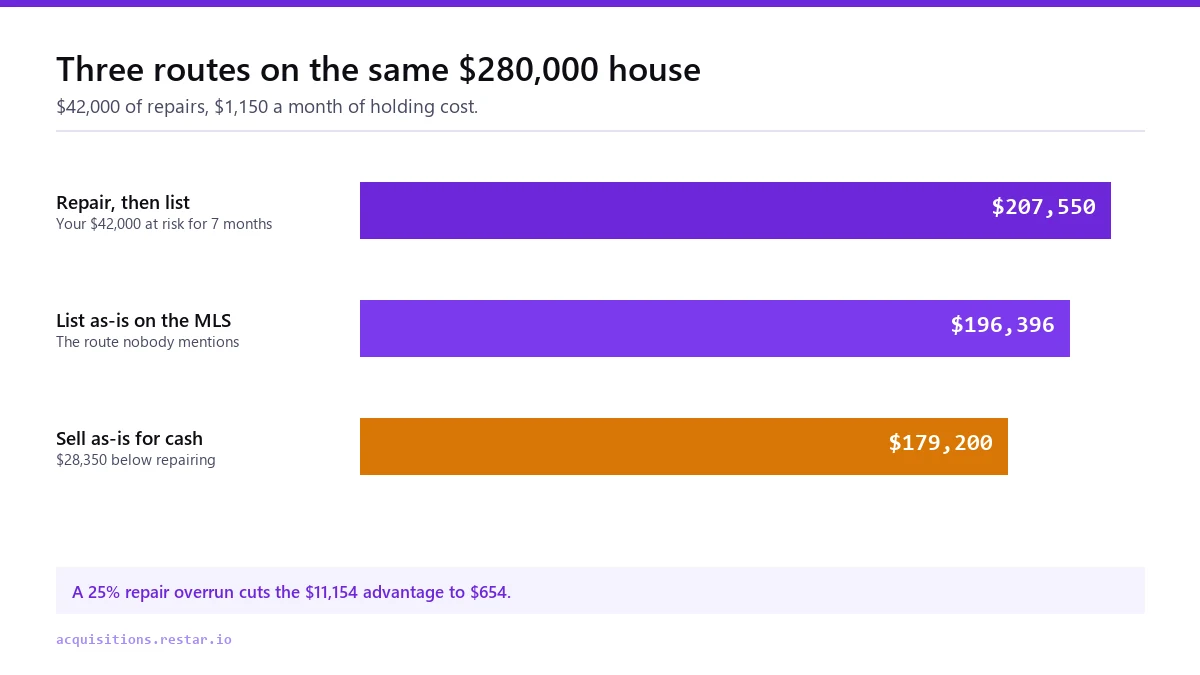
Repairing wins by $11,154 over an as-is listing, and by $28,350 over a cash sale. That ordering is the usual one and it is why we tell people to list. But look at what the first gap is made of before you accept it.
The $42,000 of repairs bought $60,900 of price — $1.45 of price for every dollar spent, which sounds excellent. By the time the extra two and a half months of carry, the larger commission on a larger price and the larger concession are taken out, only $11,154 of that $18,900 gross gain survives. You are risking $42,000 of your own cash, for seven months, to net $11,154. That is the sentence the decision actually turns on.
Two things move this result, and both of them are common rather than exotic.
1. The repairs run over. They usually do. Take the same job at 25% over budget — $52,500 rather than $42,000, which is an ordinary outcome on a house of any age once a wall is open. Nothing else changes:
| Line | Repair at budget | Repair 25% over | List as-is |
|---|---|---|---|
| Sale price | $280,000 | $280,000 | $219,100 |
| Repairs | −$42,000 | −$52,500 | $0 |
| Commission, closing, concessions | −$22,400 | −$22,400 | −$17,529 |
| Holding | −$8,050 | −$8,050 | −$5,175 |
| You keep | $207,550 | $197,050 | $196,396 |
A 25% overrun turns an $11,154 win into a $654 win. The repair route is not a comfortable margin with a bit of upside — it is a leveraged bet with almost no margin of safety, and the overrun does not even have to be large. A 26% overrun loses. So does a two-month delay. So does the furnace turning out to need ductwork.
2. The work does not change how the house shows. This is the bigger one and it is badly understood. Spend the same $42,000 entirely on mechanical systems — $14,000 roof, $9,000 furnace and air conditioning, $12,000 electrical panel and partial rewire, $7,000 sewer line — and the house still has its 1978 kitchen and its avocado bathroom. Buyers pay for kitchens and bathrooms. A dry, safe, functional house with a dated interior does not sell for the fully-renovated price, and the lift might be $34,000 rather than $60,900:
| Line | Mechanical repairs, then list | List as-is |
|---|---|---|
| Sale price | $253,100 | $219,100 |
| Repairs | −$42,000 | $0 |
| Agent commission (5.5%) | −$13,921 | −$12,051 |
| Seller closing costs (1.5%) | −$3,797 | −$3,287 |
| Buyer concessions (1%) | −$2,531 | −$2,191 |
| Holding | −$8,050 (7 months) | −$5,175 (4.5 months) |
| You keep | $182,801 | $196,396 |
Listing as-is now wins by $13,595. Same house, same $42,000, opposite answer — because what you spent it on changed. The rule that falls out of it is the most useful thing on this page: cosmetic and presentation work is an investment; mechanical work is a gate. You do mechanical work when something on the other side of it requires it, not because it pays.
The word gate is literal. Some conditions stop a financed buyer from closing at all, no matter how much they want the house, because the lender will not fund against the appraisal.
FHA appraisals in particular require the property to be safe, sound and secure, and appraisers commonly call out defective paint surfaces on houses built before 1978, a roof without adequate remaining life, active leaks, missing handrails, inoperable systems and exposed wiring. Requirements sit in HUD's Single Family Housing Policy Handbook 4000.1. Conventional lenders are less prescriptive, but individual lenders add their own conditions. Note also that on a house built before 1978, any repair disturbing painted surfaces must be carried out by a firm certified under the EPA's Lead Renovation, Repair and Painting rule — a constraint on who you can hire, and a line in the price.
That is what makes a gate item different. It does not have to pay for itself; it has to exist for a whole class of buyer to be able to bid. In a market where most buyers are financed, a $6,000 roof repair that returns $4,000 of value can still be the right spend, because without it your buyer pool shrinks to cash and renovation-loan buyers and the price falls further than $2,000.
The gate items, roughly in order of how often they stop a sale:
And the investments, which return more than they cost when the house is otherwise sound: paint throughout, floor coverings, light fixtures, cabinet hardware and doors, landscaping and the front elevation, a deep clean and a full clear-out. These are cheap, fast, low-risk, and they move the price because they move how the house photographs and how it feels in the first eight seconds.
The trap in the middle is the partial renovation. Half a kitchen, one of the two bathrooms, new flooring in three rooms out of six. It costs real money, it takes real time, and it does not reach the renovated price because the house still reads as unrenovated. If you are not going to finish it, the money is usually better left in your pocket and the discount left in the price.
One last framing, because should I repair before selling is not purely an arithmetic question. The repair route wins on money in the base case and we have said so plainly. But it wins with your capital at risk, over months, on a scope nobody can fully see, on a house you may no longer want to think about. The as-is listing route gives up about $11,154 of that and removes every one of those exposures. For a great many sellers that is a good trade rather than a defeat, and it does not require selling to a company like ours to get it.
You cannot answer this question with one number. What you need is the price the house achieves in the condition it is in today, and a contractor's bid on the same scope, and then the arithmetic on this page. We will give you the first of those in writing within 24 hours, with the comparable sales behind it and no obligation.
The honest conclusion here is that our route comes third on the money in the base case, by $28,350 against repairing and $17,196 against an as-is listing. Plenty of people take our figure, use it as a floor, and go and list the house. That is a good outcome, and we would rather you did that than take a cash offer because nobody laid the three columns side by side. Send us the property here.
All guides · Cash offer vs listing net proceeds · Selling with unpermitted work
Step 1 of 5
No obligation, no fees, no repairs. We respond the same day.
You’ll talk to Trevor McAmis, Owner & Acquisitions Lead
(313) 710-6129
Takes about two minutes. Or call (313) 710-6129 — we answer.