A mortgage payoff statement is not the balance on your last billing statement. It is a specific dollar figure, good only through a specific date, built from your principal plus interest that accrues daily until the lender is actually paid. Miss the date it expires and the number you have is no longer the number you owe — and closings routinely miss it.

Step 1 of 5
Send the address. We order the payoff statements — first mortgage, any second lien — and build them into your closing ourselves.
You’ll talk to Trevor McAmis, Owner & Acquisitions Lead
(313) 710-6129
Takes about two minutes. Or call (313) 710-6129 — we answer.
Educational only. This explains how these situations generally work. It is not legal, tax or financial advice, and the rules differ by state — talk to an attorney or CPA about your own situation before you act on any of it.
A mortgage payoff statement shows the exact amount required to satisfy your loan in full as of one specific date, including daily interest that keeps accruing until funds arrive — not the balance shown on your regular billing statement, and not valid indefinitely.
It typically expires 10 to 15 days after it is issued. A closing that slips past that date needs a new one, which by federal rule can legally take up to another 7 business days to arrive.
This is educational information, not legal or financial advice. Ask your servicer or closing agent to confirm the exact figures and deadlines that apply to your loan.
Four things make up a payoff figure, and only one of them is fixed.
What is deliberately not on it: your escrow surplus. A common and expensive misunderstanding is expecting that balance to show up as extra cash in the proceeds check. It does not — see the escrow section below.
Take a $146,000 balance at 6.5%. Annual interest is $146,000 × 6.5% = $9,490. Most servicers divide that by 365 days to get the daily rate: $9,490 ÷ 365 = $26.00 a day.
Not all of them use 365. Some loans are serviced on a 360-day "banker's year," which produces a slightly higher daily figure on the identical loan: $9,490 ÷ 360 = $26.36 a day — 36 cents more, every day, until payoff. It is worth asking which convention your servicer uses rather than assuming; the difference is small day to day but it is one more reason the number on the statement, not a number you calculate yourself, is what a closing actually relies on.
A closing that funds 9 days after the statement was issued owes 9 × $26.00 = $234 of per diem interest on top of principal. A closing that funds 22 days after issuance owes 22 × $26.00 = $572. The dollar difference is not a fee anyone charges you — it is interest you were always going to owe for however long you carried the loan, which is why it belongs with the mortgage-interest line inside your monthly holding cost (see holding costs of a vacant house) rather than being counted a second time as a separate closing cost.
A payoff statement is only valid through a stated date — commonly 10 to 15 days from when it was issued. Under federal mortgage servicing rules (12 CFR § 1026.36(c)(3)), your servicer must provide an accurate payoff statement within a reasonable time and, in any case, no more than 7 business days after a written request.
That 7-business-day figure is a ceiling, not a same-day service. Here is where it actually bites: a retail closing originally set for day 40 slips, as financed closings often do, to day 52. The payoff statement ordered for day 40 is long expired by day 52. Someone has to submit a fresh written request, and the servicer has up to another week to answer it — which can force the closing to slip a second time waiting on paperwork that has nothing to do with either party being ready to close.
The version that costs real money rather than just time: a closing disburses on day 22 against a payoff statement that was only good through day 15, because nobody caught that the date had passed. The wire sent is short by 7 days of interest — 7 × $26.00 = $182 on the example loan above. Servicers generally will not release the lien on a partial payoff. The gap either has to be caught and cured before funds are sent, or it becomes a post-closing demand the title company has to chase from the seller's proceeds — an entirely avoidable problem that starts with one expired date nobody rechecked.
The fix is unglamorous: confirm the good-through date against the actual scheduled disbursement date a few days before closing, not at the closing table. If there is any chance the date moves, ask for the reorder before it becomes urgent, not after.
A HELOC or second mortgage has to be paid off at the same closing, from the same proceeds, and it has its own separate statement with its own expiration date — tracked by a different servicer, on a different calendar. An $18,000 HELOC balance at 8.5% accrues about 18,000 × 8.5% ÷ 365 = $4.19 a day. Smaller in dollars than a typical first mortgage, but it is fully capable of the same result: an expired second-lien payoff blocks clear title exactly as effectively as an expired first-lien one, and it is the one people more often forget to reorder because it is the smaller number.
If your loan has an escrow account for taxes and insurance, whatever is left in it after payoff is handled completely separately from the payoff figure. Under 12 CFR § 1024.34(b), a servicer must return any remaining escrow balance within 20 business days of the loan being paid in full — and it is almost always mailed as a separate check afterward, not wired into the closing.
On a loan with a $2,150 escrow balance, that is real money — but it shows up two to four weeks after closing, addressed to you, not as a line on the settlement statement. Expecting it at the table is one of the more common reasons a seller's proceeds check looks smaller than they had mentally budgeted, when nothing has actually gone wrong.
You are allowed to dispute a payoff figure. Providing an inaccurate payoff statement in response to a proper written request is itself a violation the CFPB treats as a covered error under its mortgage servicing rules (12 CFR § 1024.35), and a written notice of error to the servicer starts a formal clock for them to investigate and respond. The most common real-world disputes are a force-placed insurance premium added after a lapse the borrower disputes, or on a small number of older loans, a prepayment penalty that should not still apply. Ask for an itemized breakdown, not just a total, if a figure looks larger than expected — the itemization is what makes a dispute possible in the first place.
A house worth $175,000 repaired, needing about $12,000 of work.
| Line | Repair, then list | Sell as-is for cash |
|---|---|---|
| Sale price | $175,000 | $127,950 |
| Repairs | −$12,000 | $0 |
| Agent commission (5.5%) | −$9,625 | $0 |
| Seller closing costs (1.5%) | −$2,625 | $0 — we cover standard closing costs |
| Buyer concessions (1%) | −$1,750 | $0 |
| Holding, 6 months at $1,100 | −$6,600 | −$825 (3 weeks) |
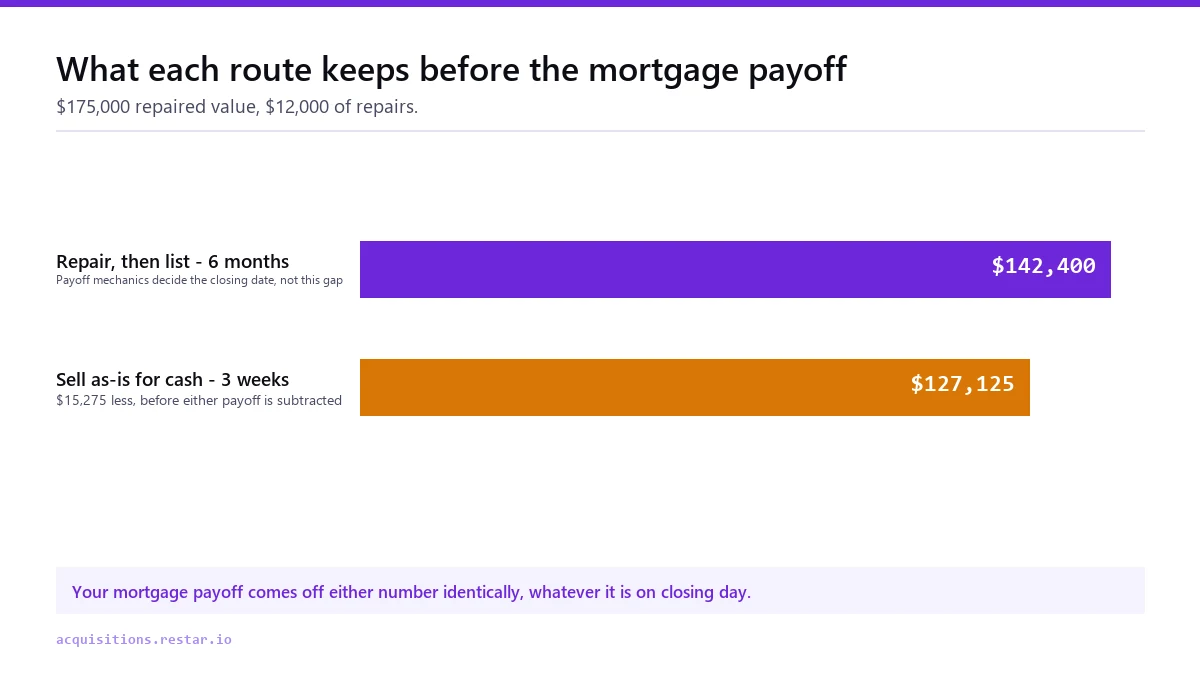
| Before debts | $142,400 | $127,125 |
The cash figure is built the same way as how cash home buyers calculate offers: $175,000 after-repair value, less $12,000 of repairs, less $20,050 of resale and holding costs — resale commission $9,625, resale closing $2,625, purchase closing $1,200 and six months' carry at $1,100, $6,600 — less $15,000 of margin.
A worked illustration on one hypothetical property. Not a quote, not a prediction about your house.
Listing wins by $15,275 in this example. Your mortgage payoff — whatever it turns out to be on the actual day of closing — comes off either number identically, and never changes which route nets more; the mechanics on this page decide whether that day goes smoothly, not which number is bigger. The general math of how any lien or loan balance interacts with the two routes is covered fully in selling a house with a lien on it.
Send us the address and we will order the payoff statements on every lien against the property ourselves, time the closing to land inside the good-through window, and cover standard closing costs on our purchases. Your mortgage balance still comes off your proceeds either way — that never changes based on who buys.
If you have weeks to spare and want to manage the payoff requests, the estoppel-style paperwork and a financed buyer's timeline yourself, listing with an agent is very often the better math, and our worked example below shows the real gap. Send us the property here if the coordination is the part you would rather not do twice.
All guides · Seller closing costs · Selling a house with a lien on it · Cash offer vs. listing net proceeds
Step 1 of 5
No obligation, no fees, no repairs. We respond the same day.
You’ll talk to Trevor McAmis, Owner & Acquisitions Lead
(313) 710-6129
Takes about two minutes. Or call (313) 710-6129 — we answer.