Private-pay nursing home and assisted living care runs $5,900 to over $10,600 a month nationally, and the first bill is often due before a house could ever close through a normal listing. Selling a house to pay for nursing home care, or assisted living, means weighing a fast cash sale against a HELOC, a reverse mortgage already in place, renting the house out, or a family bridge loan, since a 60 to 90 day listing can leave a gap the care facility will not wait through.
Step 1 of 5
Send the address and we will tell you what the house could put toward care, and how fast.
You’ll talk to Trevor McAmis, Owner & Acquisitions Lead
(313) 710-6129
Takes about two minutes. Your address is never shared.
Educational only. This explains how these situations generally work. It is not legal, tax or financial advice, and the rules differ by state. Talk to an attorney or CPA about your own situation before you act on any of it.
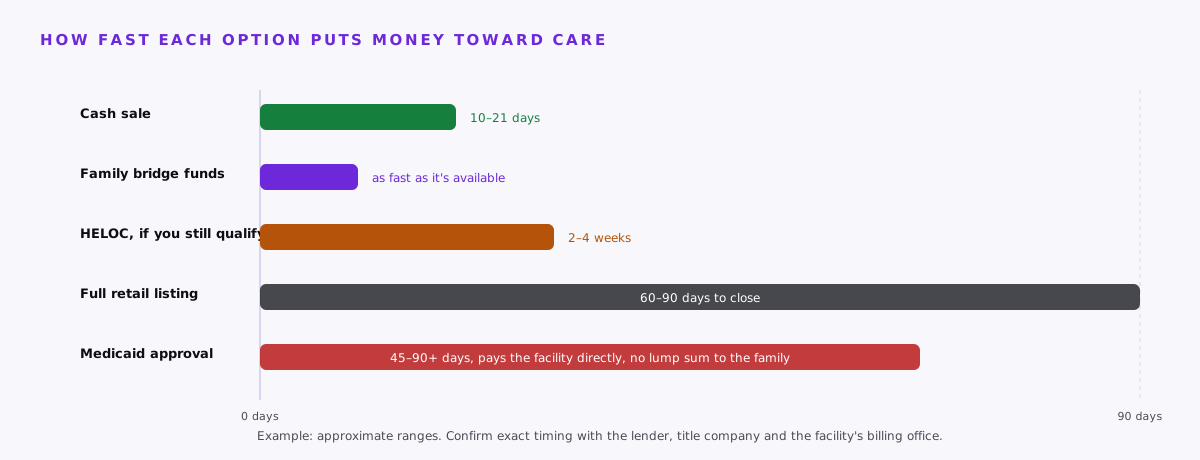
If a parent or spouse needs a care facility now and nobody has cash on hand, a fast sale is usually the most reliable way to fund it, but it is rarely the only option and not always the cheapest one. A HELOC, if the homeowner still qualifies, can buy time to list the house properly instead. Selling outright trades a lower net for speed and certainty.
This is educational information, not legal, tax or financial advice. Medicaid, reverse mortgage and power-of-attorney rules vary by state and by situation. Talk to an elder law attorney or a HUD-approved housing counselor before deciding.
Most families do not start thinking about how to pay for a nursing home or assisted living community until a hospital discharge planner says the person cannot go home, or until a fall, a stroke, or a dementia diagnosis makes staying home unsafe. At that point, the facility usually wants a deposit and the first month's rent before move-in, and automatic payment every month after.
A traditional listing is not built for that pace. Getting a house market-ready after someone has lived in it for twenty or thirty years, listing it, waiting for offers, and closing on a financed buyer's timeline typically runs 60 to 90 days, sometimes longer if the house needs real repairs first. Care facilities do not usually hold a bed open that long on a promise that a house is under contract.
That gap is the actual problem. The house is almost always worth more than enough to cover the first year or more of care. The question is whether the family can get to that money before the facility's patience, or the family's savings, runs out.
According to the 2024 Genworth/CareScout Cost of Care Survey, the most recent nationwide survey of long-term care providers, published March 2025, the median U.S. costs are:
These are national medians. Costs in a given metro can run 20 to 40% above or below that depending on the state, the city, and the level of care. A family in a high-cost market should expect the upper end; a family in a lower-cost state or a rural area may see meaningfully less. Either way, a year of private-pay nursing home care is often close to what an average U.S. house is worth in equity, which is why so many families end up looking at the house as the funding source.
Selling is not the only way to turn home equity into care money, and it should not be the first option considered without ruling out the others.
A home equity loan or HELOC. If the homeowner, not just an adult child, still qualifies based on income or has a co-signer, borrowing against the equity can cover several months of care while a house is listed and marketed properly instead of rushed to a cash sale. This only works if someone can still qualify for the loan and keep up the payments, which is often the catch once a person has moved into full-time care.
A reverse mortgage already in place. If the homeowner already has a HECM reverse mortgage, moving into a nursing home or assisted living permanently is one of the events that can trigger the loan coming due, not a new source of funds. A reverse mortgage already on the house changes the sale math; see selling a house with a reverse mortgage for how the 95% HECM protection affects proceeds at closing.
Renting the house out. If there is no urgency to liquidate and a family member can manage a tenant, renting can produce monthly income to help cover care costs while keeping the house as an asset. This takes management, carries landlord liability, and only helps if the rent covers the mortgage, taxes, and insurance with room left over for care costs. See should I rent or sell my house for the full comparison.
Long-term care insurance. If the person has a policy, it may cover part or all of the monthly cost, which changes the whole calculation. Check this before assuming the house has to fund everything.
Family contribution or a short-term bridge loan from relatives. Sometimes a family can cover the first few months out of pocket while a house sells properly, recovering the advance at closing.
Medicaid, eventually. Medicaid can pay for nursing home care once someone qualifies, but qualifying usually requires spending down most non-exempt assets first, and transfers of the house during the look-back period, set nationwide at 60 months by the Deficit Reduction Act of 2005, can trigger a penalty period if not handled correctly. This is a different track than selling to pay privately right now, and the two can conflict. See selling a house during the Medicaid look-back period before assuming Medicaid will backstop a sale.
Example: A family needs to fund a parent's assisted living move within three weeks and has no other source of cash. The house is worth about $280,000 fully repaired and listed, but it needs roughly $25,000 in updates and repairs to show well and compete on the open market.
Listing it: sale price $280,000, minus a 6% agent commission ($16,800), minus the $25,000 in repairs, minus about $1,500 in holding costs (insurance, utilities, taxes) across a 75 to 90 day marketing and closing period, minus roughly $3,000 to clean out and stage the house. Net to the family: around $233,700, arriving in roughly three months, after someone manages contractors, showings, and a financed buyer's underwriting timeline.
A cash offer on the house as-is, based on the same $280,000 value minus the $25,000 repair estimate and a buyer's margin, might land closer to $220,000 to $230,000, with no commission, no repair bills, and a close in 10 to 21 days instead of three months.
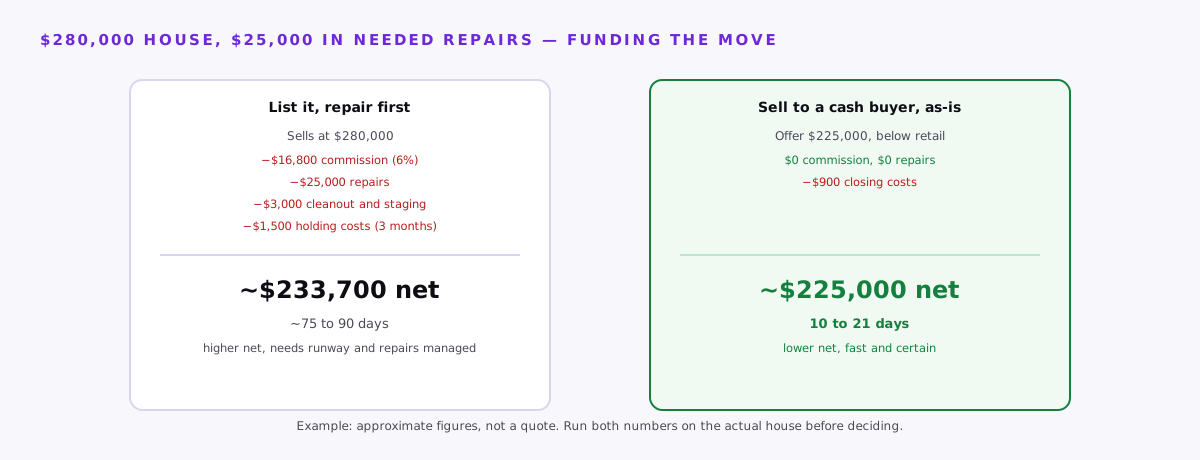
The math is not always close. In a market with more buyer competition or a house in better condition, a listing can clear noticeably more than a cash offer, sometimes by $20,000 or more, and if the family has a few months of runway, that gap is worth a conversation before deciding. If the money is needed in two to three weeks and there is no bridge financing available, the certainty and speed of a cash sale usually wins even though the net number is lower. Either way, run both numbers before committing, not after.
Many homes end up in a parent's name alone, held in a revocable trust, or requiring someone to act under a power of attorney once the parent can no longer manage their own affairs. Each of those changes what paperwork is needed before a sale can close, not just the financial math. See selling a house held in a trust and selling a parent's house with power of attorney for what to have ready before a title company will close.
If a parent or spouse needs to move into care and the house is the only real source of funds, the fastest useful thing we can do is give you a written number within 24 hours so you can compare it against what a listing would realistically net after commission, repairs and a few months of carrying costs.
We buy as-is, cover standard closing costs, and let you pick the closing date, often 10 to 21 days out. If the math says listing nets meaningfully more and there is time for that, we will tell you so. Send us the property here.
All guides · Medicaid look-back period · Selling a house with a reverse mortgage
Step 1 of 5
No obligation, no fees, no repairs. We respond the same day.
You’ll talk to Trevor McAmis, Owner & Acquisitions Lead
(313) 710-6129
Takes about two minutes. Your address is never shared.
