Every market page publishes the numbers behind its offer. See the math
Home › Guides › Selling a House Held in a Trust: A Trustee's Guide
Guide
Selling a House Held in a Trust: A Trustee's Guide
Selling a house held in a trust is usually easier than selling one stuck in probate, which is the whole point of the trust. But it comes with something probate does not: you are personally on the hook. A trustee who sells too cheaply, too quickly, or without documenting why can be made to pay the difference out of their own pocket. This page covers the authority you have to prove, the duty you owe, and how to protect yourself if a cash sale genuinely is the right answer.
Takes about two minutes. Or call
(313) 710-6129 — we answer.
Educational only. This explains how these situations generally work. It is not legal, tax or financial advice, and the rules differ by state — talk to an attorney or CPA about your own situation before you act on any of it.
Selling a house held in a trust: the short answer
If the deed is in the trust's name and the trust gives the trustee power to sell, you can sell without probate. You will need to prove your authority to the title company, and you owe the beneficiaries a duty to get a defensible price, which means documenting how you arrived at it.
This is educational information about how trust sales generally work. It is not legal or tax advice, and trust law varies significantly by state. Talk to an estate attorney and a CPA about your specific trust before you sign anything — the personal exposure described on this page is a real reason to spend that money.
First: is the house actually in the trust?
This is the single most common and most expensive surprise, and it is worth checking before you do anything else. Creating a trust does not move assets into it. Someone has to sign a deed transferring the property to the trust, and record it. Plenty of people set up a trust with an attorney, never got round to deeding the house across, and died believing it was handled.
Pull the recorded deed from your county recorder or register of deeds. Look at how the grantee is named. If it reads something like “Jane Doe, Trustee of the Doe Family Revocable Trust dated March 3, 2011,” the house is in the trust. If it reads “Jane Doe” or “Jane Doe and John Doe, husband and wife,” it is not, and the trust does not control it regardless of what the trust document says.
If it is not in the trust, you are dealing with an estate rather than a trust sale, and probate or a small-estate procedure may be required. Our guides on selling an inherited house and when heirs cannot agree to sell cover that route.
Proving you have authority to sign
The title company will not insure the sale until it is satisfied you can legally convey the property. What it wants depends on the situation, but it generally comes down to three things.
The trust instrument, or a certification of trust. Most states permit a short certification — a summary confirming the trust exists, who the current trustee is, and that the trustee has power to sell — instead of handing over the entire document. This is worth using. The full trust reveals who inherits what, and that is nobody's business at a closing table.
Evidence you are the acting trustee. If you are the successor trustee stepping in after a death, that means a certified death certificate for the prior trustee plus whatever the trust requires to confirm your appointment. Some trusts require a physician's certification if a trustee stepped down due to incapacity rather than death.
Confirmation the power to sell exists. Almost every well-drafted trust grants it, but some restrict it — requiring beneficiary consent, or barring sale of a specific property for a period. Read the instrument. Do not assume.
Selling a house held in a trust stalls at the title company more often than anywhere else, so send this package over at the start, not the week of closing. Title review of trust documents routinely surfaces problems — a missing successor appointment, an ambiguous power clause, a trust amendment nobody mentioned — and each takes time to fix. Sorting it out during the option period is inconvenient; discovering it three days before closing costs you the buyer.
The part nobody tells trustees: you are personally exposed
A trustee is a fiduciary. You are handling somebody else's property for their benefit, and that carries duties enforceable against you personally — loyalty to the beneficiaries, prudent administration, impartiality between beneficiaries, and keeping records. The Consumer Financial Protection Bureau publishes plain-language guides for people in exactly this position, including one written for trustees under revocable living trusts.
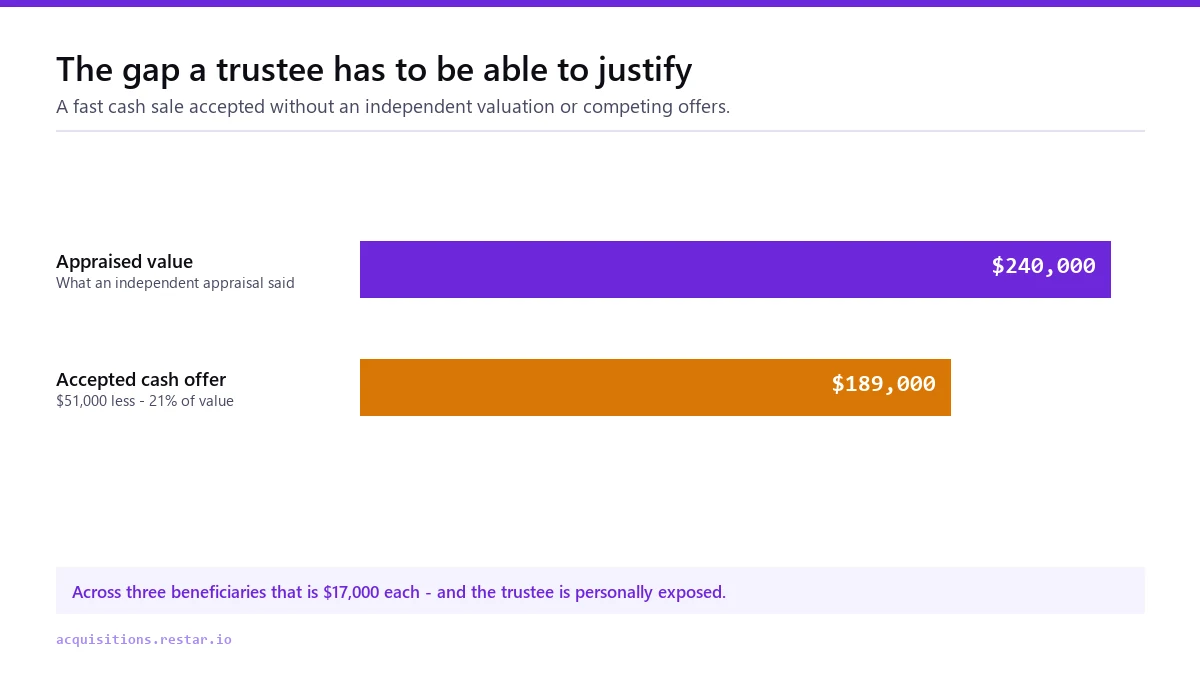
Here is where it collides with a fast sale. Suppose the house appraises at $240,000 and you accept a cash offer of $189,000 because you want it done. That is a $51,000 gap — about 21% of value. If there are three beneficiaries and one of them later objects, they are pointing at $17,000 each that they say your decision cost them.
The gap a trustee has to be able to justifyRestar Acquisitions · worked example from this page
A worked illustration on one hypothetical trust. Not a quote, not legal advice, and not a prediction about any specific dispute.
The important nuance: a below-appraisal sale is not automatically a breach. An appraisal assumes a repaired house and a normal marketing period. If the house needs $38,000 of work the trust has no cash to fund, if it is sitting vacant and burning $900 a month, if a beneficiary is living in it rent-free and refusing to cooperate — then a lower price obtained quickly may genuinely be the prudent decision. Fiduciary duty is about process, not about achieving the highest theoretical number.
What gets trustees into trouble is not the price. It is the absence of any record showing how they arrived at it.
How to document a cash sale so it holds up
If you conclude a fast cash sale is right for the trust, do these five things. They cost very little and they convert a decision that looks arbitrary into one that looks reasoned.
Get an independent valuation. An appraisal is strongest; a broker price opinion from an agent with no stake in the sale is usually enough. Not a valuation from the party buying the house.
Get more than one offer. One offer is a decision you cannot defend. Three offers is a market test. This is the single highest-value thing on the list.
Write down the reasoning. A one-page memo to the trust file: condition, repair estimates, carrying costs, offers received, why you chose this one. Written at the time, not reconstructed afterwards.
Notify the beneficiaries in writing, in advance. Tell them the price, the buyer, and why. Many states require notice; more importantly, a beneficiary who was told and said nothing is in a far weaker position than one who found out at distribution.
Get written consent where you can. A signed consent from adult beneficiaries is close to decisive. Where a beneficiary is a minor, unborn, or refuses, ask your attorney about a court instruction — some states let a trustee ask a court to approve the sale in advance.
None of this stops you selling quickly. A broker price opinion takes a few days, and getting three offers takes a week. Against personal liability for a five-figure gap, that is cheap insurance.
The tax side is usually better than trustees fear
One genuine piece of good news. Property that was in a revocable living trust and is included in the deceased person's gross estate generally receives a basis adjustment to its fair market value at the date of death, under 26 U.S.C. § 1014. In practice that means a house sold reasonably soon after the death often produces little or no taxable gain, because the basis has been reset to roughly what it is now worth.
That is the general rule for revocable trusts. Irrevocable trusts are a different animal and the answer depends on how the trust was structured and whether the property was includible in the estate — some irrevocable structures deliberately trade the basis step-up for other benefits. The IRS's Publication 559 covers the ground for survivors, executors and administrators. Do not guess at which category your trust falls into; ask the CPA, because the difference can be tens of thousands of dollars.
For most trustees with a house in reasonable condition, the honest answer is the boring one: list it with an agent. A trust sale does not need probate court approval in most states, you are not on anybody's clock, and the open market will pay more than a cash buyer will — ours included. The trust structure exists precisely so you can take the normal route without the delay probate would impose.
A cash sale earns its place when the trust has no liquidity to fund repairs or carrying costs, when the house is deteriorating or vacant and exposed, when a co-trustee or occupying beneficiary is making a listing impractical, or when the trust needs to close and distribute against a real deadline. In those cases document it as described above, and the speed is defensible.
Alternatives to consider
List it with an agent — the default, and the highest-net route whenever the house is saleable and the trust can carry it for a few months.
Distribute the house to the beneficiaries instead of selling — if they all want it and the trust permits it, deeding it out and letting them decide avoids the whole question. Ask the attorney about basis and any transfer tax first.
Have one beneficiary buy out the others — common where someone wants to keep a family home. Needs an independent valuation to be fair to everyone.
Rent it out — if the trust permits and there is no rush, this can carry the property while the market improves. It also makes you a landlord, with everything that entails.
Ask the court for instructions — slow, but where beneficiaries are in conflict it converts your personal risk into a court's decision.
Sell as-is for cash — right when the trust lacks the money or the time to do anything else, documented as described above.
Common questions
Can a trustee sell a house without going through probate?
Generally yes. That is the main reason people put a house in a trust. If the deed is in the trust's name and the instrument grants the trustee power to sell, the sale proceeds without probate, though the title company will require proof of the trustee's authority before insuring it.
What documents does a title company need for a trust sale?
Usually a certification of trust or the trust instrument itself, proof that you are the acting trustee (a certified death certificate for a deceased prior trustee, plus any appointment documents), and confirmation the trust grants the power to sell. Send these at the start of the transaction, not the week of closing.
Can a trustee be sued for selling a house too cheaply?
Yes. A trustee is a fiduciary and can be personally liable to beneficiaries for a breach of duty. A below-market price is not automatically a breach if the circumstances justified it, but a trustee with no independent valuation, no competing offers, and no written reasoning is in a much weaker position than one who documented the decision.
What if the house was never actually transferred into the trust?
Then the trust does not control it, whatever the trust document says. Check the recorded deed and see how the grantee is named. If the house is still in the individual's name, you are dealing with an estate, and probate or a small-estate procedure may be required to sell it.
Do beneficiaries have to agree to the sale?
It depends on the trust. Many grant the trustee power to sell without consent, but some require it, and some states require advance notice to beneficiaries regardless. Even where consent is not legally required, obtaining it in writing substantially reduces your personal exposure, so it is usually worth asking for.
Will the trust owe capital gains tax on the sale?
Often very little, if it is a revocable trust and the property was included in the deceased person's gross estate, because the basis is generally adjusted to the date-of-death fair market value. Irrevocable trusts vary considerably depending on how they were structured, so confirm the treatment of your specific trust with a CPA.
If you are a trustee weighing a cash sale, one thing we can do that helps you regardless of who you sell to is put our number in writing, with the reasoning behind it, so it sits in the trust file as evidence of what you considered.
Send us the property here. And get a broker price opinion as well — the point of this page is that one offer is not enough to protect you.
Every offer on this site is underwritten by a person, not a form. If the
numbers do not work for you, say so and I will tell you what would.
Also from Restar
Want the data behind all of this?
Restar Acquisitions is the acquisitions arm of Restar — a housing-market analytics
platform tracking 180+ metrics across every U.S. market, with composite scores and 12-month
price forecasts. The numbers on this page come from the same work.