Every market page publishes the numbers behind its offer. See the math
Home › Guides › Selling a Parent's House With Power of Attorney
Guide
Selling a Parent's House With Power of Attorney
An adult child managing an aging parent's affairs usually finds out the hard way that not every power of attorney actually works when it's needed most. The type of document, when it was written, and whether it's been recorded can decide whether you can list the house next month or spend months in court first.
Tell us what document you have and where things stand. We'll tell you honestly whether it's enough to sell, or what the next step looks like if it isn't.
Takes about two minutes. Or call
(313) 710-6129 — we answer.
Educational only. This explains how these situations generally work. It is not legal, tax or financial advice, and the rules differ by state — talk to an attorney or CPA about your own situation before you act on any of it.
Selling a parent's house with power of attorney: the short answer
You can sell a parent's house under a power of attorney only if it's durable and covers real estate — a standard POA becomes void once your parent can no longer decide for themselves. Without a valid POA, the family generally has to petition for guardianship instead, which is slower, costlier, and still needs a judge to approve the sale.
This is educational information, not legal advice. Power of attorney law, recording requirements, and guardianship procedure are set by each state — confirm your specific document and situation with an elder law or estate attorney.
Not every power of attorney survives incapacity
A power of attorney is only as useful as its timing. There are three distinctions worth knowing before you assume a document will work.
Durable vs. non-durable. A "durable" POA is written to remain valid after the person who signed it (the principal) becomes incapacitated. A standard, non-durable POA automatically terminates at the exact moment it's needed most — the whole point of an elder-care POA is that it's durable.
Immediately effective vs. "springing." An immediately-effective durable POA works as soon as it's signed. A "springing" POA only activates once a defined triggering event occurs, typically a physician's written certification of incapacity — which means at the moment your parent can no longer sign, you first have to get a doctor's letter before the agent's authority even begins. Estate attorneys commonly recommend an immediately-effective durable POA over a springing one for exactly this reason.
General authority vs. real-estate authority. The document has to expressly authorize the agent to buy, sell, or otherwise deal with real property — broad "handle my affairs" language isn't always enough for a title company to rely on.
If your parent already has a POA, the first step is confirming it's durable, already effective (not springing), and specifically covers real estate — not assuming that any POA in a drawer will do the job.
Recording the POA is often required before the deed can close
Real estate law and title insurance practice vary by state, but in many states the POA document itself — not just the deed it authorizes — has to be recorded in the county land records, often at or before the closing, for the sale to be valid and insurable. Even in states where recording isn't strictly mandated by statute, title companies routinely refuse to close or insure a POA-based sale unless the document is on file with the county recorder, because recording puts the transaction on public notice.
Title companies and lenders also commonly add their own overlay requirements on top of state law — for example, many prefer a POA that was executed relatively recently and reserve the right to have their own counsel review it or request an affidavit confirming it's still in force. These are underwriting practices that vary by company, not a fixed legal deadline, but they can add real delay if you don't find out about them until you're already under contract.
If there's no valid POA and your parent is incapacitated
Without a durable POA that covers real estate, the family generally cannot sell the house directly. The path instead runs through the probate or family court system.
Petition for guardianship or conservatorship over the incapacitated parent (terminology varies by state) — this appoints someone with legal authority to manage their affairs, including property.
Petition the court to approve the sale itself. In most states, a guardian or conservator can't simply list and sell the ward's real property on their own judgment — a separate court filing, often with an independent appraisal, is required, and a judge has to approve the price and terms before closing.
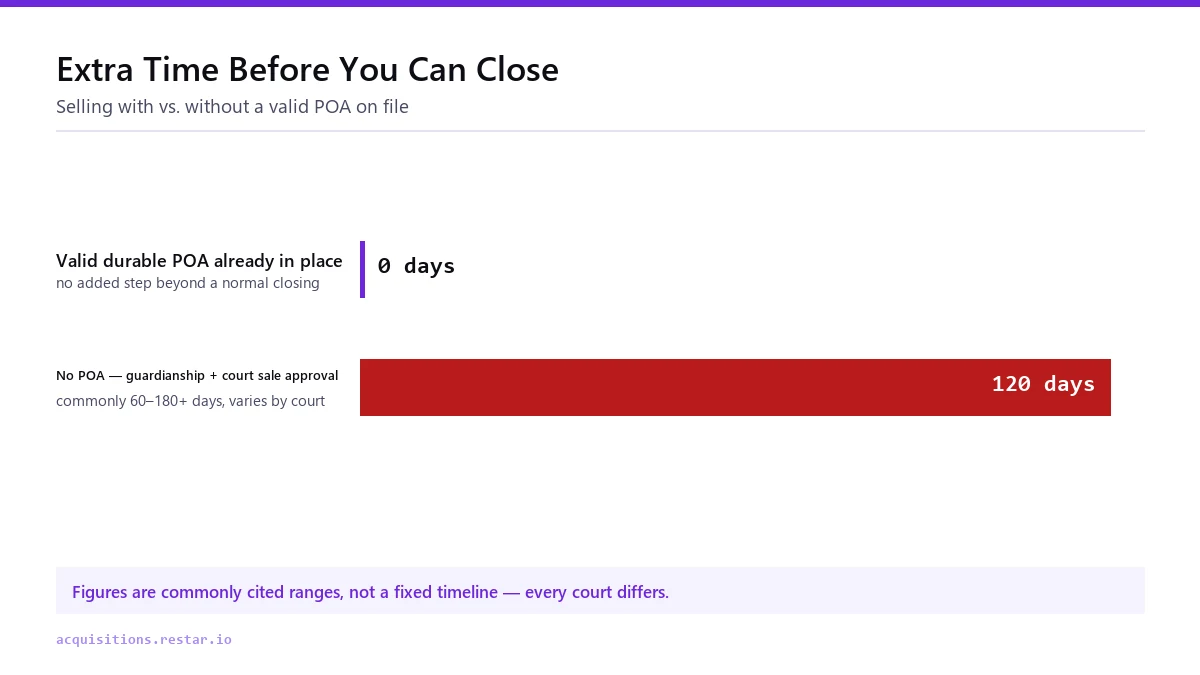
Both steps add attorneys, court filings, and time that a valid POA would have avoided entirely. This is the practical reason estate attorneys push families to set up a durable POA, and a healthcare directive alongside it, well before a health crisis, not after.
Extra time before you can closeRestar Acquisitions · commonly cited ranges, not a fixed timeline — every court differs.
The agent's duty doesn't disappear because it's family
Acting under a POA doesn't give the agent free rein, even when the agent is an adult child acting in good faith. Under most states' power of attorney statutes — Virginia's is one example — the agent is a fiduciary who must act in the principal's best interest and within the scope the document actually grants, avoid self-dealing, and remain accountable to other family members or beneficiaries who generally have standing to challenge a transaction that looks like it favored the agent over the principal.
None of this is unique to elder-care situations, but it matters more here because siblings and other heirs are often watching the same transaction closely, sometimes after the fact.
One more thing worth knowing: the POA dies with the principal
A power of attorney — durable or not — automatically ends the moment the principal dies. If your parent passes away mid-transaction, the agent's authority ends immediately, and whoever is going to sell the house next needs to be appointed executor or administrator through probate. A POA is a tool for managing a living parent's affairs; it is not a substitute for an estate plan once they're gone.
The honest tradeoff once you're actually able to sell
Whether you're selling under a POA or after a guardianship is approved, the same math applies to how you sell. Listing with an agent typically nets more once you subtract commission and closing costs, but it takes longer and usually requires repairs that an aging or vacant house may need — money and time a family managing someone else's affairs may not want to spend. A cash sale closes faster, as-is, without needing court-supervised repair decisions or a long marketing period, but it prices in that speed and skips the retail premium a prepared listing could bring. If the guardianship court requires an appraisal-backed sale price regardless of how you sell, get that number before comparing offers, so you're comparing both paths against the same baseline.
Common questions
Can any power of attorney be used to sell a house?
No. It has to be a "durable" power of attorney that survives incapacity and explicitly grants authority over real estate. A standard, non-durable POA becomes void the moment the principal is incapacitated — exactly when it's usually needed.
What's the difference between a durable and a springing power of attorney?
A durable POA that's immediately effective works as soon as it's signed. A "springing" POA only takes effect once a specific triggering event happens, typically a doctor certifying incapacity, which can delay things right when you need to act.
What happens if my parent becomes incapacitated with no power of attorney in place?
The family generally has to petition the court for guardianship or conservatorship, and in most states, the court must also separately approve the actual terms of any real estate sale — both steps add time and legal cost that a valid POA would have avoided.
Does the power of attorney need to be recorded before closing?
In many states, yes — title companies typically require the POA document itself to be recorded in the county land records, at or before the deed, before they'll insure the sale.
Can I sell my parent's house to myself or another family member under a POA?
Only with real caution. As the agent, you have a fiduciary duty to avoid self-dealing. Selling to yourself or a relative below fair market value without an independent appraisal and full disclosure to other heirs can expose you to legal liability.
Does the power of attorney still work after my parent dies?
No. A power of attorney automatically ends at death. Authority to deal with the property then passes to the personal representative appointed through probate, not to the former agent.
Already have the authority to sell? We can make the closing itself simple
If you're acting under a valid power of attorney, or the court has already approved a sale, we can give you a straightforward cash offer and close on the timeline the situation actually needs — no repairs, no open-house months while you're also managing everything else. Send us the address and we'll tell you honestly what the numbers look like next to a traditional listing.
Every offer on this site is underwritten by a person, not a form. If the
numbers do not work for you, say so and I will tell you what would.
Also from Restar
Want the data behind all of this?
Restar Acquisitions is the acquisitions arm of Restar — a housing-market analytics
platform tracking 180+ metrics across every U.S. market, with composite scores and 12-month
price forecasts. The numbers on this page come from the same work.