Selling a house during the Medicaid look-back period is generally safe for eligibility if you sell for a real, defensible fair market value — converting a house into cash isn't a gift. Selling below market value or gifting the house is a penalized transfer that can trigger months of Medicaid ineligibility. Talk to an elder law attorney before either move. This article is about the pre-death situation: an aging parent or spouse who is applying for or anticipating Medicaid long-term-care coverage and is weighing whether to sell the family home before or during that process. It is not about what happens after a Medicaid recipient has already died — that's estate recovery, a different set of rules covered in our guide to <a href="/guides/medicaid-estate-recovery-selling-the-house/">Medicaid estate recovery when selling the house</a>.
Step 1 of 5
Talk to an elder law attorney first. If selling turns out to be the right move, we can give a written fair-market offer within 24 hours.
You’ll talk to Trevor McAmis, Owner & Acquisitions Lead
(313) 710-6129
Takes about two minutes. Or call (313) 710-6129 — we answer.
Educational only. This explains how these situations generally work. It is not legal, tax or financial advice, and the rules differ by state — talk to an attorney or CPA about your own situation before you act on any of it.
This is educational only and is not legal or financial advice. Medicaid rules vary significantly by state and change over time. Talk to an elder law attorney about your state's specific rules and your family's situation before selling, gifting, or transferring a house anywhere near a Medicaid application.
Medicaid's look-back period exists to catch people who give away assets right before applying for benefits, so the government isn't asked to pay for care while family members keep the house. The rule only cares about transfers for less than fair market value — gifts, in effect. A sale is not automatically one of those.
When you sell a house at a price a willing, arm's-length buyer would actually pay, you haven't reduced your assets — you've converted one asset (the house) into another asset of equal value (cash). Federal Medicaid guidance on transfer-of-assets rules treats this distinction as the whole ballgame: it's the below-value gap between what an asset is worth and what was actually received that gets penalized, not the act of selling itself. Sell a $200,000 house for $200,000 in cash, and there's no transfer-of-assets problem, even if the sale happens the week before a Medicaid application is filed.
In 49 states and Washington, D.C., Medicaid's look-back period as of 2026 runs 60 months — five years — before the month someone applies for long-term-care Medicaid while institutionalized. New York's Department of Health, for example, confirms the review window runs “the 60-month period immediately preceding the month of institutionalization and application for Medicaid.” Any transfer for less than fair value inside that window can trigger a penalty period of ineligibility, calculated by dividing the uncompensated value given away by the average monthly private-pay cost of nursing home care in that state.
California is the outlier, and it's currently mid-transition, which makes it a genuinely bad state to guess about. California eliminated its Medi-Cal asset limit effective January 1, 2024, and transfers made from January 1, 2024 through December 31, 2025 are permanently excluded from look-back scrutiny — those two years are simply not reviewable. California then reinstated the asset limit on January 1, 2026 ($130,000 for an individual, per 2022-level figures) and resumed a look-back period, but only for transfers made on or after that date; per CANHR's 2026 asset-limit reinstatement guidance, that look-back window is still ramping up month by month toward a full 30 months by mid-2028, not a full 30 months retroactively. If your family is in California, this is exactly the kind of detail an elder law attorney needs to confirm against the current date.
Selling a house at true fair market value during the look-back period is not a penalized transfer, because the asset simply changes form from a house to cash of equal value. Selling below that value, or gifting the house to family, is treated as an uncompensated transfer of the shortfall and can trigger months of Medicaid ineligibility. The gap between those two outcomes comes down entirely to whether the sale price reflects real market value.
Sell at fair market value: the house becomes cash of equivalent value — not a penalized transfer, regardless of when it happens relative to a Medicaid application. Sell below market value, or gift the house outright: the difference between what the house was worth and what was received (or the full value, if it's a gift) is treated as an uncompensated transfer, creating a penalty period — a stretch of months where Medicaid won't pay for nursing home care, even though the person now qualifies financially.
This is where well-meaning families get hurt. Selling the house cheap to a relative “to get Mom under the asset limit faster” is precisely the move that backfires — it doesn't speed up eligibility, it delays it by manufacturing a penalty period on top of everything else. Any cash offer, from us or anyone else, needs to be backed by a real fair-market valuation — comparable sales, a broker opinion of value, or an appraisal — not a number picked to make the math convenient.
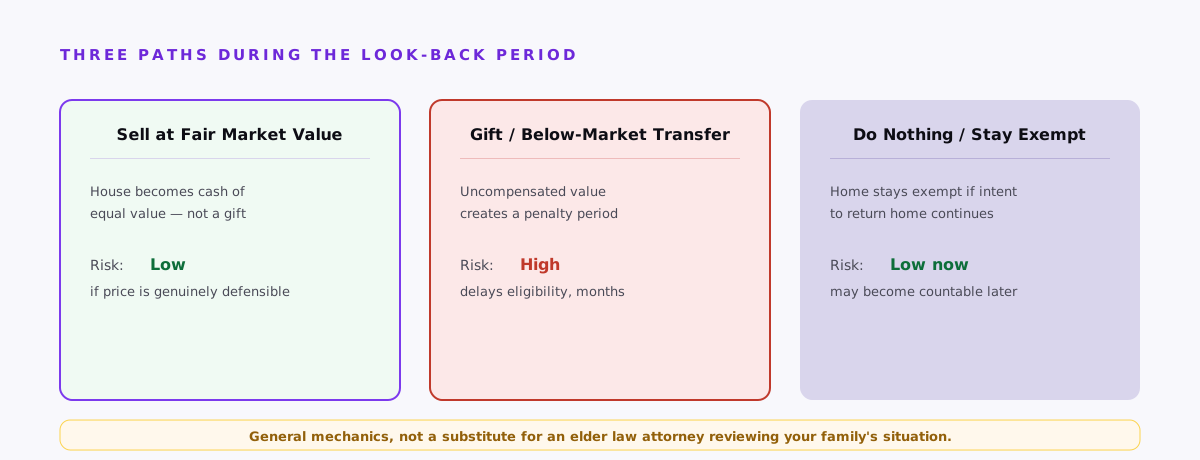
While the Medicaid applicant lives in the home, it's typically excluded from the countable asset limit (which is around $2,000 for an individual in most states) up to a state-set home equity limit. Federal rules set a floor for that equity limit that states can raise but not lower. Texas's Health and Human Services Commission, for one of our operating states, lists the current limit at $752,000, effective January 1, 2026 — confirm the exact figure for your state with a caseworker or elder law attorney, since it changes and varies by state. The home stays exempt without any equity cap at all if a spouse, a child under 21, or a blind or permanently disabled child of any age continues to live there.
The exemption doesn't disappear the day someone is admitted to a nursing home — it depends on intent to return home. If the applicant (or their representative) documents an intent to return, most states continue to treat the home as exempt regardless of how long the stay lasts, as long as no one has sold it and equity stays under the limit. Once that intent is dropped, or the state determines return is no longer realistic, the home can become a countable asset — and after the recipient's death, it can become subject to estate recovery, the separate, after-the-fact process covered in our Medicaid estate recovery guide.
Not every transfer during the look-back period is penalized. The federal rules carve out several exceptions, including a transfer to a spouse, a transfer to a blind or permanently disabled child of any age, and the caregiver child exemption: a biological or legally adopted adult child who lived in the parent's home for at least two years immediately before the parent's institutionalization, and who during that time provided care that delayed the parent's need for a nursing home, can receive the home without triggering a penalty.
This one requires real documentation — medical records, a caregiving log, proof of residency — and is exactly the kind of claim a Medicaid caseworker will scrutinize. Don't attempt it without an elder law attorney's help.
Selling at fair market value protects Medicaid eligibility either way — cash and retail sales can both qualify, as long as the price is defensible. The real tradeoff is what each path nets, and it deserves real arithmetic instead of a sales pitch.
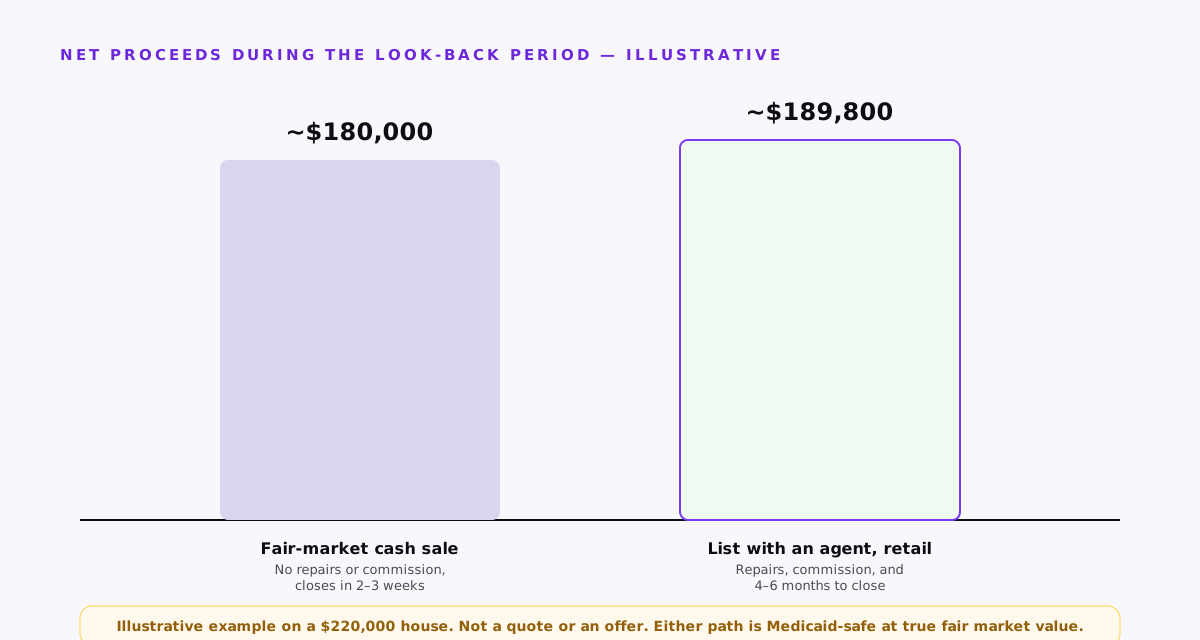
Illustrative example (a $220,000 house, not a quote or offer). Retail listing path: sale price after a few weeks on market $220,000, minus pre-listing repairs and cleanout $8,000, minus agent commissions (~6%) $13,200, minus closing costs and concessions $3,000, minus holding costs during a 4–5 month window $6,000 — net proceeds roughly $189,800, received in 4–6 months. Fair-market cash sale path: cash offer reflecting as-is condition, comparable sales, and no financing contingency $180,000, with no repairs, no commissions, no months of holding costs — net proceeds $180,000, received in 2–3 weeks.
In this example, retail nets about $9,800 more — a real gap, not nothing. But it comes with 4–6 months of uncertainty at exactly the moment a family is also managing a nursing home transition, a Medicaid application, and a parent's care needs. Neither number is universally “right.” What's not acceptable is taking a price so far below fair market value that it stops being a real sale and becomes the kind of below-value transfer that creates a Medicaid penalty period instead of solving anything.
This is the part families most often miss: the house was exempt. Cash is not. The moment the sale closes, the proceeds count toward the Medicaid asset limit — generally around $2,000 for an individual — unless they're spent down properly on exempt purposes (paying down debt, prepaying funeral expenses, home modifications for a spouse who still lives somewhere, medical care) or restructured through a Medicaid-compliant strategy an elder law attorney sets up, such as a properly drafted annuity or promissory note. Selling the house without a spend-down plan already in place can create a cash-asset eligibility problem on day one, even though the sale itself was never a penalized transfer.
Talk to an elder law attorney first. Before any sale, gift, or transfer, this is the step that actually protects the family. A Medicaid-compliant annuity or promissory note strategy, set up by an elder law attorney, to convert sale proceeds into an exempt or protected form. The caregiver child exemption, if an adult child genuinely meets the two-year residency-and-care requirement. List retail with an agent, if the family can carry the home for several months and wants to capture the higher price shown above. Do nothing and let the home stay exempt, if the applicant still intends to return home and equity is under the state limit — selling isn't always necessary.
We're not Medicaid planners or elder law attorneys, and buying the house isn't itself a Medicaid strategy — but if an attorney confirms a fair-market sale is the right step, we can give a written cash offer within 24 hours, no repairs, no commissions.
All guides · Medicaid estate recovery when selling the house · Cash offer vs listing net proceeds · How cash home buyers calculate offers
Step 1 of 5
No obligation, no fees, no repairs. We respond the same day.
You’ll talk to Trevor McAmis, Owner & Acquisitions Lead
(313) 710-6129
Takes about two minutes. Or call (313) 710-6129 — we answer.
