The house is rarely the problem. When heirs cannot agree to sell, the disagreement is usually about something older than the property — who did the caretaking, who moved away, who was named executor. But the law does not resolve any of that. It offers one blunt instrument, called partition, and it is expensive enough that understanding it is usually what persuades people to settle instead.

Step 1 of 5
Send the address. We will tell you what it is worth and what the routes actually net.
You’ll talk to Trevor McAmis, Owner & Acquisitions Lead
(313) 710-6129
Takes about two minutes. Or call (313) 710-6129 — we answer.
Educational only. This explains how these situations generally work. It is not legal, tax or financial advice, and the rules differ by state — talk to an attorney or CPA about your own situation before you act on any of it.
Any co-owner can force a sale of the whole property through a partition action, and no co-owner can be made to sell voluntarily. A court will order the property divided or sold. It will not order an heir to accept a deal. That single fact shapes every negotiation that follows.
This is educational information, not legal advice. Talk to a probate or real estate attorney licensed in the state where the property sits, particularly before filing or responding to a partition action.
Two things co-owners commonly get wrong, in opposite directions:
So the holdout has less power than they think, and the seller has a costlier remedy than they think. Both facts point the same direction: when heirs cannot agree to sell, a negotiated outcome beats a litigated one by a wide margin, and the numbers further down this page say how wide.
When heirs cannot agree to sell, the cause is usually structural rather than a family failing. When someone dies without a will, state intestacy law divides the property into fractional shares among heirs — and then does it again in the next generation. A house owned by one grandparent becomes four siblings, then eleven cousins, each holding an undivided interest in the whole thing rather than a specific room or acre.
Property held this way is often called heirs property. Its defining features are that nobody has clear marketable title, nobody can refinance or borrow against it, and any one of the eleven can trigger a forced sale.
The first practical step is therefore not a real estate step. It is establishing who actually owns what, which usually means completing probate or an heirship determination. Our guide to selling an inherited house covers that sequence, and inheriting a house that is paid off covers the case where there is no mortgage to force the issue.
Until ownership is documented, no title company will insure a sale to anyone — including us. Sorting this out is not optional preparation. It is the thing that has to happen first.
A partition suit asks the court to end the co-ownership. Courts have two ways to do it.
Partition in kind physically divides the land among the owners. This works for acreage. It essentially never works for a single house on a single lot, because you cannot cut a three-bedroom ranch into quarters and leave four usable properties.
Partition by sale sells the property and divides the money. For a house, this is almost always what happens.
Historically, partition by sale meant a courthouse auction — a thin, poorly advertised sale to whoever showed up, routinely producing far below market value. That mechanism did enormous damage, and it is the reason the law was reformed.
Most states have now adopted a version of the Uniform Partition of Heirs Property Act, and it is the most important development in this area in decades. It applies where property is held in tenancy in common, no written agreement governs partition, and at least one cotenant inherited their share from a relative.
It creates four protections, in sequence:
That last point is the one that moves the most money. An open-market listing supervised by the court reaches ordinary buyers. A courthouse auction reaches a handful of speculators. The difference between those two prices, on the same house, is routinely tens of thousands of dollars.
Check whether your state has adopted it, and in what form. A majority have, but not all, and several states extended it to all partition actions rather than only inherited property. This is the first question for an attorney, because it determines whether the buyout right is available to you at all.
Four siblings inherit a house. Repaired it would be worth $190,000; as-is, needing about $16,000 of work, it is worth roughly $162,000. Three want to sell. One will not sign.
Route D below uses the four-term formula we publish in how cash home buyers calculate offers — $190,000 after-repair value, minus $16,000 of repairs, minus $19,950 of resale and holding costs, minus a $23,000 margin, or about $131,000.
These are worked illustrations on one hypothetical property, not a quote, not a prediction about your house, and not a fixed formula we apply.
| Route | Gross | Costs deducted | Net to estate | Per heir |
|---|---|---|---|---|
| A. Contested partition, courthouse auction | $118,000 | $24,000 legal & court | $94,000 | $23,500 |
| B. Partition under the heirs property act, open-market sale | $162,000 | $8,910 commission, $2,600 closing, $16,000 legal, $12,600 carry over 9 months | $121,890 | $30,473 |
| C. Heirs agree, repair and list | $190,000 | $16,000 repairs, $10,450 commission, $3,200 closing, $7,000 carry, $2,500 concessions | $150,850 | $37,713 |
| D. Heirs agree, sell as-is for cash | $131,000 | $1,000 carry; we cover standard closing costs | $130,000 | $32,500 |
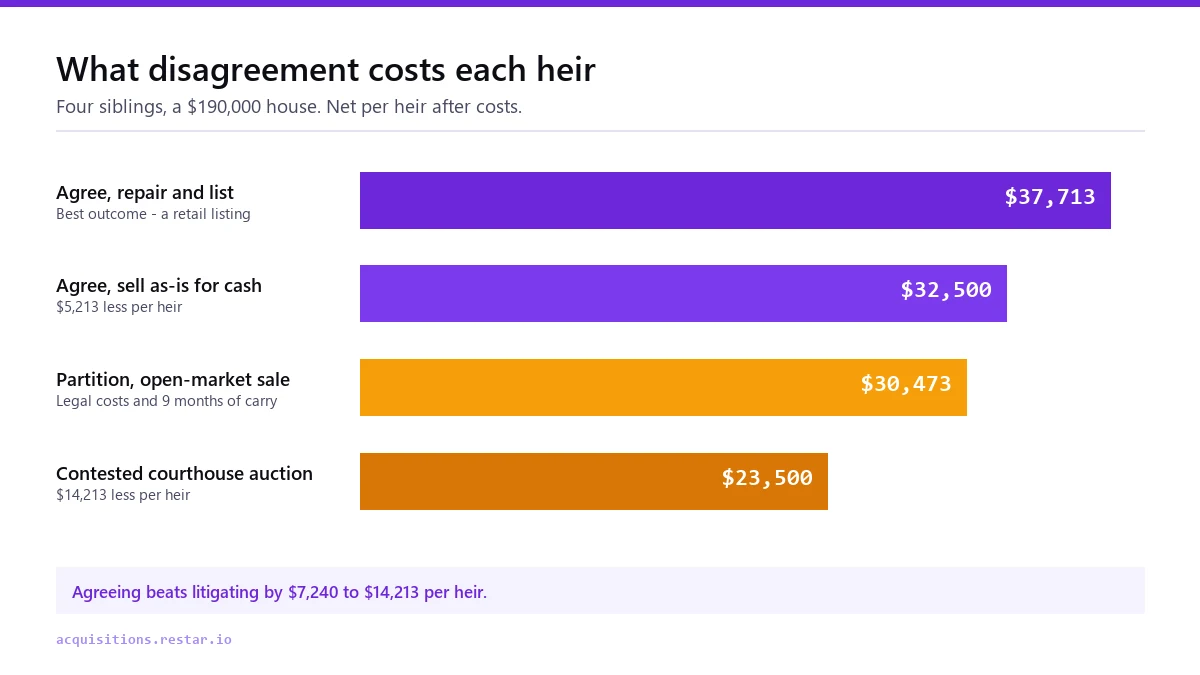
Read the two ends of that table together.
Route C is the best outcome by a clear margin, and it is a retail listing. If the four of you can agree and someone can front $16,000 for repairs, list the house with an agent. That nets $37,713 each and beats our own offer by $5,213 a head — more than $20,000 across the family. We publish that because it is true, and because people deciding this deserve the real comparison rather than a sales pitch.
Route D is $5,213 per heir behind C, and that gap is what a cash sale costs you. It buys no repair bill, no showings, no four-way argument about contractors and a closing in weeks. If the estate has $16,000 and the patience for a five-month project, Route C is plainly better and you should take it.
But notice that Route D still beats Route B by $2,027 a head. Simply agreeing to a discounted cash sale nets each heir more than a court-supervised open-market sale under the heirs property act — even though that route sells the house for $31,000 more. The $16,000 of legal costs and nine months of carrying costs consume the difference and then some. Litigation is expensive enough to turn a better sale price into a worse outcome.
Route A destroys $14,213 per heir against Route C. Across four siblings, a contested auction burns roughly $56,850 of family money — very nearly a third of the entire value of the house — and produces exactly the sale nobody wanted, at the worst available price, after a year of legal correspondence.
Even the reformed route costs $7,240 per heir. Route B is far better than a courthouse auction, and it is still $7,240 a head worse than agreeing. The heirs property acts limit the damage of litigation. They do not make litigation cheap.
One line in Route B is easy to overlook and worth naming: $12,600 of carrying costs over nine months. Taxes, insurance and utilities do not pause while a partition case runs, and the estate pays them out of the same pot everyone is arguing over. Our breakdown of what it costs to hold a vacant house works that figure out month by month.
There is a business model built on exactly this situation, and heirs should know its shape.
A speculator approaches the heir with the least money or the least interest — often one who lives out of state — and buys their fractional share for a small fraction of what it is worth. Having become a cotenant, the speculator immediately files for partition by sale. Under the old auction rules they would then buy the whole property cheaply at a sale nobody else attended, and the remaining family, who may have lived there for decades, would be left with a token share of a distressed price.
This caused generational loss of land, particularly among Black families in the rural South, and it is the documented history the Uniform Partition of Heirs Property Act was written to end.
The buyout right is the specific defence. When a cotenant demands a sale, the others may purchase that interest at appraised value. A speculator who paid a small sum for one heir's share can be bought out at the appraised value of that share and removed from the picture — which removes the profit from the strategy in the first place.
Two practical warnings follow. Do not sell your individual fractional interest to anyone without talking to an attorney first; you will get a fraction of a fraction, and you may hand your relatives a lawsuit. And be wary of anyone who approaches one heir privately with an offer for their share alone. A legitimate buyer wants to buy the whole property from all the owners, with a title company involved. We only buy where every owner of record signs.
In rough order of how often it works, here is what resolves things when heirs cannot agree to sell:
1. Establish the facts everyone is missing. Most of these disputes run on three unknowns: what the house is genuinely worth, what it costs to keep every month, and what each route nets after costs. Get an appraisal or a written offer, get the tax and insurance figures, and put a table like the one above in front of everyone. A surprising number of arguments end there, because the holdout was defending a number nobody had ever checked.
2. A buyout. The heir who wants to keep the house buys the others out, refinancing to fund it if the property will support a loan. Cleanest outcome available, and the one the statutory buyout right is designed to make possible.
3. A deadline everyone agrees to. List it for a defined period at an agreed price, with a written agreement that if it has not sold by a set date, the family accepts the best cash offer. This converts an open-ended argument into a decision with a date on it.
4. Mediation. Far cheaper than partition, and available through most probate courts. Where the real dispute is about caretaking or a parent's intentions, a mediator addresses it and a judge will not.
5. Partition, last. Sometimes it genuinely is necessary — an heir who cannot be located, or one who will not engage at all. File it knowing the numbers above, and ask your attorney about the heirs property act in your state before anything is filed.
If the property is in one of our markets, our Florida and Texas pages carry the local price data, and cash offer vs listing net proceeds works both routes line by line. If probate has not been opened yet, start with selling an inherited house.
For a plain-language explanation of the process from a neutral source, the Consumer Financial Protection Bureau's resources for older adults and their families cover inherited-property decisions without anyone trying to buy the house at the end of it.
If the heirs can reach agreement and someone can fund repairs, list the house with an agent. That is the highest-netting route in the worked example on this page, and we would say so before we said anything else.
What we can offer is often useful earlier than a sale: a written, no-obligation number on the property, with the comparable sales attached, usually within 24 hours. Several families have used ours simply as a neutral figure to argue from — a buyout price, or a floor to measure a listing against. Use it that way if it helps. Start at tell us about the property, or read selling an inherited house first.
All guides · Selling an inherited house · Inherited a property
Step 1 of 5
No obligation, no fees, no repairs. We respond the same day.
You’ll talk to Trevor McAmis, Owner & Acquisitions Lead
(313) 710-6129
Takes about two minutes. Or call (313) 710-6129 — we answer.