Selling a house in Florida runs on a set of rules that behave in opposite directions, and confusing them costs people money. Foreclosure here is slow, because a lender has to sue you and win. But once the sale happens there is essentially no way back — Florida gives no redemption period after the certificate of sale is filed. Add a brand-new flood disclosure obligation, a condo inspection regime that is repricing entire buildings, and an insurance market that decides which houses can be financed at all.

Step 1 of 5
Send the address and we will tell you what it is worth and what your options are.
You’ll talk to Trevor McAmis, Owner & Acquisitions Lead
(313) 710-6129
Takes about two minutes. Or call (313) 710-6129 — we answer.
Educational only. This explains how these situations generally work. It is not legal, tax or financial advice, and the rules differ by state — talk to an attorney or CPA about your own situation before you act on any of it.
Before the detail, the short version of what is different here.
This is educational information, not legal or tax advice. Talk to a Florida attorney or a CPA about your situation, particularly on foreclosure, probate, condominium or tax matters.
Foreclosure is judicial — the lender must sue and win, which takes months. There is no redemption after the sale, so the certificate of sale is an absolute deadline. Sellers must give a written flood disclosure under a law effective October 2024. And documentary stamp tax runs 70 cents per $100 — about $1,715 on a $245,000 house.
Each of those changes what you should do, and when. Taken together they mean the front half of a Florida problem is slower than sellers expect and the back half is far more final.
Florida is a judicial foreclosure state. Your lender cannot simply post a notice and sell the house; it must file a lawsuit, serve you, and obtain a judgment of foreclosure from a circuit judge. You are a defendant with a right to answer, raise defences, and be heard.
That takes time — commonly many months, and longer where the case is contested or the docket is busy. Compared with Georgia, where four weekly advertisements and a first-Tuesday sale can end the matter in about a month, Florida gives a homeowner substantially more room.
Then it slams shut. Under Florida Statutes section 45.0315, you may cure the debt and stop the sale at any time before the later of the clerk filing the certificate of sale or the deadline set in the judgment. The statute then says, in as many words, that otherwise there is no right of redemption.
Read that against a state like Michigan, where a homeowner generally has six months after the sheriff's sale to redeem. Florida has no equivalent. The instant that certificate is filed, the house is gone. There is no grace period, no buy-back window, and no second chance.
The practical consequence for anyone behind on payments: all of your options exist before the sale date and none exist after it. The extra months Florida's court process gives you are the whole of your opportunity, and they should be spent doing something rather than waiting to see what happens.
Federal servicing rules still apply first — a servicer generally cannot make a first foreclosure filing until you are more than 120 days delinquent, per the Consumer Financial Protection Bureau. Our foreclosure guide covers the sequence and the alternatives, including loan modification, forbearance and reinstatement.
If the foreclosure sale does not cover the debt, the lender may pursue you for the shortfall. Two Florida provisions limit that.
First, section 702.06 makes a deficiency decree discretionary with the court, and for owner-occupied residential property caps the amount at the difference between the judgment and the fair market value of the property on the date of sale. That matters because foreclosure sales frequently produce prices below market. Without the cap, a low auction bid would inflate what you owe; with it, the measure is what the house was actually worth.
Second, there is a hard clock. Under section 95.11 of the Florida Statutes, an action to enforce a deficiency claim on a note secured by a mortgage on residential property of one to four dwelling units must be brought within one year, running from the day after the clerk issues the certificate — or the day after the lender accepts a deed in lieu of foreclosure.
If you are being pursued for a deficiency on a Florida home, the first two questions for an attorney are when the certificate issued, and what the property was worth on the sale date. Both are frequently decisive.
This one catches sellers who last sold a house a few years ago, because it did not exist then.
Since 1 October 2024, Florida law has required a seller of residential real property to give the buyer a written flood disclosure at or before the time the sales contract is executed. It was expanded again by a 2025 amendment. In broad terms you must disclose what you know about flood damage during your ownership, any flood-related insurance claims you have filed — including claims under the National Flood Insurance Program — and any federal flood assistance you have received, such as FEMA aid.
Florida defines flooding broadly for this purpose: overflow of inland or tidal water, rapid accumulation of runoff or surface water, and sustained standing water from rainfall. That last limb reaches properties nobody would describe as coastal.
Selling as-is does not waive this. Nor does it waive Florida's older, judge-made rule that a seller of residential property must disclose known defects materially affecting value which are not readily observable. As-is governs who pays for repairs. It has never governed whether you must tell the truth about what you know.
The practical advice is unglamorous and it protects you: write down what you know, disclose it, and price accordingly. A disclosed flood history reduces your price. An undisclosed one is a lawsuit after closing, when the money has already been spent.
This is the single largest difference between selling a house in Florida and selling one almost anywhere else, and it is not a legal rule. It is a market condition.
A mortgage requires insurance. If a house cannot be insured, it cannot be financed, and if it cannot be financed the pool of buyers collapses to people paying cash. In Florida, insurability turns heavily on a handful of specifics:
This is why Florida produces a specific and unusual seller: someone with real equity, in a decent neighbourhood, whose house simply cannot be sold to a financed buyer because no carrier will write it. If that is you, the choice is to fund the roof and repairs yourself and reach the retail market, or to sell as-is at a discount to a cash buyer. Which of those nets more depends entirely on the size of the repair bill against the discount — our net-proceeds guide works exactly that comparison.
Florida's Department of Financial Services runs a consumer helpline and insurance guidance at the Division of Consumer Services, which is the neutral place to start before you accept a carrier's decision as final.
If you are selling a Florida condominium, this section may matter more than everything above combined.
After Surfside, Florida imposed two obligations on condominium associations: milestone structural inspections for buildings of three storeys or more at defined ages, and a Structural Integrity Reserve Study, which requires an association to determine and then actually fund reserves for major structural components. House Bill 913, effective 1 July 2025, adjusted the deadlines and consolidated the study into eight component categories with a $25,000 threshold.
The part that reaches sellers is the money. Associations that had waived or underfunded reserves for years can no longer do so for the covered components, and the shortfall arrives as special assessments — sometimes very large ones.
Three consequences when you sell:
Before you list a condo, get the association's current documents: the milestone inspection status, the reserve study, the budget, and any assessment under discussion. Selling a house in Florida is mostly a question about the house. Selling a condo is substantially a question about the association.
Florida's transfer tax is called documentary stamp tax. Per the Florida Department of Revenue, deeds are taxed at 70 cents per $100 of consideration in every county except Miami-Dade, which charges 60 cents per $100 plus a 45-cent surtax that does not apply to single-family dwellings. All parties to the document are liable, though in most of Florida the seller customarily pays it on the deed.
| Sale price | Doc stamps at $0.70 per $100 |
|---|---|
| $150,000 | $1,050 |
| $245,000 (our Jacksonville median) | $1,715 |
| $253,500 (our Lehigh Acres median) | $1,775 |
| $350,000 | $2,450 |
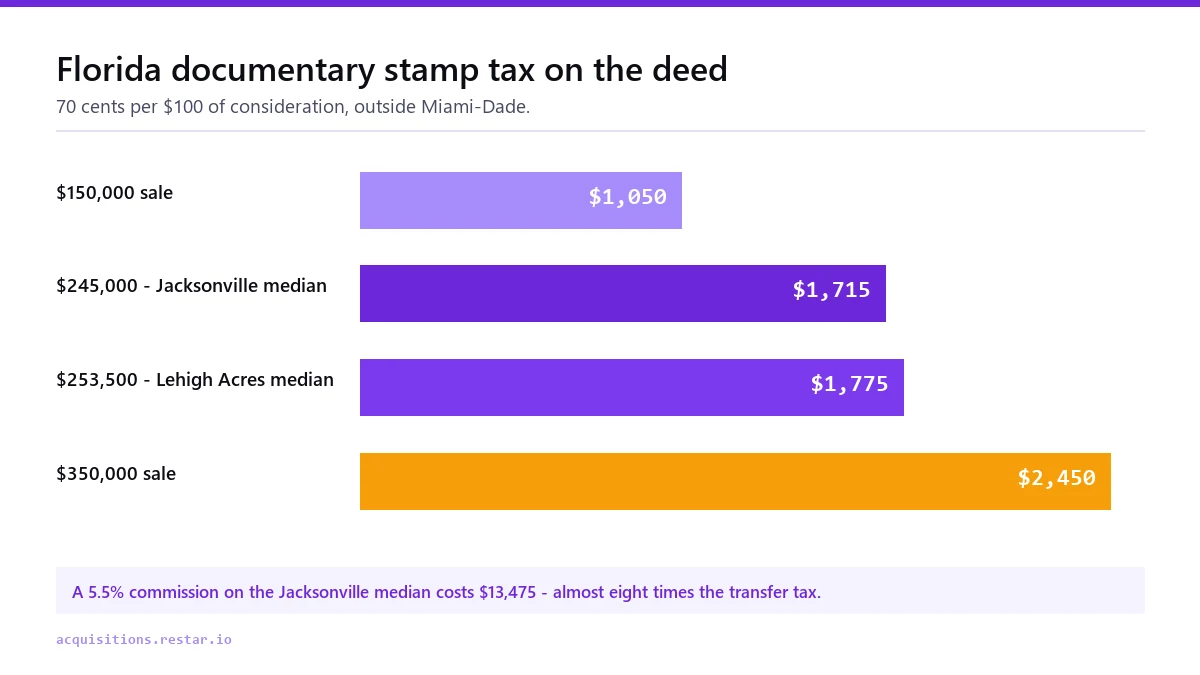
That is modest — roughly a seventh of what a Michigan seller pays, and comparable to North Carolina. On a $245,000 Jacksonville sale, a 5.5% commission at $13,475 costs you nearly eight times the transfer tax.
The Florida-specific item that is not on your settlement statement at all, but shapes what buyers will pay: Save Our Homes resets on sale. A homesteaded owner's assessed value can rise no more than 3% a year or the change in the Consumer Price Index, whichever is lower. When the property changes hands, that accumulated cap is lost and the property is reassessed at just value the following January.
For a long-time owner this produces a jarring conversation. Your buyer's tax bill may be dramatically higher than the one you have been paying, on the identical house. Buyers and their lenders calculate affordability on the reset number, not yours. If you have owned a Florida home for fifteen years, do not quote your own property tax figure to a buyer as though it will be theirs — it will not be, and the correction usually arrives during underwriting at the worst possible moment.
If you are buying another Florida homestead, ask about portability, which lets you transfer accumulated Save Our Homes benefit up to a statutory cap when you establish a new homestead within the permitted window. That is a question for your county property appraiser, and it is worth real money.
Florida is not one market. Our own recorded sales across the three Florida markets we buy in make the point.
| Market | Median sale | 25th–75th percentile | Median $/sq ft | Median year built |
|---|---|---|---|---|
| Lehigh Acres | $253,500 | $160,000–$289,900 | $160 | 1982 |
| Jacksonville | $245,000 | $160,500–$359,000 | $163 | 1956 |
| North Fort Myers | Median sale not published — too few recorded sales in our data for an honest figure. Median home there is small and old: about 1,018 sq ft, built around 1962. | |||
Three things in that data are worth acting on.
Jacksonville and Lehigh Acres are priced almost identically per square foot — $163 against $160 — and are completely different housing markets. The median Jacksonville house in our recorded sales was built in 1956; the median Lehigh Acres house in 1982. That is a twenty-six-year gap in roof age, wiring, plumbing and window specification, which in Florida translates directly into insurability. Two houses at the same price per foot can face entirely different pools of buyers.
Jacksonville has by far the wider price band — a 25th-to-75th percentile range of $160,500 to $359,000, a 2.2x spread, against Lehigh Acres at $160,000 to $289,900. There is no such thing as "the Jacksonville price", and any valuation quoting a citywide average across thirteen ZIP codes is telling you very little about your house.
Jacksonville is moving quickly. Our recorded median is 12 days on market. In a market that fast, the argument for a discounted cash sale is weak unless something specific rules out financed buyers — which, in Florida, is usually the roof or the insurance rather than the market.
North Fort Myers is where we publish a gap rather than a number. We have too few recorded sales in that market to state a median honestly, so we do not state one. What the data does support is the housing stock: small homes, around 1,018 square feet, built around 1962. That is a market of modest older properties where an insurance decline or a failed four-point inspection removes financed buyers entirely.
Plainly: if your Florida house is insurable and financeable, list it with an agent. Jacksonville's twelve-day median says the retail buyers are there. Transfer costs are low. A listing will very likely net you more, and that is the advice we would give you.
A cash sale earns its lower price in these situations, and mostly these:
For the arithmetic on both routes side by side, our cash offer vs listing net-proceeds guide works it line by line, and how cash home buyers calculate offers publishes the formula behind our number.
If your house is insurable and financeable and you are not against a deadline, list it. Jacksonville is moving at a median of twelve days on market in our recorded sales, and a retail listing there will almost certainly net you more than we will pay. We would tell you that on the phone.
Where a cash sale earns its lower price in Florida is narrower and specific: a roof or a four-point inspection that no insurer will write over, a condo carrying an assessment nobody wants to inherit, a foreclosure case reaching judgment, or an inherited property the estate cannot afford to keep. Send the address and we will send a written offer within 24 hours with the comparable sales attached. No cost, no obligation. Start on our Florida page or tell us about the property here.
Step 1 of 5
No obligation, no fees, no repairs. We respond the same day.
You’ll talk to Trevor McAmis, Owner & Acquisitions Lead
(313) 710-6129
Takes about two minutes. Or call (313) 710-6129 — we answer.