<b>Missing a balloon payment doesn't trigger an overnight foreclosure, but it starts a federally timed clock.</b> Under CFPB rules, your servicer generally can't file the first foreclosure notice until you're more than 120 days behind. Before that window closes, refinancing into a new loan, negotiating directly with the note holder, or selling — to a retail buyer or a cash buyer — are all real, costed options. Here's what each one actually runs you.
Step 1 of 5
Tell us about the property and the loan and we'll send a written cash offer within 24 hours, priced to close before your due date. No lender approval needed, no repairs or commissions.
You’ll talk to Trevor McAmis, Owner & Acquisitions Lead
(313) 710-6129
Takes about two minutes. Or call (313) 710-6129 — we answer.
Educational only. This explains how these situations generally work. It is not legal, tax or financial advice, and the rules differ by state — talk to an attorney or CPA about your own situation before you act on any of it.
Missing a balloon payment is a default under the note, and most mortgages and promissory notes contain an acceleration clause that lets the lender demand the entire remaining balance immediately once you're in default, rather than waiting for you to catch up on the one missed payment.
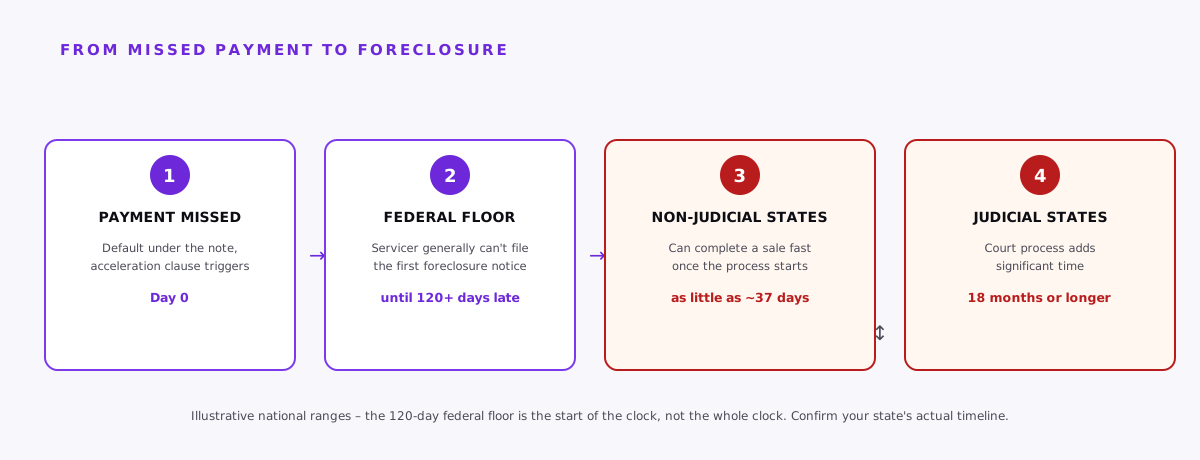
That doesn't mean foreclosure starts the next day. Federal rules under Regulation X generally bar a mortgage servicer from making the first notice or filing required to begin a foreclosure until a borrower is more than 120 days delinquent. The CFPB is direct about where this is headed if nothing changes: “If you are unable to make this payment, you could lose your home.”
What happens after that 120-day floor varies enormously by state. Non-judicial foreclosure states can move from first missed payment to a completed sale in as little as roughly 37 days once the process actually starts; judicial foreclosure states can take 18 months or longer. How long you have to sell before a foreclosure auction breaks down the state-by-state timeline in more depth — the short version is that the 120-day federal floor is the start of the clock, not the whole clock.
This is general education, not legal or financial advice. Default and foreclosure procedure varies by state and by the specific terms of your note — talk to a HUD-approved housing counselor or an attorney about your situation before you decide anything based on timing.
If you're dealing with a balloon payment at all, it's worth knowing why that's unusual. Since 2014, the CFPB's ability-to-repay/Qualified Mortgage rule has generally prohibited balloon payments, interest-only payments, and negative amortization on qualified first-lien mortgages for an owner-occupied home, with a narrow exception for small, rural-area portfolio lenders. That rule is a direct response to the pre-2008 lending practices that let borrowers qualify for loans they could only afford as long as they refinanced before a large payment came due.
In practice, a homeowner today usually ends up with a balloon payment one of four ways: an older loan originated before the 2014 rule took effect; a seller-financed or owner-carry note from when they bought the house (seller financing is itself exempt from some of these rules only if the loan is fully amortizing — a seller who structured a balloon note was generally working outside that exemption, or outside the rules entirely); a commercial or investment-property loan, since Dodd-Frank's consumer protections don't apply to non-owner-occupied or business-purpose lending; or a HELOC or second mortgage, which commonly still carries a balloon-style final payment. Cost of seller financing vs. a cash sale and cost of a HELOC or second mortgage when you sell cover the first and last of those in more depth.
Which category you're in matters for what comes next: a seller-financed note usually means negotiating with an individual, not a bank's loss-mitigation department, and a commercial loan usually means less regulatory protection than a federally backed residential mortgage would carry.
Refinance into a new loan. The CFPB names this as the main way to avoid a balloon payment outright, while being candid that it doesn't always work — “declining property values or worsening financial conditions” can block a refinance right when you need one most. If a conventional refinance isn't available, a hard-money or bridge loan is a realistic fallback: lender-reported rates in Q3 2026 averaged roughly 10.1–10.3% with 1.5 to 3 points (averaging about 2.96%) in origination fees — materially more expensive than a conventional mortgage, which is why it's usually a short-term bridge to a later retail sale, not a long-term solution.
Negotiate directly with whoever holds the note. If a bank or servicer holds your loan, federal loss-mitigation rules generally require it to evaluate options — a modification, a repayment plan, a short sale, or a deed-in-lieu — before completing a foreclosure. If an individual seller holds a seller-financed note instead, those federal servicer rules don't automatically apply the same way; it's a direct negotiation with that person, not a regulated process, which can cut either way depending on your relationship with them.
Sell before the due date. A traditional retail listing can net the most if there's enough runway to find a buyer, get through underwriting, and close before your balloon date — but it depends on timing working out. A cash sale trades some of that upside for speed and certainty: no financing contingency, no appraisal gap risk, and a close that can happen in 1 to 3 weeks, before the default clock starts at all.
Worked example, illustrative only: a $240,000 house with a $200,000 balloon balance due in 60 days, where a conventional refinance isn't available.
| Refinance into a bridge loan, then sell retail | Let it default, negotiate a short sale | Sell to a cash buyer now | |
|---|---|---|---|
| Timeline | ~3 wks bridge underwriting + ~16–18 wks to list and close ≈ 5 months | 120+ days before first foreclosure notice, then negotiate ≈ 6 months, not guaranteed to be approved | 1–3 weeks, before the default clock starts |
| Sale/payoff price | Sells at $240,000 retail | Lender-approved short sale at $225,000 | $206,000 — below retail, reflects speed and certainty, not a quote |
| Financing cost | −$5,920 bridge points, −$6,867 bridge interest (4 mo at ~10.3%) | −$5,833 continued interest accrual, −$750 late/default fees | $0 — no bridge loan needed |
| Commission/closing | −$13,440 commission (5.6%), −$3,600 closing costs | −$12,600 commission (5.6%), −$3,375 closing costs | $0 commission; −$900 title/escrow-only closing |
| Original balance payoff | −$200,000 | −$200,000 | −$200,000 |
| Certainty | Depends on a retail buyer closing after you've already taken on bridge-loan risk | Short sale isn't guaranteed — if the lender declines, foreclosure proceeds instead | High — buyer closes on the house as-is, no financing contingency |
| Net to seller | ~$10,173, ~5 months, highest net but compounding risk | ~$2,442, ~6 months, not guaranteed, worst-case total loss plus credit damage | ~$5,100, 1–3 weeks, lower net but fast and certain |
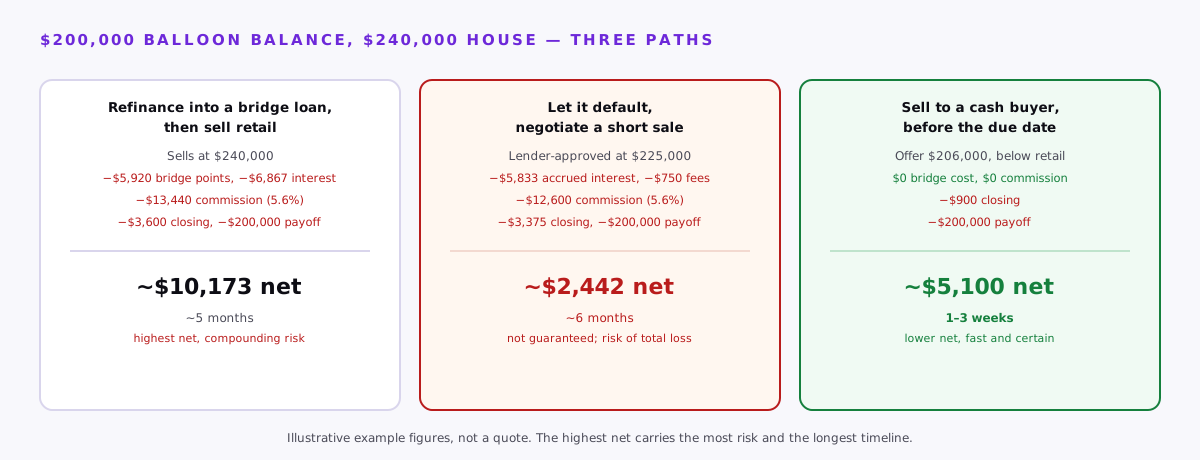
The honest read: refinancing into a bridge loan and selling retail nets the most if everything goes right — but it means taking on a second, more expensive loan while still depending on a retail buyer closing on time. Letting it ride into default and hoping for a short sale nets the least and isn't guaranteed at all; if the lender declines the short sale, the next step is foreclosure, which can mean losing remaining equity entirely along with significant, lasting credit damage. Selling to a cash buyer now nets less than a successful bridge-and-sell, but more than a shaky short sale, in a fraction of the time and without betting on anyone else's approval.
Alternatives worth checking before you decide:
Restar Acquisitions buys houses as-is for cash in Alabama, Arizona, Florida, Georgia, Indiana, Maryland, Michigan, Missouri, New York, North Carolina, Ohio, and Texas. We give a written offer within 24 hours, no repairs or commissions required, and you pick the closing date. We're a direct buyer, not your lender, your real estate agent, or a financial advisor.
This article is for general education only and isn't financial or legal advice. Loan terms, default procedures, and foreclosure timelines vary by state, by lender, and by the specific note — confirm your own situation with your servicer, a HUD-approved housing counselor, or an attorney before making a decision based on anything in this guide.
A cash sale doesn't require lender approval the way a refinance does, and it can close in 1–3 weeks — often faster than a bridge loan alone takes to underwrite.
You'll get a written offer within 24 hours, no repairs or commissions required, and you pick the closing date. We're a direct buyer, not your lender or your financial advisor, and this isn't financial advice.
All guides · Foreclosure situation guide · Missed mortgage payment, what happens next · Cost of seller financing vs. a cash sale
Step 1 of 5
No obligation, no fees, no repairs. We respond the same day.
You’ll talk to Trevor McAmis, Owner & Acquisitions Lead
(313) 710-6129
Takes about two minutes. Or call (313) 710-6129 — we answer.