Every market page publishes the numbers behind its offer. See the math
Home › Guides › How Long Do You Have to Sell Before Foreclosure Auction?
Guide
How Long Do You Have to Sell Before Foreclosure Auction?
Nobody hands you a single countdown number when a foreclosure starts — the honest answer to how long do you have to sell before foreclosure auction is that it depends on whether your state forecloses through the courts or through a trustee's sale outside of them, and on the specific date printed on the notice you were served. Both routes give you real time to act, but the runway is not the same size, and guessing wrong about which kind you're in is how people miss a sale date they could have beaten.
Takes about two minutes. Or call
(313) 710-6129 — we answer.
Educational only. This explains how these situations generally work. It is not legal, tax or financial advice, and the rules differ by state — talk to an attorney or CPA about your own situation before you act on any of it.
How long do you have to sell before foreclosure auction: the short answer
Federal rule requires your servicer to wait until you're 120 days delinquent before starting foreclosure. Once a sale date is set, non-judicial states can close in as little as 30 to 90 days after the notice, while judicial states typically run several months to over a year on the court's calendar.
This is educational information, not legal advice. Foreclosure timelines vary by state, by lender or loan investor, and by your specific case — confirm the actual dates in your notice or court filing with an attorney or a HUD-approved housing counselor before making a decision.
The federal floor: 120 days before your servicer can even file
Under the Consumer Financial Protection Bureau's mortgage servicing rule, a servicer generally cannot make the "first notice or filing" required to start a foreclosure until your loan is more than 120 days delinquent, counted from the date you missed a payment you never made up. That's a floor, not a countdown to auction — it only marks when the process is allowed to begin. There are exceptions: if you've already gone through a completed loss mitigation review and are back in default, or the loan is a junior lien behind a foreclosing senior lien, or the property is vacant or abandoned, the servicer can sometimes move sooner.
This 120-day period is also when you have the strongest leverage to apply for loss mitigation — forbearance, a repayment plan, or a loan modification — because federal rules require the servicer to review a complete application you submit more than 37 days before a scheduled sale. Once that 37-day window closes, the servicer is no longer required to pause the sale for a new application, which is one more reason the calendar matters more here than almost anywhere else in the process.
Non-judicial states move fast once the notice is filed
States that foreclose by trustee's sale (also called "power of sale") skip the courtroom entirely unless you sue to stop it. The deed of trust already gives the lender's trustee authority to sell the house once you default, so the entire post-notice process is often a matter of weeks, not months. Several of the states we buy in work this way:
90 days from recording the notice of trustee's sale (A.R.S. §33-807)
Georgia
Non-judicial
Notice published once a week for 4 weeks before the sale (O.C.G.A. §44-14-162)
Michigan
Non-judicial
Notice published once a week for 4 successive weeks (MCL 600.3208)
Alabama
Non-judicial
Notice published once a week for 3 successive weeks (Ala. Code §35-10-8)
North Carolina sits in between: it requires a hearing before the Clerk of Superior Court, but the hearing itself is quick, and after the sale there's a 10-day upset-bid period that can restart the clock each time someone outbids the winning bidder — which can either shorten or extend your practical window depending on how the bidding goes.
Even in these states, the minimums above are floors, not a promise your specific sale won't be postponed or moved sooner for cause — the notice you were actually served controls, not the statute.
Judicial states run on the court's calendar, not a fixed number of days
Indiana, Maryland, New York, Ohio, and Florida all require the lender to file a lawsuit and get a judgment before a sale can happen. There is no statutory minimum number of days from filing to sale in these states the way there is in Texas or Georgia, because the timeline depends on how backed up the local court's foreclosure docket is, whether you contest the case, and whether the lender's paperwork holds up the first time. That can mean the case moves in a few months in a light docket, or drags well past a year in a heavy one.
Maryland adds a required pre-filing step: the servicer must send a 45-day notice of intent to foreclose and, on most owner-occupied loans, offer a loss mitigation application window before filing at all — so the clock in Maryland effectively starts before the case is even docketed.
The practical implication is that if you're in a judicial state, the single most useful number isn't a state average, it's the sale date on your own case once one is actually scheduled — check your court docket or ask your attorney or housing counselor directly rather than planning around a general estimate.
How long do you have to sell before foreclosure auction, state by state
Put together, the honest range across the states we buy in looks like this: non-judicial states (Texas, Georgia, Michigan, Arizona, Alabama) can move from a filed notice to a completed sale in roughly 30 to 90 days; the quasi-judicial hearing in North Carolina typically adds a few weeks on top of that; and judicial states (Florida, Indiana, Maryland, New York, Ohio) have no fixed floor and commonly run several months to well over a year once a case is filed, purely as a function of the local docket.
None of that tells you your date. It tells you which kind of clock you're on, so you know whether to expect weeks or months once your case has actually moved to a scheduled sale.
The honest math: listing still beats a cash sale if you have the runway
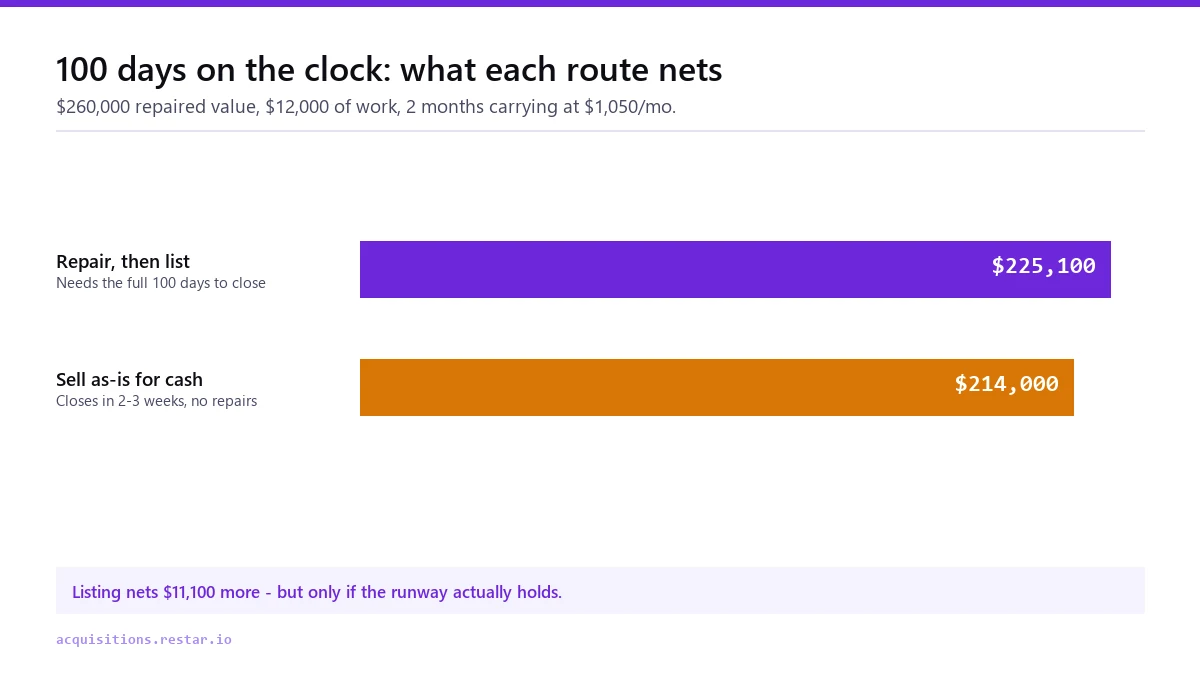
Say a house is worth $260,000 repaired, needs about $12,000 of work to show well, and the seller has 100 days until a posted sale date — typical of a mid-range non-judicial timeline once notice has run.
Repair, then list ($260,000, $12,000 repairs, 6% commission, $2,600 settlement, 1% concession, 2 months carrying at $1,050/mo)
$225,100
Sell as-is for cash in 2–3 weeks, no repairs, no commission
$214,000
100 days on the clock: what each route netsRestar Acquisitions · worked example from this page
A worked illustration on one hypothetical property. Not a quote, not a prediction about your house, and not a fixed formula we apply.
Listing nets about $11,100 more here — but it needs the 100 days to actually close, and a financed buyer's loan can still fall through on inspection or appraisal with weeks left on the clock. Once the runway shrinks below what a listed sale realistically needs to close — typically 45 to 75 days from list to closing table even for a buyer who never wavers — the certainty of a cash sale starts to outweigh the extra dollars, because a collapsed financed deal with 20 days left before the auction is a worse outcome than either route completed on time.
Alternatives if you don't have enough time to sell
A sale isn't the only way to stop a foreclosure, and several of these can work even after a sale date is already set:
Reinstatement — paying the full missed amount plus fees to bring the loan current, sometimes possible right up until the sale.
Forbearance or a repayment plan — the servicer pauses or reduces payments temporarily, then adds the difference back later.
Loan modification — permanently changing the loan's terms, which requires a complete application submitted with enough lead time before the sale.
A short sale — selling for less than you owe with lender approval, which takes its own approval time and only applies if you're underwater.
A deed in lieu — handing the deed back to the lender, which pays you nothing for any equity in the house.
Filing bankruptcy — an automatic stay pauses the sale temporarily, though it does not cancel the debt.
A HUD-approved housing counselor (free, and not affiliated with your servicer) is the fastest way to find out which of these you actually qualify for given your specific timeline.
Common questions
Does filing bankruptcy stop a foreclosure auction?
Filing Chapter 7 or Chapter 13 triggers an automatic stay that generally pauses a scheduled foreclosure sale immediately, but it's usually temporary — the lender can ask the court to lift the stay, and in a Chapter 13 you still have to keep up with a repayment plan afterward. This is not a permanent fix on its own; talk to a bankruptcy attorney about your specific case.
Can I still sell my house after the auction date has passed?
Once a foreclosure sale is completed, ownership has transferred, and in most cases you can no longer sell the house yourself. Some states give you a post-sale right of redemption — a window to buy the property back by paying what's owed — but the length varies widely by state and loan type, so confirm whether yours applies before assuming it does.
What exactly is a notice of sale?
It's the formal document — posted, published in a local paper, mailed to you, or filed with the court depending on your state — that sets or announces the date, time, and location of the foreclosure sale. It's the single most reliable date to plan around, more reliable than any state-average timeline.
Does applying for a loan modification stop the clock?
It can, but only within a window: federal rules generally require the servicer to review a complete loss mitigation application submitted more than 37 days before a scheduled sale, and to pause dual-tracking the foreclosure while that review is pending. Submit late, or with missing documents, and the servicer isn't required to pause anything.
How do I know if my state is judicial or non-judicial?
It depends on whether your mortgage document is a "deed of trust" (usually non-judicial, trustee's sale) or a "mortgage" (usually judicial, court-filed) and on your specific state's law, since a few states use hybrids or let lenders choose. A local foreclosure attorney or your state's court self-help center can confirm which applies to your loan.
Can I list my house with a real estate agent while in foreclosure?
Yes, listing with an agent remains available up until the sale is completed in most states, and it's often the better financial outcome if you have enough time left on the clock. The risk is entirely about timing — a financed sale that falls through with the auction date close behind it can leave you worse off than starting with a faster, more certain option.
The safest number to plan around is not a state average — it's the specific sale date on the notice your servicer or trustee sent you, or the docket date on your foreclosure case if you're in a judicial state. If you can't find that date or aren't sure what kind of foreclosure you're in, send us the address and we'll help you figure out what's realistic before you commit to a listing timeline you can't actually make.
If there's enough runway to list, we'll tell you that too — a cash sale only makes sense here if the clock genuinely doesn't allow for anything else.
Every offer on this site is underwritten by a person, not a form. If the
numbers do not work for you, say so and I will tell you what would.
Also from Restar
Want the data behind all of this?
Restar Acquisitions is the acquisitions arm of Restar — a housing-market analytics
platform tracking 180+ metrics across every U.S. market, with composite scores and 12-month
price forecasts. The numbers on this page come from the same work.