The cost of seller financing vs a cash sale comes down to time value of money and default risk, not the sticker total. Seller financing — carrying the note yourself instead of taking a lump sum — looks like a bigger number on paper, because a 10-year note's total payments always add up to more than a single cash price today. That's the wrong comparison. A dollar received in year 7 is worth less than a dollar today, and a payment stream also carries real default risk a cash sale doesn't: if the buyer stops paying, getting the house back through a seller-carried mortgage typically means a full foreclosure process, not a quick remedy. Discount the note's payments for both time and risk, and the honest comparison looks a lot closer than the sticker total suggests.

Step 1 of 5
Tell us about the property. We'll give you a straight cash number to put next to the note math before you decide.
You’ll talk to Trevor McAmis, Owner & Acquisitions Lead
(313) 710-6129
Takes about two minutes. Or call (313) 710-6129 — we answer.
Educational only. This explains how these situations generally work. It is not legal, tax or financial advice, and the rules differ by state — talk to an attorney or CPA about your own situation before you act on any of it.
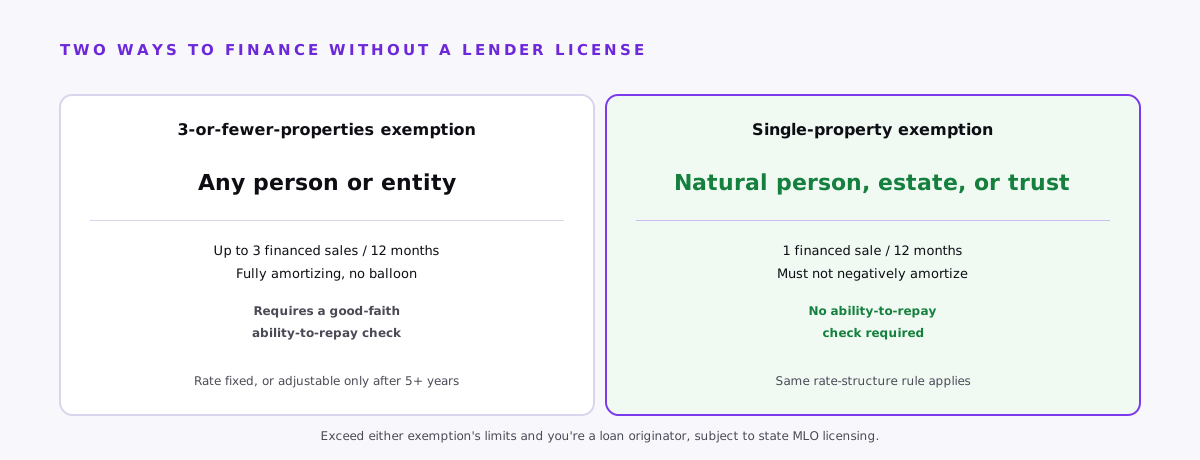
Congress created this carve-out in the Dodd-Frank Act, and the CFPB's implementing rule under Regulation Z took effect in January 2014, treating a lifetime adjustable-rate cap of 6 percentage points as reasonable. It spells out two exemptions that let a seller finance a buyer's purchase without being treated as a licensed mortgage loan originator. They're not identical, and mixing them up is the single easiest compliance mistake to make here.
| Three-or-fewer-properties exemption | Single-property exemption | |
|---|---|---|
| Who qualifies | Any person or entity | Only a natural person, estate, or trust |
| Property limit | 3 or fewer financed sales per 12 months | 1 financed sale per 12 months |
| Payment structure | Must be fully amortizing — no balloon payment | Must not negatively amortize |
| Rate structure | Fixed, or adjustable only after 5+ years, with reasonable caps | Same |
| Ability-to-repay check required? | Yes, a good-faith income check | No |
Both exemptions require the seller to have actually owned the property (not built it as a contractor in the ordinary course of business), and both cap adjustable-rate caps at what the CFPB's own commentary treats as reasonable — 2 points a year, 6 points lifetime. Exceed either exemption's limits, skip the ability-to-repay check under the three-property rule, or structure in a balloon payment, and you're no longer exempt — you're a loan originator, with the state licensing exposure that comes with it.
Here's the arithmetic that gets skipped. Say you carry a $200,000 note at 7% fixed, fully amortizing over 10 years. The math works out to a monthly payment of $2,322.17, which means $278,660 total paid over the life of the note — a number that looks like a clear win over a $200,000 cash price.
It isn't, once you discount it properly. Discounted at the note's own 7% rate, that payment stream is worth exactly $200,000 today — a mathematical identity, not a coincidence. But 7% isn't necessarily the rate that reflects the actual risk you're taking on as an unsecured, non-bank lender to one borrower. Discount the same $2,322.17-a-month stream at a more realistic risk-adjusted rate — say 10%, reflecting illiquidity and real default risk — and it's worth $175,721 today, about $24,279 less than face value.
| Discount rate applied | Present value of the $2,322.17/month, 10-year stream |
|---|---|
| 6% (below the note's own rate) | $209,166 |
| 7% (the note's own coupon rate) | $200,000 |
| 10% (risk-adjusted for default/illiquidity) | $175,721 |
That $278,660 nominal total is real money if every payment arrives on schedule for 10 years. The present-value number is what the note is actually worth today, discounted for the years you'll wait and the risk you're carrying — and it's the number that belongs next to a cash offer, not the nominal total.
This is the part that gets glossed over in casual seller-financing advice. If the buyer stops paying on a seller-carried purchase-money mortgage or deed of trust — the standard instrument for seller financing, distinct from a land contract — you don't get a quick, no-court remedy. Legal title passed to the buyer at closing; your interest is just a recorded lien. Getting the house back typically means the same full foreclosure process — judicial or non-judicial depending on the state — a bank would have to run: statutory notice periods, court filings or trustee-sale procedures, and commonly months to over a year before you have the property back.
That's a materially different risk than a land contract, where legal title stays with the seller and many states allow faster forfeiture on default — though a growing number of states require full foreclosure there too once the buyer has built up meaningful equity. Either way, the time, legal cost, and uncertainty of getting the property back is real and belongs in the decision, not just the interest rate you're charging.
The one place seller financing has a genuine, IRS-confirmed advantage: the installment sale method under IRS Topic 705. Any sale where at least one payment arrives after the year of sale qualifies, and it lets you report capital gains only as you actually receive the payments — spreading the tax liability across the years the note pays out, rather than owing it all in the year you sell.
Two real limits worth knowing before you count on this: depreciation recapture has to be reported as ordinary income in full, in the year of sale — it can't be spread out even if the rest of the gain is, which matters directly if the property was a rental. And the installment method isn't available for a sale that results in a loss, or for dealer property. It's reported annually on Form 6252 for every year a payment comes in, and you can elect out of installment treatment if you'd rather recognize everything now.
There's no published government survey of residential seller-financing rates, so treat any specific percentage you see quoted online with caution. What's consistently true across lending-industry sources: sellers typically negotiate a rate above prevailing conventional mortgage rates — commonly cited in the range of 1 to 4 percentage points higher — to compensate for being a subordinated, non-bank lender with no rate sheet and no easy way to sell the note if you need cash. The honest framing for a seller deciding what to charge is risk-based negotiation, not a quoted market rate.
Say the house is worth $200,000. A cash, as-is buyer offers $178,000 today, closing in 2–3 weeks, no note, no foreclosure exposure. Carrying a $200,000 note yourself at 7% over 10 years pays out $278,660 nominally — but discounted at a realistic 10% risk-adjusted rate, that stream is worth $175,721 today.
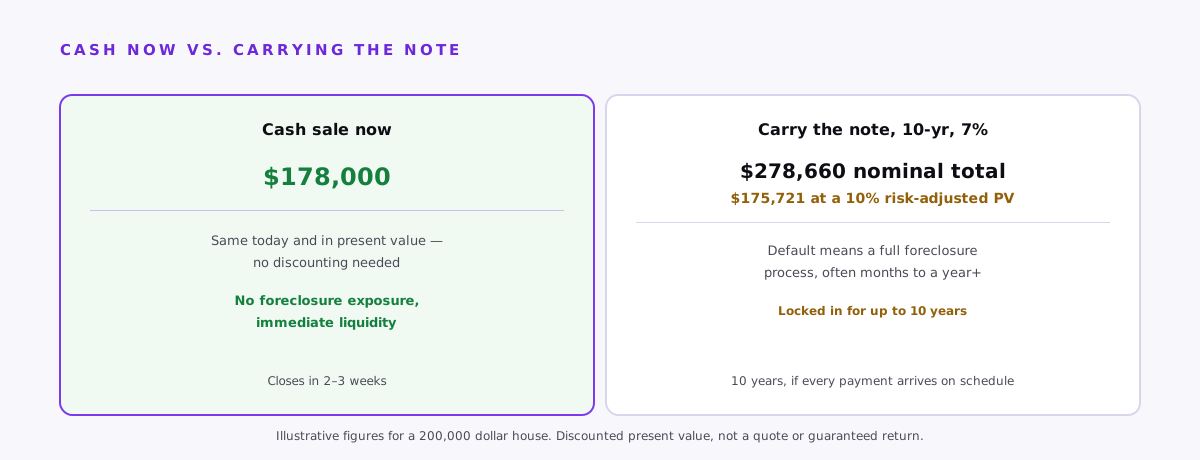
| Cash sale now | Carry the note (10-yr, 7%) | |
|---|---|---|
| Nominal total | $178,000 | $278,660 |
| Present value today (risk-adjusted) | $178,000 | $175,721 |
| Default remedy if it goes wrong | N/A — already closed | Full foreclosure process, often months to over a year |
| Liquidity | Immediate | Locked into monthly payments for up to 10 years |
| Timeline to cash in hand | 2–3 weeks | 10 years, if every payment arrives on schedule |
Once you price in time and realistic risk, the $278,660 nominal total and the $178,000 cash offer are much closer than they look — and the cash offer carries none of the foreclosure exposure or 10-year wait. Seller financing can still be the right call for a seller who wants an above-market effective yield and is genuinely comfortable being a lender, but “I'll make an extra $100,000” is not an honest way to describe the choice.
Sell for cash now. Immediate liquidity, no note to service, no foreclosure risk if a buyer stops paying. Send us the property here and we'll walk you through the numbers.
List retail with a traditional, bank-financed buyer. Avoids becoming a lender entirely, at the cost of the usual retail timeline and commission.
Carry the note, structured correctly. Can net a higher effective return for a seller comfortable with the wait and the foreclosure risk if it goes wrong — confirm which CFPB exemption applies before you finalize terms.
An installment sale structured with a third-party note buyer or escrow service, if you want some of the tax-deferral benefit without personally servicing payments for a decade — discuss with a CPA or real estate attorney.
This article is general educational information, not legal, tax, or financial advice. Seller-financing compliance under Regulation Z, foreclosure procedure, and installment-sale tax treatment are all fact- and state-specific; confirm your own structure with an attorney and a CPA before you finalize any seller-financed sale.
If carrying a note means waiting years for your money and taking on real foreclosure risk if the buyer stops paying, we can make a cash offer today — no note to service, no default exposure, no decade-long timeline.
Send us the property here and we'll walk you through the numbers.
All guides · Land contract forfeiture · Cash offer vs. listing net proceeds · Capital gains tax when you sell your house
Step 1 of 5
No obligation, no fees, no repairs. We respond the same day.
You’ll talk to Trevor McAmis, Owner & Acquisitions Lead
(313) 710-6129
Takes about two minutes. Or call (313) 710-6129 — we answer.
