Selling a house with unpermitted work is legal in essentially every state, and the fear that it is not costs sellers more than the work ever does. Fannie Mae's own selling guide accepts non-permitted additions provided the appraiser comments on the quality of the work and its effect on value. What unpermitted work actually costs you is narrower and more measurable than the panic suggests: square footage that does not count, a smaller pool of lenders, an insurer with an argument, and a disclosure you cannot skip.

Step 1 of 5
Tell us what was built and when, and we will tell you what the house is worth with it and without it.
You’ll talk to Trevor McAmis, Owner & Acquisitions Lead
(313) 710-6129
Takes about two minutes. Or call (313) 710-6129 — we answer.
Educational only. This explains how these situations generally work. It is not legal, tax or financial advice, and the rules differ by state — talk to an attorney or CPA about your own situation before you act on any of it.
Selling a house with unpermitted work is legal and routine, and most lenders will finance it — Fannie Mae accepts it where the appraiser addresses quality and market impact. The real cost is that unpermitted space often is not counted as living area, so it does not appraise, and the disclosure duty is yours.
This is educational information, not legal advice. Permit requirements, retroactive permitting procedures, enforcement powers and disclosure duties are set by state law and by your city or county, and they differ sharply. Have a local attorney and your building department confirm anything here against your own address before you act on it.
Selling a house with unpermitted work breaks five things, in a fairly reliable order. Almost none of them are what sellers worry about, and the first one is where the money goes.
1. The square footage may not count. Appraisers generally include only finished area that is legally permitted and consistent with the rest of the house when calculating gross living area. A 600 square foot garage conversion or a finished basement bedroom can be genuinely useful, genuinely nice, and still contribute nothing to the appraised value. The buyer loves it; the appraisal does not see it; the loan is sized off the appraisal.
2. Financing narrows, but does not close. Fannie Mae's guidance is explicit that where an appraiser identifies an addition without the required permit, the appraiser must comment on the quality and appearance of the work and its impact, if any, on market value — not that the property is ineligible. FHA takes a similar line: HUD does not enforce municipal permit rules, but the property must meet minimum property requirements and comply with local land use rules. What varies is lender overlays, the extra conditions individual lenders add on top. Some will not touch it. That shrinks your buyer pool without eliminating it.
3. Insurance gets an argument it did not have before. Carriers rate a policy on what they were told the house is. An unpermitted structure or conversion gives an insurer a basis to dispute a claim arising from it, and some will decline to insure the structure at all. Call your carrier and ask the question directly, in writing, before you assume you are covered.
4. Enforcement can be triggered by the sale itself. Pulling a retroactive permit tells the building department the work exists. So, in many jurisdictions, does a sale, because the transfer is reported to the assessor. The outcome ranges from a permit and a fee to an order to correct or remove. This is the risk that makes people freeze, and it is real but usually smaller than the fear of it.
5. The tax bill follows the permit. Finalising a retroactive permit typically triggers reassessment of the improved value. That is a permanent annual cost added to a one-off project cost, and it belongs in the comparison.
The distinction that matters throughout: unpermitted work usually means nobody has noticed yet. A code violation means enforcement has already started. If you have received a notice, a citation or a daily fine, you are in a different situation with a running clock — see code violations and open permits. If nobody has ever written to you about it, you are choosing your timing, and that is worth a great deal.
The relevant guidance sits in Fannie Mae's selling guide on the improvements section of the appraisal report and in HUD's Single Family Housing Policy Handbook 4000.1.
In most states, known unpermitted work is a material fact that has to be disclosed on the seller's property condition form. Not knowing the exact permit status is a fair answer. Knowing and saying nothing is not, and the exposure does not end at closing.
Three practical points that save money.
Disclose what you know, in the words you actually know it in. “The previous owner finished the basement; I have no permit records for it and have not confirmed the status with the county” is an honest, accurate, defensible disclosure. Inventing certainty in either direction is the mistake.
Pull the permit history yourself first. Most building departments will produce a property's permit record on request, often online. It costs little and occasionally reveals that the work was permitted after all, which turns the whole problem into a paperwork exercise.
A handful of states run on caveat emptor and require no disclosure form at all. Alabama is the clearest example, with narrow exceptions for known health and safety defects that are not readily observable, for questions the buyer asks directly, and where a fiduciary relationship exists — see selling a house in Alabama. Indiana sits at the other end, with a statutory disclosure form that has to be given before an offer is accepted — see selling a house in Indiana. Two neighbouring markets, opposite obligations. Check yours rather than assuming.
Federal law is not state law: a house built before 1978 carries lead-based paint disclosure duties regardless of what your state requires. That one has no exceptions.
A house that would be worth $320,000 if the converted garage counted as living area. The conversion is unpermitted, and an appraiser will not include it, so the same house appraises at $286,000 — the $34,000 the space would have contributed simply is not there.
Route one: legalise it retroactively, then list. A realistic retroactive permit on a conversion of this age, where the work has to be brought to current code rather than the code in force when it was built:
| Line | Cost |
|---|---|
| Permit application and retroactive fee (commonly doubled) | $2,400 |
| As-built drawings | $1,800 |
| Structural engineer's letter | $1,200 |
| Opening walls; framing, electrical and egress corrections | $16,500 |
| Egress window, insulation, smoke and CO detection | $4,100 |
| Re-inspection fees | $600 |
| Total to legalise | $26,600 |
One line item people miss: if the house was built before 1978 and the corrections disturb painted surfaces, the work has to be done by a firm certified under the EPA's Lead Renovation, Repair and Painting rule. That narrows who may legally do the job, and it is not the cheapest quote you were given.
Add four to six months of permitting before the house can even be listed. The two routes, then:
| Line | Legalise, then list | List as-is, disclosed |
|---|---|---|
| Sale price | $320,000 | $286,000 |
| Cost to legalise | −$26,600 | $0 |
| Agent commission (5.5%) | −$17,600 | −$15,730 |
| Seller closing costs (1.5%) | −$4,800 | −$4,290 |
| Buyer concessions (1%) | −$3,200 | −$2,860 |
| Holding while it happens | −$12,600 (9 months) | −$7,000 (5 months) |
| You keep | $255,200 | $256,120 |
Listing as-is wins by $920, which is to say the two routes are a coin flip. The $34,000 of value the permit unlocks is very nearly consumed by the $26,600 it costs to unlock it, plus four extra months of carry and a larger commission on a larger number. That is the finding that surprises people, and it holds across a wide range of inputs.
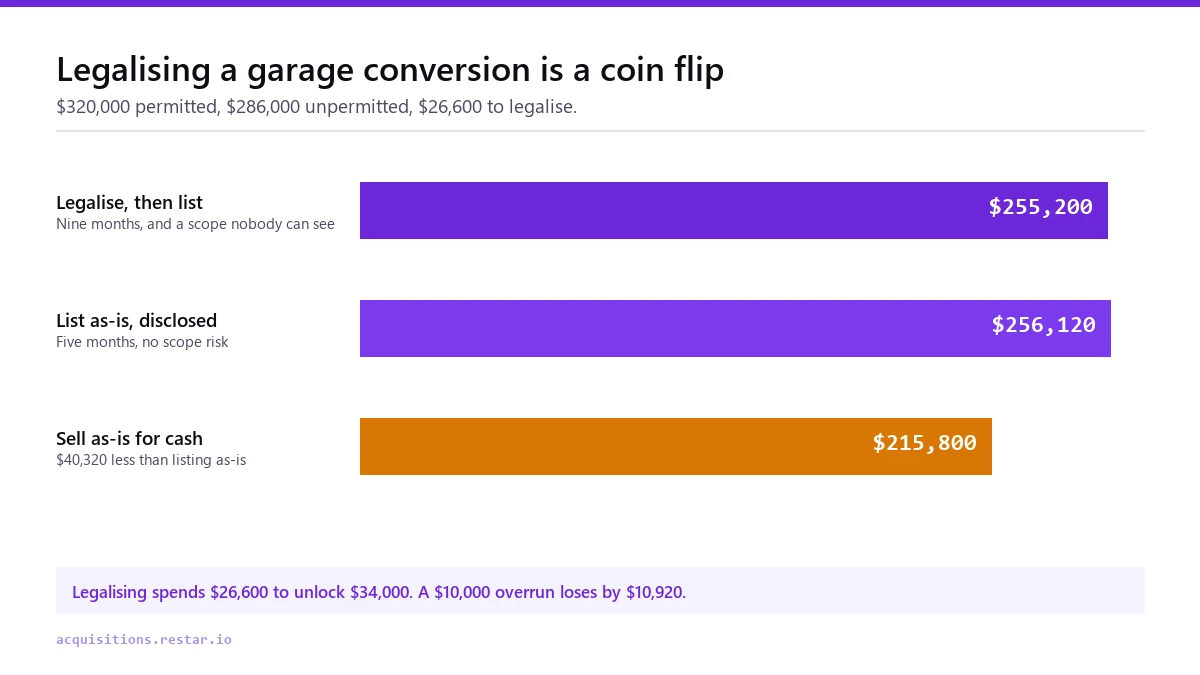
And the sensitivity that should decide it for you. The $26,600 is the only figure in the table that nobody can pin down in advance, because the scope is not knowable until a wall is open. If the retroactive permit runs $10,000 over — a header that has to be replaced, a panel that has to be upgraded, a slab that has to be cut — legalising nets $245,200 and loses to a plain as-is listing by $10,920. The as-is column has no comparable downside. You are being asked to make a leveraged bet on an unknown scope in order to win $920.
Route three: sell as-is for cash. Built with the four terms in how cash home buyers calculate offers, with a buyer who intends to legalise the conversion and fix $6,000 of other deferred maintenance:
| Term | Amount |
|---|---|
| After-repair value, conversion legalised | $320,000 |
| Permit work and repairs | −$32,600 |
| Resale and holding — commission $17,600, seller closing $3,200, purchase closing $2,300, nine months' carry $13,500 | −$36,600 |
| Margin | −$34,000 |
| Illustrative cash figure | $216,800 |
A worked illustration on one hypothetical property. Not a quote, not a prediction about your house, and not a fixed formula we apply.
After three weeks of holding, that nets $215,800 — $40,320 below simply listing the house as-is and telling the truth about the garage. On a sound house with a co-operative timeline, the cash route is the worst of the three, and we would rather you read that here than find it out afterwards.
The coin flip above assumes an ordinary conversion in an ordinary market. Four things swing selling a house with unpermitted work decisively toward pulling the permit first.
The work is trivially legalisable. A deck, a water heater, a re-roof, a like-for-like window replacement, a shed under the size threshold. Where the fee is a few hundred dollars and the inspection is one visit, do it. The asymmetry is enormous and the scope risk is near zero.
The space is the reason the house is desirable. A permitted fourth bedroom or a legal second bathroom can move a house into a different search bracket and a different buyer pool. Where the unlocked value is a multiple of the permit cost rather than a near-tie with it, the arithmetic stops being close.
Local buyers will not finance it and your market is financed. In a market where nearly every buyer uses an FHA or conventional loan and local lenders are conservative about unpermitted additions, an as-is listing may sit. Ask two local agents what actually happens to these listings in your market before assuming the national answer applies.
You are going to keep it a while anyway. If a sale is a year or more away, the permit cost is spread over time you were going to hold regardless, and it removes an insurance exposure you are carrying in the meantime.
And the situations where legalising it is simply not available, which is when a cash sale genuinely earns its place. Zoning, not code, is the wall. A permit can cure work that was built to the wrong standard. It cannot cure a structure sitting over a setback line, exceeding lot coverage, or creating a second dwelling unit where the zoning allows only one. Those need a variance, which is discretionary, slow and often refused. If your building department tells you the work cannot be permitted at any price, no amount of money fixes it — and the honest options narrow to removing the work, or selling it disclosed to a buyer who will.
The decision on this page turns on a number nobody can quote you until a wall is open: what retroactive permitting will actually cost. The other number, what the house is worth today with the work disclosed and uncounted, we can put in writing within 24 hours with the comparable sales behind it and no obligation.
On the worked example below, listing the house as-is with full disclosure beats our figure by $40,320, and it also beats legalising first. That is the usual answer where the house is otherwise sound and you have five months. We are the right route when the permit cannot be obtained at any price, when enforcement has already started, or when nobody is available to run a permitting process. Send us the property here.
All guides · Code violations and open permits · Should I repair before selling?
Step 1 of 5
No obligation, no fees, no repairs. We respond the same day.
You’ll talk to Trevor McAmis, Owner & Acquisitions Lead
(313) 710-6129
Takes about two minutes. Or call (313) 710-6129 — we answer.