Selling a house in Alabama differs from the rest of the country in three ways that actually change what you do. There is no state seller disclosure form, because Alabama is one of the few remaining caveat emptor states. Foreclosure is fast and non-judicial, but redemption runs for months afterwards rather than before. And if you live out of state — which describes most people who inherit an Alabama house — 3% of the purchase price is withheld at closing unless you file the right affidavit.

Step 1 of 5
Send the address and we will tell you what it is worth as-is, with the Birmingham sales behind it.
You’ll talk to Trevor McAmis, Owner & Acquisitions Lead
(313) 710-6129
Takes about two minutes. Or call (313) 710-6129 — we answer.
Educational only. This explains how these situations generally work. It is not legal, tax or financial advice, and the rules differ by state — talk to an attorney or CPA about your own situation before you act on any of it.
Selling a house in Alabama needs no state disclosure form, because Alabama applies caveat emptor with three narrow exceptions — known health and safety defects that are not readily observable, direct questions answered untruthfully, and fiduciary relationships. Deed tax is $0.50 per $500, and non-resident sellers face withholding.
This is educational information, not legal or tax advice. Alabama redemption, disclosure and withholding rules turn on facts specific to your deed, your mortgage date and your residency. Talk to an Alabama attorney and a CPA about your own situation before relying on any of it.
Alabama is one of a small handful of states with no mandatory residential seller disclosure form. The governing rule is caveat emptor — buyer beware — and as a general matter an Alabama seller has no affirmative duty to volunteer the condition of the property.
The exceptions are narrow but they are not nothing:
Federal law sits on top of all of it: a house built before 1978 carries lead-based paint disclosure obligations regardless of what Alabama requires, and the median house in our Birmingham records was built in 1955, so this applies to most of them.
Two practical consequences that are worth more than the rule itself. First, because there is no form, the inspection carries all the weight, and an Alabama transaction lives or dies on the inspection response. Second, and counter-intuitively, sellers who volunteer a short written condition summary anyway tend to see fewer renegotiations after inspection, because the buyer has already priced what they found. Caveat emptor is a shield against a claim, not a strategy for a smooth closing.
It is worth knowing how unusual this is. Cross the state line into most of the country and the position inverts — Indiana, for instance, requires a statutory disclosure form to be given to the buyer before an offer is accepted, and a second tax form filed at closing. See selling a house in Indiana for the opposite arrangement.
Alabama is a non-judicial foreclosure state. Where the mortgage contains a power of sale — almost all of them do — no lawsuit is filed and no judge is involved. The lender advertises the sale in a newspaper in the county where the property sits, typically once a week for three consecutive weeks, and then sells at auction. From acceleration to sale can be a matter of weeks.
The unusual part is what happens next. Most states that move this fast give the borrower no second chance. Alabama gives a statutory right of redemption after the sale, and the length of it depends on facts about your loan:
For someone trying to sell, this cuts in two directions and both are worth money.
Before the sale, it argues for moving quickly. A redemption right is an encumbrance on title. A property that has been through an Alabama foreclosure is difficult to resell or insure while redemption is live, which is exactly why buyers pay less for one. Every week before the auction is worth more than any week after it.
After the sale, you may still have something to sell. Who may redeem, in what order of priority, and whether the right can be transferred, are set out in the Alabama redemption statutes, and the answer is not a flat no. If you are inside a live redemption period, that is a question for an Alabama attorney rather than for a buyer, and it is worth asking before assuming everything is gone.
If you are behind but the sale has not happened, the ordinary loss mitigation routes all remain open — reinstatement, a repayment plan, forbearance, a modification. The CFPB's mortgage help pages set out what a servicer has to consider, and the CFPB's directory of HUD-approved housing counsellors will find you free advice. Our guide to selling a house in foreclosure covers the sequence in detail.
This is the pleasant surprise, and it is large enough to change a decision.
Deed recordation tax is $0.50 for each $500 of value conveyed — one dollar per thousand, or 0.1%. On the $140,000 sale worked through below that is $140.00. On the $119,000 median Birmingham sale in our records it is $119.00. If you have sold a house in a state with a percentage-based transfer tax, compare that to the four figures you paid there. There is no separate state or county transfer tax stacked on top.
The mortgage recordation tax of $0.15 per $100 is the buyer's problem, charged on a new loan rather than on your sale, but it turns up on the settlement statement and sellers routinely mistake it for their own.
Property taxes are among the lowest in the country, and the reason is the assessment ratio rather than the rate. Alabama assesses owner-occupied single family residential property as Class III at 10% of appraised value. A $140,000 house therefore carries a taxable base of $14,000 before any homestead exemption — one tenth of the base the same house would carry in a state that assesses at 100% of market value. Millage rates are set locally, so ask your county, but the direction is unambiguous and it makes holding an Alabama house cheap in tax terms.
That has a specific consequence for a vacant house. Because tax is so low, the carrying cost of an empty Alabama property is dominated by insurance rather than by tax — and a vacant older house in a hail and wind exposed state is not cheap to insure. Standard policies commonly restrict coverage after 30 to 60 consecutive vacant days. Tell your carrier in writing and get the right endorsement; our guide to holding costs of a vacant house covers the vacancy clause. The Alabama saving is real, it is just not where people look for it.
The classification rules are set out by the Alabama Department of Revenue's property tax assessment guidance.
This is the single most expensive thing on this page for the people most likely to be reading it, and almost nobody mentions it.
Under Alabama Code section 40-18-86, the buyer is required to withhold on a sale by a non-resident seller and remit it to the state: 3% of the purchase price where the buyer is an individual, 4% where the buyer is a corporation, partnership or unincorporated association. On a $140,000 sale that is $4,200 or $5,600 taken out of your proceeds at the closing table. It applies to sales on or after 1 August 2008 and does not apply to Alabama residents at all.
It is a withholding, not a tax — you reconcile it when you file an Alabama return — but the cash is gone in the meantime, which matters if you were counting on the proceeds.
The fix is a form, and it is the seller's job to produce it. Where the gain on the sale is less than the purchase price, the seller can give the buyer an Affidavit of Seller's Gain (Form NR-AF2) and the withholding is calculated on the gain rather than the price. For an inherited house this is frequently transformative: the basis is stepped up to the value at the date of death, so a sale shortly afterwards often shows little or no gain, and little or no withholding. Get the affidavit prepared before closing, not after.
There is also a deemed-resident route for sellers who have filed Alabama returns for the two preceding years. The forms, the FAQs and the conditions are published by the Alabama Department of Revenue's non-resident withholding pages. Ask your closing attorney about it at the contract stage — raising it the day before closing is how it gets missed.
If the house came to you through an estate, the stepped-up basis is also what usually keeps the federal bill small; our guide to capital gains on inherited property works through how that is calculated.
Our Birmingham records hold 713 recorded sales across 11 ZIP codes: a median of $119,000 at $81 a square foot, a middle half running from $72,750 to $175,000, and a median house built in 1955 with three bedrooms, one bathroom and 1,277 square feet.
Two of those numbers do more work than the rest. The first is the ZIP spread: the median sale runs from $56,800 in 35221 to $284,250 in 35205 — a five-fold range inside one city. Any Birmingham valuation built on a city average is wrong before it starts, which is why we underwrite by street here rather than by ZIP, let alone by city.
The second is that one bathroom. The median Birmingham house in our data has a single bath, and the retail buyer paying the prices in the upper ZIPs will not accept that. Adding a second bathroom is the defining Birmingham rehab, it is the most expensive line in the budget, and it is the item that most often decides whether repairing before selling is worth doing at all.
So: a 1955 three-bed, one-bath in the eastern side of the city, worth $140,000 renovated, needing $38,000 of work including $14,000 for a second bathroom. Holding runs about $540 a month — roughly $95 tax, $210 insurance on a vacant older house, $145 utilities, $90 yard and security.
| Line | Repair, then list | Sell as-is for cash |
|---|---|---|
| Sale price | $140,000 | $70,460 |
| Repairs, including the second bath | −$38,000 | $0 |
| Agent commission (5.5%) | −$7,700 | $0 |
| Seller closing costs, deed tax $140 included | −$2,100 | $0 — we cover standard closing costs |
| Buyer concessions (1%) | −$1,400 | $0 |
| Holding while it happens | −$3,780 (7 months) | −$400 (3 weeks) |
| You keep | $87,020 | $70,060 |
The cash figure is built with the four terms in how cash home buyers calculate offers: $140,000 after-repair value, less $38,000 of repairs, less $13,540 of resale and holding costs — resale commission $7,700, seller closing at resale $1,400, purchase closing $1,200 and six months' carry of $3,240 — less $18,000 of margin.
A worked illustration on one hypothetical property. Not a quote, not a prediction about your house, and not a fixed formula we apply.
Listing wins by $16,960. On a $140,000 house that is a fifth of what you keep, and it is the honest headline for most Birmingham sellers who have the time and the money to do the work.
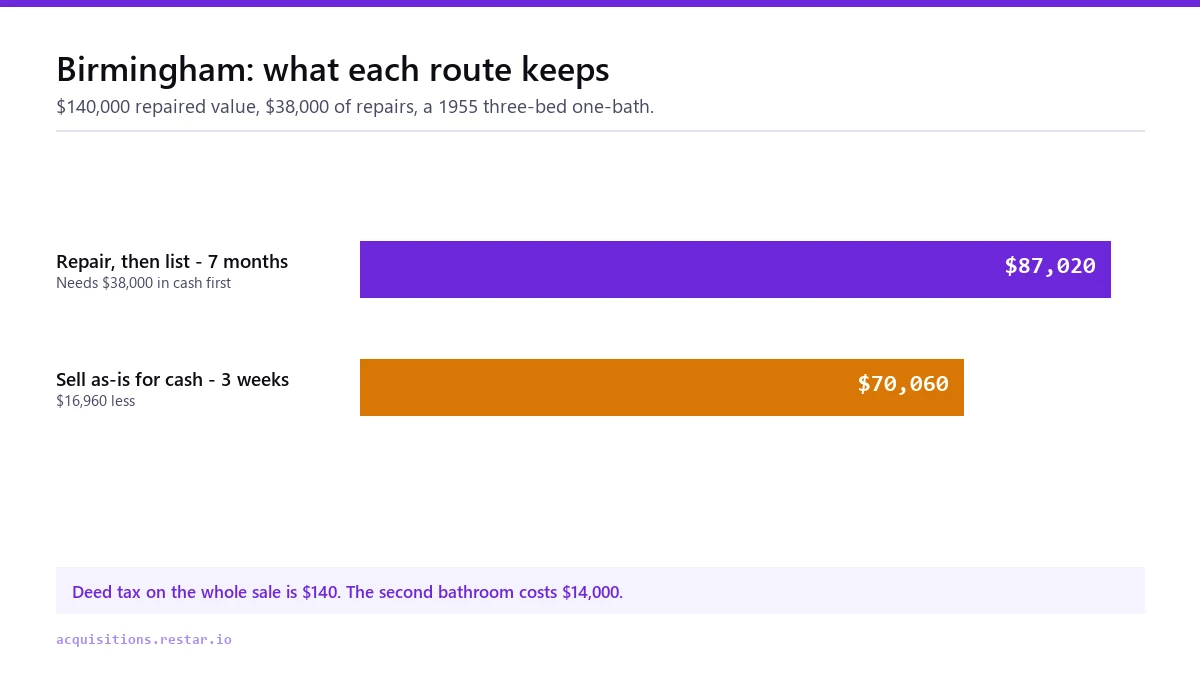
Note what the retail column quietly assumes: $38,000 in cash you have to find first, seven months during which the house is yours, and someone to manage a bathroom addition in a 1955 house. If you are an out-of-state heir, that is three flights and a contractor you have never met. The gap is what you are being paid to take that on, and if you cannot take it on, the gap is not available to you. Where the property sits in a ZIP with a $60,000 median, the whole comparison compresses and the $38,000 stops making sense at all — which is why the ZIP matters more here than in almost any market we buy in.
We hold 713 recorded sales across 11 Birmingham ZIP codes, and the spread between the cheapest and the dearest of them is more than five to one. That is the reason a city-level average is useless here and a street-level number is not. Send the address and we will put our figure in writing within 24 hours, with the comparables behind it and no obligation.
On the worked example below a retail listing keeps $16,960 more than we would pay. If you have the time, the cash for a second bathroom and someone to manage the work, listing is the better route and we will say so. Where a house is inherited from three states away, where the redemption clock is running, or where a second bathroom is not happening, our column is the one that closes. Send us the property here.
All guides · We buy houses in Birmingham · Selling a house in foreclosure
Step 1 of 5
No obligation, no fees, no repairs. We respond the same day.
You’ll talk to Trevor McAmis, Owner & Acquisitions Lead
(313) 710-6129
Takes about two minutes. Or call (313) 710-6129 — we answer.