Selling a house in Indiana involves two different disclosure forms that even experienced sellers mix up, and only one of them is about the condition of the house. The state's foreclosure process is judicial and comparatively slow, but the redemption right it gives you ends at the moment the gavel falls rather than months afterwards — the exact reverse of how Alabama handles the same moment. And an inherited or vacated Indiana house can see its property tax cap double the year after the homestead deduction falls off.

Step 1 of 5
Send the address and we will tell you what it is worth as-is, with the Fort Wayne sales behind it.
You’ll talk to Trevor McAmis, Owner & Acquisitions Lead
(313) 710-6129
Takes about two minutes. Or call (313) 710-6129 — we answer.
Educational only. This explains how these situations generally work. It is not legal, tax or financial advice, and the rules differ by state — talk to an attorney or CPA about your own situation before you act on any of it.
Selling a house in Indiana requires a seller's residential real estate disclosure under IC 32-21-5 before an offer is accepted, plus a Sales Disclosure Form filed with the county at closing. There is no state transfer tax. Redemption ends at the sheriff's sale, so a foreclosure date is a hard deadline.
This is educational information, not legal or tax advice. Indiana disclosure exemptions, foreclosure timing and tax sale redemption all turn on facts specific to your deed, your mortgage and your county. Talk to an Indiana attorney and a CPA about your own situation.
Indiana requires two separate documents with confusingly similar names. They do different jobs, go to different people, and are governed by different chapters of the code.
1. The Seller's Residential Real Estate Sales Disclosure, under IC 32-21-5. This is the condition form. It covers the systems, the structure, water and sewage, known hazards and defects, and it has to be completed and given to the prospective buyer before an offer is accepted — not at closing, not with the contract. It goes to the buyer, not to a government office.
Its exemptions matter to exactly the people reading this site. The disclosure requirements do not apply to transfers ordered by a court, including transfers in the administration of an estate, transfers by foreclosure sale, by a trustee in bankruptcy, by eminent domain, under a decree of specific performance, or arising from a divorce decree or property settlement agreement. So a personal representative selling an inherited Indiana house is generally not filling this form in — which is a genuine relief when you never lived in the property and could not answer half the questions honestly. Confirm your exemption with your attorney rather than assuming it.
Being exempt from the form is not a licence to conceal. Indiana still recognises fraud, and an exempt seller who actively misrepresents a known defect has not been protected by the exemption.
2. The Sales Disclosure Form, State Form 46021, under IC 6-1.1-5.5. This is not about condition at all. It is a property tax document filed with the county auditor at closing, recording the terms of the transfer, and it is what the assessor uses to track sales and what the buyer uses to claim the homestead deduction going forward. Buyer and seller both sign one form, or each files a separate one if they cannot agree on the contents. Knowingly falsifying the value of transferred property, or omitting or falsifying required information, is a Level 5 felony, which is a striking penalty for a form most sellers sign without reading.
The practical takeaway: if your closing agent asks for “the sales disclosure”, establish which one they mean. The condition form should already have been delivered weeks earlier, and if it has not been, the contract may be exposed.
This is the opposite arrangement from some neighbouring markets. Alabama has no state disclosure form at all and runs on caveat emptor — see selling a house in Alabama. Two states, two entirely different sets of obligations for the same house.
Indiana is a judicial foreclosure state. The lender files a complaint in the circuit or superior court for the county, and the case proceeds as litigation before any sale can be scheduled.
The three-month bar. Under IC 32-29-7-3, in a proceeding to foreclose a mortgage on real estate, process may not issue for the execution of a judgment or decree of sale for a period of three months after the complaint is filed. Older mortgages carry longer waits — twelve months for mortgages executed before 1 January 1958, six months for those executed after 31 December 1957 but before 1 July 1975. In practice, between the statutory bar, the court's calendar and the sheriff's advertising requirements, an Indiana foreclosure usually runs many months rather than weeks.
And then the redemption right ends at the sale, not after it. IC 32-29-7-7 opens with the words “Before the sale under this chapter”: an owner or part owner may redeem by paying the clerk, or the sheriff once the judgment has been issued to them, at any point up to the sale. There is no post-sale redemption period for a mortgage foreclosure in Indiana. When the sheriff's gavel falls, it is finished.
That single fact should shape how you plan a sale. In a state with post-sale redemption, missing the auction date is bad but survivable. In Indiana, the sale date is an absolute deadline, and a closing that lands the day after it is worth nothing at all. The corollary is more useful than the warning: because the process is slow, an Indiana homeowner who acts when the complaint arrives usually has months of genuine runway. That is enough time to list, market and close a retail sale — which is why the sensible order here is agent first, cash buyer second, and panic never.
The CFPB's mortgage help pages set out the loss mitigation options a servicer has to consider, and the CFPB's directory of HUD-approved housing counsellors costs nothing. Reinstatement, a repayment plan, forbearance and modification all remain on the table while the case is pending. Our guide to selling a house in foreclosure works through the sequence.
Property taxes run on their own separate track. An Indiana county tax sale carries a one-year redemption period, and the amount required is 110% of the minimum bid if redeemed within six months of the sale, or 115% if redeemed after six months but within the year, plus 5% per annum on the amount by which the purchase price exceeded the minimum bid. Delinquent taxes and a delinquent mortgage are two different clocks, and paying one does not stop the other — see selling a house with delinquent property taxes.
Indiana levies no state or county real estate transfer tax. That is unusual, and it takes a line straight off your settlement statement that would run into the thousands in many states. It is the main reason the seller closing cost line in the table below is lower than the figure we use elsewhere on this site.
The bigger Indiana-specific number is the property tax cap, and it is a genuine trap for exactly the situations this site exists for.
Indiana's circuit breaker caps are written into Article 10 of the state constitution, and they limit a property tax bill to a fixed percentage of the property's gross assessed value: 1% for homesteads, 2% for other residential property and agricultural land, and 3% for non-residential property. Where the calculated bill would exceed the cap, a circuit breaker credit reduces it to the capped amount.
Now apply that to an inherited or vacated house. The homestead standard deduction and the 1% cap attach to an owner-occupied primary residence. Once the owner dies, moves into care, or moves out and the property stops being anyone's homestead, the property falls to the 2% cap. The cap is a ceiling rather than the bill itself, so how much you actually feel depends on where your bill sat. On a house with a gross assessed value of $150,000 whose bill was already pressed up against the cap, it is the difference between about $1,500 and about $3,000 a year — the tax roughly doubles. Where the bill sat below the cap, losing the homestead standard and supplemental deductions still lifts the taxable base sharply, just by less than double. Either way it typically lands a full assessment cycle after the event, which is why it arrives as a surprise in a year when nobody was expecting a bill at all.
Two practical consequences. First, budget the holding cost of an empty Indiana house at the non-homestead rate, not at whatever the deceased was paying. Second, the deduction is not automatic for a buyer either — it is claimed, and the Sales Disclosure Form at closing is part of how that happens. The Department of Local Government Finance's circuit breaker fact sheet sets out how the caps and credits are applied.
The rest of the vacancy arithmetic behaves as it does everywhere: insurance restrictions after 30 to 60 consecutive vacant days, utilities that cannot simply be shut off in an Indiana winter without risking a burst pipe, and a lawn ordinance that does not care that the owner has died. Our guide to holding costs of a vacant house covers all of it.
Our Fort Wayne records hold 795 recorded sales across 12 ZIP codes: a median of $186,900 at $137 a square foot, a middle half from $115,000 to $249,900, a median house built in 1955, and a median of 74 days on market.
Fort Wayne houses are notably larger than the older Midwestern stock we buy in elsewhere — the median in our data runs four bedrooms, two bathrooms and 1,824 square feet, against 1,277 square feet and a single bathroom in Birmingham. The second bathroom that dominates a Birmingham rehab budget is usually already there in Fort Wayne. What replaces it is scale: more roof, more siding, more windows and more furnace on every job.
The ZIP spread is wide but not extreme by our standards — a median of $95,000 in 46806 against $348,700 in 46845, roughly three and a half to one, with the older central ZIPs at $79 to $90 a square foot and the northern ones at $157 to $176.
So: a 1955 house in the middle of that range, worth $205,000 renovated, needing $34,000 of work. Holding runs about $660 a month — roughly $250 of tax at the 2% non-homestead cap, $175 insurance on a vacant older house, $160 utilities kept on through the winter, $75 yard and security.
| Line | Repair, then list | Sell as-is for cash |
|---|---|---|
| Sale price | $205,000 | $125,145 |
| Repairs | −$34,000 | $0 |
| Agent commission (5.5%) | −$11,275 | $0 |
| Seller closing costs (1.2%, no transfer tax) | −$2,460 | $0 — we cover standard closing costs |
| Buyer concessions (1%) | −$2,050 | $0 |
| Holding while it happens | −$4,290 (6.5 months) | −$500 (3 weeks) |
| You keep | $150,925 | $124,645 |
The cash figure is built with the four terms in how cash home buyers calculate offers: $205,000 after-repair value, less $34,000 of repairs, less $19,855 of resale and holding costs — resale commission $11,275, seller closing at resale $2,460, purchase closing $1,500 and seven months' carry of $4,620 — less $26,000 of margin.
A worked illustration on one hypothetical property. Not a quote, not a prediction about your house, and not a fixed formula we apply.
Listing wins by $26,280. That is the honest answer for a Fort Wayne seller who can fund $34,000 of repairs and has six or seven months.
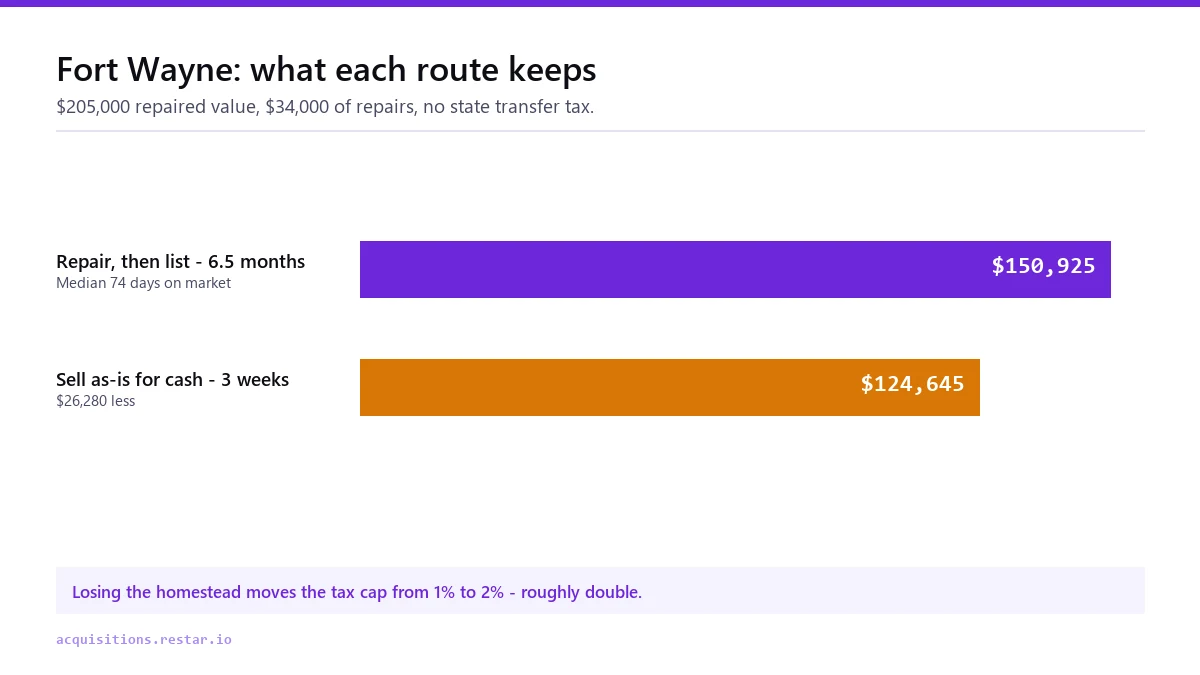
The six and a half months in that column is not padding, and Fort Wayne is the market where we can show it. Three months of repairs, then a median 74 days on market, then a financed closing on top. That is the number a cash buyer is really competing against, and it is why the certainty is worth something even though it is not worth $26,280 to most people. Where it does earn its price is where the timeline is not yours to control: a sheriff's sale already scheduled, an estate that has to be closed, a house whose furnace failed in January and whose pipes went with it.
One local note on timing that has nothing to do with law. Northern Indiana selling seasons are real, and a house that comes to market in late autumn will sit through the winter at the wrong price. A repair programme that finishes in February pushes the sale into a thin market and adds months to the holding column that the table above does not show. If you are starting work in September, run the numbers with nine months of carry rather than six and a half, and see whether the gap survives it.
We hold 795 recorded sales across 12 Fort Wayne ZIP codes, with a median of $186,900 and a median of 74 days on market. That last number is the one that makes the holding column on this page real, and it is the honest case for certainty being worth something. Send the address and we will put our figure in writing within 24 hours, with the comparables behind it and no obligation.
On the worked example below a retail listing keeps $26,280 more than we would pay. If you can fund the repairs and can wait out 74 days plus a closing, listing is the better route and we will tell you so. Where an Indiana sheriff's sale is scheduled, the deadline is absolute rather than negotiable, and that is the situation where speed genuinely beats price. Send us the property here.
All guides · We buy houses in Fort Wayne · Holding costs of a vacant house
Step 1 of 5
No obligation, no fees, no repairs. We respond the same day.
You’ll talk to Trevor McAmis, Owner & Acquisitions Lead
(313) 710-6129
Takes about two minutes. Or call (313) 710-6129 — we answer.