If you own a rental house built before 1978 anywhere near Baltimore, the Maryland lead risk reduction program is probably already attached to that property whether you've dealt with it or not. It requires annual registration with the Maryland Department of the Environment, a risk reduction certificate at each tenant turnover, and disclosure of any open obligations before you sell. Ignoring it doesn't make it go away. It just adds up.
Step 1 of 5
Tell us about the property and we'll give you a written cash offer within 24 hours, open violation or not.
You’ll talk to Trevor McAmis, Owner & Acquisitions Lead
(313) 710-6129
Takes about two minutes. Your address is never shared.
Educational only. This explains how these situations generally work. It is not legal, tax or financial advice, and the rules differ by state. Talk to an attorney or CPA about your own situation before you act on any of it.
This program has a separate name on paper (Maryland calls it the "Reduction of Lead Risk in Housing" program, codified in the Environment Article, Title 6, Subtitle 8), but landlords mostly just call it the lead law. It's not the same thing as the federal lead-paint disclosure rule you may have heard about for selling older homes. Maryland's version is rental-specific, it runs every year you own the property, and it has its own registration, inspection, and penalty structure. We'll walk through all of it, then get to what this means if you're trying to sell.
The Maryland lead risk reduction program applies to what the statute calls an "affected property." Under Environment Article §6-801, that's any property with at least one rental dwelling unit that was built before 1950. Since January 1, 2015, the definition expanded to also cover rental properties built before 1978. So if your Baltimore rowhouse, duplex, or multi-unit was built any time before 1978 and you rent it out, it's almost certainly covered.
There's an exception. A property that's been inspected and certified by MDE as "lead-free" (or "limited lead-free") is exempt from the ongoing registration and risk reduction requirements. That certification is a one-time finding from an accredited inspector, not something you can self-declare.
Properties built in 1978 or later fall outside this program entirely, because federal law banned residential lead paint that year.
If your rental is an affected property, you're required to register it with MDE, generally within 30 days of acquiring it, and renew that registration every year by December 31. There's a per-unit fee attached to registration and renewal; the exact amount has changed over the years and depends on your property's status, so confirm the current fee directly on MDE's registration portal rather than relying on an old number.
A few things catch owners off guard here. Registration is tied to the specific owner on record with the Maryland Department of Assessments and Taxation. When ownership changes hands, including a sale, the registration doesn't carry over. The new owner has to file a fresh registration under their own name and get a new tracking number, typically within 30 days of the transfer.
Failing to register, or letting a registration lapse past the renewal deadline, puts the property out of compliance even if the physical unit itself is in decent shape. That matters more than it sounds like, because compliance is what protects you from certain liability claims, more on that below.
Separate from registration, Maryland requires affected properties to pass a lead risk reduction standard and get a certificate from an MDE-accredited lead inspector. The inspection checks for things like defective interior and exterior paint, and the inspector tests for lead-contaminated dust.
This isn't a one-time certificate that lasts forever. Under §6-815 and §6-816 of the Environment Article, owners generally have to satisfy the risk reduction standard and pass inspection again at each change in occupancy, meaning every time a tenant moves out and a new one is about to move in. If your property has had the same tenant for years, you may not have had to touch this in a while. If you've had turnover, or you're planning to sell to someone who'll put a tenant back in, it's worth checking whether your certificate is current before you do anything else.
Maryland's law has a separate track that kicks in if a tenant notifies you of defective paint, or if a child or pregnant woman living in the unit is found to have an elevated blood lead level. Under §6-819, a standard that has applied to pre-1978 units since the law's January 2015 expansion, you generally have 30 days after that notice to complete a modified risk reduction standard (repainting and repairing specific surfaces, treating windows and doors, HEPA-vacuuming) and pass inspection, or temporarily relocate the tenant to a lead-safe unit while the work gets done.
If a child in the unit develops an elevated blood lead level, Maryland's law also gives an owner the option of making what's called a "qualified offer," essentially offering to relocate the family to a certified lead-safe unit and cover related medical costs, in lieu of facing a lawsuit. The exact blood-lead threshold and procedural requirements for a qualified offer are specific and have shifted over time as Maryland has tightened its reference levels. If you're dealing with an actual notice like this, that's the moment to call an attorney or MDE directly rather than work from a general guide.
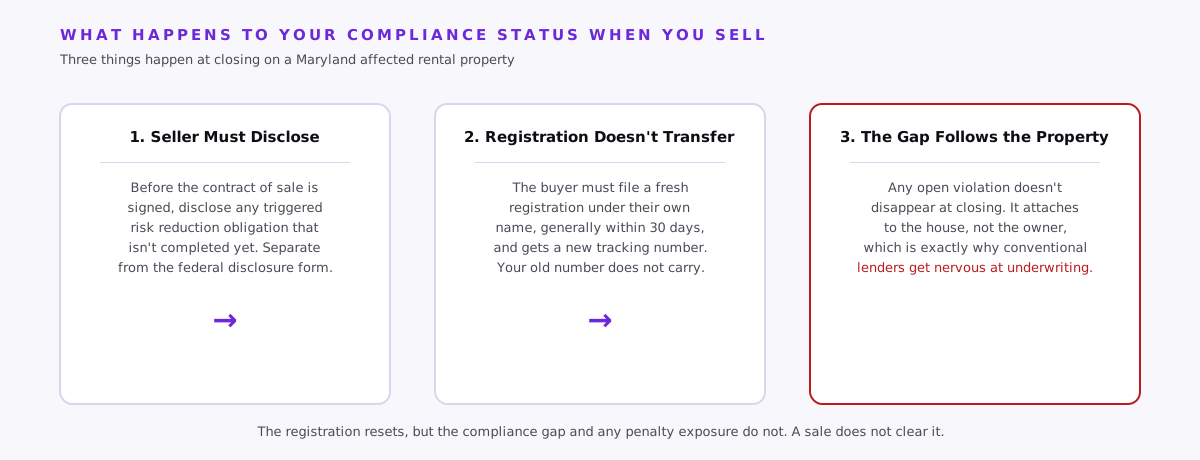
This is the part most existing guides skip, because it's specific to Maryland's rental program and not the same as the federal disclosure rule everyone talks about. Three things happen when an affected property changes hands.
The seller has to disclose to the buyer, before the contract of sale is signed, any risk reduction obligation that's already been triggered (by tenant turnover, a notice of defective paint, or a notice of elevated blood lead) and hasn't been completed yet. This is separate from, and in addition to, the federal lead-paint disclosure paperwork.
The registration itself does not transfer. The buyer has to register the property fresh, under their own name, generally within 30 days of taking ownership. They don't inherit your tracking number, but they do inherit the property's status as an affected property and whatever compliance gap exists on the day they close.
Any violation or open obligation doesn't disappear at closing. It follows the property. That's exactly why some conventional buyers, and their lenders, get nervous about a rowhouse with an open lead violation on record, and why some retail deals on these properties fall apart in underwriting.
If you've got a current violation notice, or you're not sure whether your registration or certificate is current, check our guide on selling a house with code violations for how recorded violations and fines typically get handled at closing.
It's easy to confuse these two, so here's the plain difference.
The federal lead-based paint disclosure rule (42 U.S.C. §4852d) applies to the sale of any home built before 1978, rental or not. It only requires disclosure: you tell the buyer what you know about lead paint in the house, hand over any records you have, give them the EPA pamphlet, include a lead warning statement in the contract, and give them a 10-day window to do their own inspection if they want one. It doesn't require you to test for lead or fix anything. We've got a full breakdown in our guide to the federal lead-based paint disclosure rule.
Maryland's lead risk reduction program is a different animal. It only applies to rental properties, it requires annual registration with a state agency, it requires an actual inspection and certificate from an accredited inspector tied to tenant turnover, and it has its own penalty structure for noncompliance that has nothing to do with the federal disclosure paperwork. You can be fully compliant with the federal disclosure rule and still be out of compliance with Maryland's program, and vice versa. Selling a Maryland rental means dealing with both.
Maryland backs this program with real penalties. An owner who fails to register an affected property, or fails to renew or update a registration on time, can face an administrative penalty of up to $20 per day under §6-849 until the registration is fixed.
Separately, failing to get a required risk reduction certificate can carry a civil penalty of up to $500 per day per affected property, capped at $100,000 total, until the certificate is filed with MDE.
On top of the dollar penalties, staying out of compliance costs you the liability protection that §6-836 otherwise gives owners who register and follow the risk reduction standard. Translation: noncompliance doesn't just risk a fine, it also strips away a legal protection you'd otherwise have if a tenant ever claims lead exposure.
These are the statutory ranges. Your specific notice from MDE will say what applies to your property.
Here's the math, because an open lead compliance issue changes the calculation on both paths.
Example: a Baltimore rowhouse with an ARV (after-repair value) of $210,000, built in the 1940s, with an expired lead certificate and a tenant who just moved out.
To list it retail, you'd typically need to complete the lead risk reduction treatment and pass inspection first, since most retail buyers and their lenders won't touch a property with an open lead obligation. Then you've got general repairs to make it market-ready, an agent's commission, likely some concessions after the buyer's own inspection, and holding costs while it sits on the market.
| List Retail (after compliance work) | Cash Sale As-Is | |
|---|---|---|
| Starting value (ARV) | $210,000 | $210,000 |
| Lead risk reduction treatment | −$3,500 | $0 (buyer absorbs it) |
| General repairs to list | −$8,000 | $0 |
| Agent commission (6%) | −$12,600 | $0 |
| Buyer concessions/credits | −$4,000 | $0 |
| Holding costs (~3 months) | −$4,200 | $0 |
| Estimated net to you | ~$177,700 | ~$150,000* |
| Typical time to close | 3-4 months | 1-2 weeks |
| Who handles the open compliance work | You, before listing | The buyer, after closing |
*Cash offers are built from the ARV minus repairs, holding costs, and the buyer's margin, so the exact number depends on the property's actual condition and compliance status. This is a round example, not a quote.
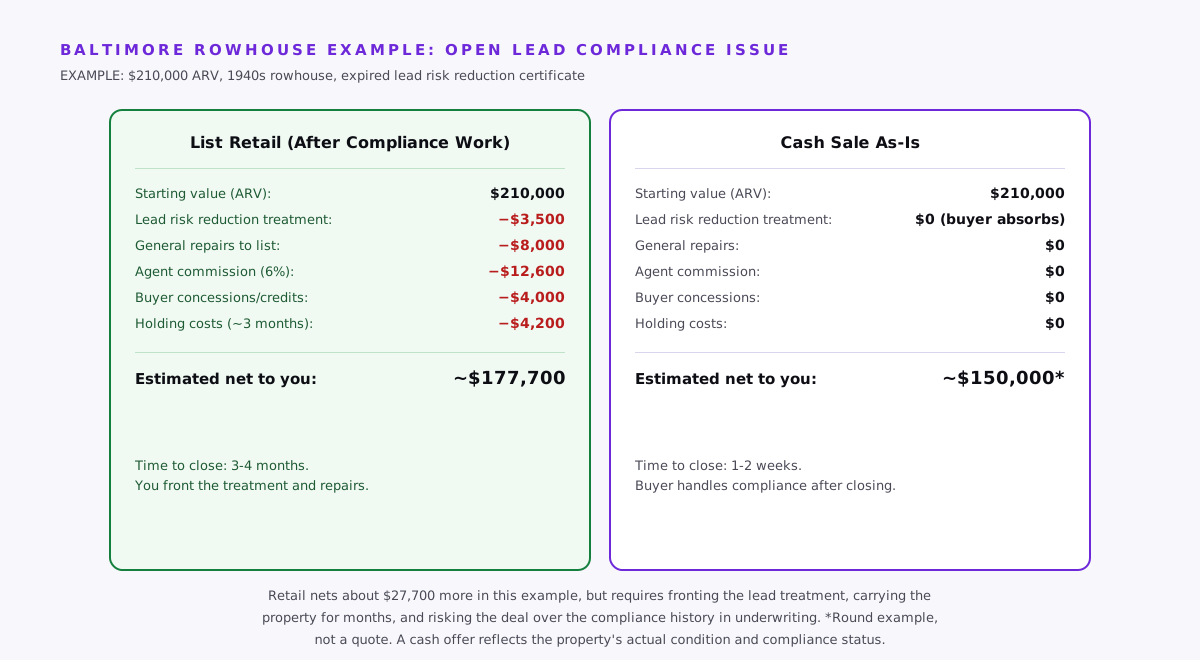
Retail nets more money in this example, around $27,700 more. It also requires you to front the lead treatment and repair costs, carry the property for several months, and risk a deal falling apart in underwriting over the compliance history. If you've got the cash and time and the property is otherwise in reasonable shape, listing with an agent after getting current on the lead certificate is a legitimate option, sometimes the better one. If you're out of cash for the treatment, out of time, or the violation is already escalating, selling as-is shifts that work and that risk to the buyer.
| Path | What it involves | Best when |
|---|---|---|
| Complete the risk reduction treatment, get the certificate, then list retail | Pay for inspection and treatment now, sell on the open market | You have the cash and time, and want full market exposure |
| Get the certificate, then sell to any buyer | Same compliance work, but you can take any offer once the certificate is filed | You want the compliance issue resolved without committing to a long listing |
| Sell as-is to an investor who takes on the compliance burden | Disclose the open obligation; the buyer absorbs registration, inspection, and treatment after closing | You're out of cash or time, or the property needs more work than it's worth fixing yourself |
| Consult an attorney about an existing violation notice | An attorney reviews your specific notice, deadline, and exposure | You've already received a notice from MDE or a tenant and need to know exactly where you stand |
Doing nothing isn't on that list on purpose. The penalties accrue daily, the liability protection stays off, and the obligation still follows the property whenever you do decide to sell or rent it again.
We buy rental houses in the Baltimore area as-is, including ones with an expired registration, a lapsed certificate, or an open violation notice. You get a written offer within 24 hours, no commission, no repairs or lead treatment required on your end, and you pick the closing date. If the lease has a tenant in place, it can transfer with the sale instead of forcing you through an eviction. If listing it after getting compliant would net you more, we'll tell you that too.
All guides · Tired landlord situation guide · Selling a house with code violations · We buy houses in Baltimore, MD
Step 1 of 5
No obligation, no fees, no repairs. We respond the same day.
You’ll talk to Trevor McAmis, Owner & Acquisitions Lead
(313) 710-6129
Takes about two minutes. Your address is never shared.