Every market page publishes the numbers behind its offer. See the math
Home › Guides › Selling a House With Code Violations: What Happens to the Fines at Closing
Guide
Selling a House With Code Violations: What Happens to the Fines at Closing
Open code violations don't stop a sale, but they do stop a clean one. The fines and abatement costs are usually recorded as a lien that has to be paid or resolved before title can transfer — and in cities that run vacant-building receivership programs, an ignored violation can escalate past a lien into losing the property outright.
Takes about two minutes. Or call
(313) 710-6129 — we answer.
Educational only. This explains how these situations generally work. It is not legal, tax or financial advice, and the rules differ by state — talk to an attorney or CPA about your own situation before you act on any of it.
Selling a house with code violations: the short answer
You can sell a house with code violations on it. A recorded violation, by itself, does not block a sale the way a court injunction would. What it usually creates is a municipal lien — the city's claim for unpaid fines, abatement costs, or work it did on the property (boarding, mowing, demolition of a hazard) — and liens have to be cleared, negotiated, or paid out of proceeds before a title company will issue clean title to a buyer.
This is educational information, not legal advice. Talk to a real estate attorney about your specific violation and jurisdiction.
The mechanics are close to any other lien — see our guide to selling a house with a lien on it for the general priority rules — but code violations have three things that make them behave differently from a mortgage or a judgment.
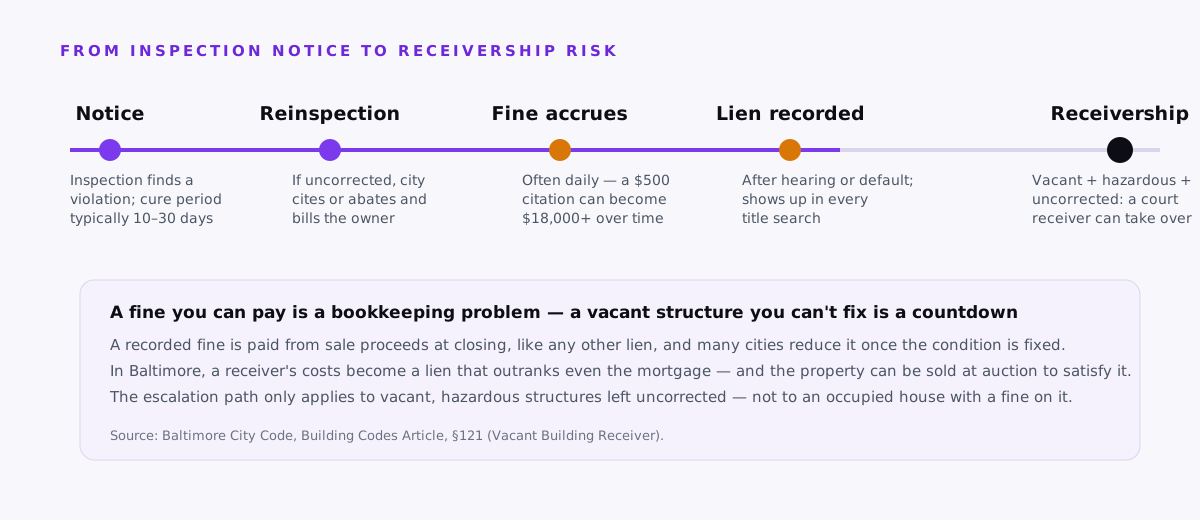
1. The debt can still be growing. Many cities assess fines per day the violation remains uncorrected, not as a one-time penalty. A $500 initial citation can become an $18,000 lien over eighteen months of daily accrual.
2. Cities will frequently reduce it — but usually only after the condition is fixed, or as part of a sale they have approved. Mitigation hearings exist in most municipal codes specifically because the fine's purpose is to compel a fix, not to collect revenue forever.
3. In some cities, ignoring it long enough moves past a lien and into losing control of the property. That is the part most sellers do not know about, and it is worth understanding even if your violation is not there yet.
How a violation becomes a lien
The sequence is broadly the same across the markets we buy in, though the names and timelines vary by city.
1. Inspection and notice. A code officer documents the violation — unpermitted work, an unsafe structure, an overgrown lot, a vacant or boarded building not properly registered — and mails or posts notice, usually with a cure period commonly running 10 to 30 days.
2. Reinspection. If uncorrected, the city either issues a citation or, for safety violations, may abate the condition itself and bill the owner.
3. The fine or abatement cost is recorded as a lien against the property, typically after a hearing or a default judgment if the owner does not appear.
4. The lien shows up in a title search, and a buyer's closing agent will require it resolved before insuring title.
Where it can go further — in cities running an active nuisance-abatement or receivership program — is a fifth step. If the property is vacant and the violation is a structural or safety hazard the owner never addresses, the city or a court-appointed receiver can take control of the repair, rehabilitation, or demolition process, with the cost secured by a lien that in some states outranks even the mortgage.
Where the fine can leadRestar Acquisitions · Baltimore City Code §121
Why Detroit, Baltimore and Cleveland sellers should read this section twice
Three of the markets we buy in — Michigan, Maryland and Ohio — run some of the more active code-enforcement and receivership programs in the country, because all three have a large stock of aging, formerly vacant housing.
Baltimore codified vacant-building receivership directly into its housing code. When an owner fails to remedy a Vacant Building Notice, the city's housing department can petition the District Court to appoint a receiver — currently a nonprofit that auctions the structure to a developer legally required to complete rehabilitation within a year. Under that section of the city code, the receiver's costs become a lien that has priority over all other liens and encumbrances except taxes and other government assessments — ahead of your mortgage. If the receiver forecloses, the property is sold at public auction and the former owner is paid only what is left after every lien in priority order, if anything (Baltimore City Code, Building Codes Article, §121).
Detroit runs a large blight-ticket system, and unpaid tickets attach to the parcel, not just the person cited. A buyer's title company will find every unpaid ticket on the parcel, including ones issued to a prior owner, because the lien follows the property rather than whoever was cited.
Cleveland, like many Ohio cities, enforces housing code through a dedicated housing court, and Ohio law authorizes receivership for chronically neglected, vacant structures in some circumstances — a similar sequence to Baltimore's: notice, hearing, and, for properties that stay vacant and hazardous, court-ordered receivership.
The through-line: a fine you can pay is a manageable problem. A vacant, hazardous structure you cannot afford to fix is a countdown, and in these cities the clock runs toward losing the property to a receiver, not just toward a bigger bill. If your house is vacant and cited, moving before that escalation matters more than negotiating the fine amount.
What actually happens at closing
For the more common case — a fine or abatement lien on an occupied or maintained property — closing works like any other lien payoff.
The title company's search turns up the recorded lien with a dollar amount.
The closing agent contacts the code enforcement or housing department for a current payoff or release figure, since fines sometimes continue accruing until a hearing date.
The lien is paid out of sale proceeds at closing, same as a mortgage, and the city records a release.
If proceeds do not cover it, the seller either negotiates a reduction, pays the difference in cash, or the sale does not close as structured.
The one place code violations differ meaningfully from a mortgage or judgment lien: many cities will reduce accrued fines once the underlying condition is fixed or a sale that will fix it is under contract. This is worth asking about directly, in writing, before you assume the full recorded amount is fixed. It is usually not a courtesy — it is because the fine existed to force a repair, and once a sale guarantees the repair happens, the city's interest in collecting the full daily-accrual amount drops.
What a violation actually costs you, in numbers
Say a house would sell for $185,000 repaired and code-compliant, needs $22,000 of work including curing an open violation, and carries a $9,400 accrued fine lien.
Line
List it repaired
Sell as-is for cash
Sale price
$185,000
$137,000
Repairs you fund first (incl. curing violation)
−$22,000
$0
Agent commission (5.5%)
−$10,175
$0
Seller closing costs
−$2,775
−$1,000
Holding costs while repairs happen
−$3,600 (3 months)
−$650 (2–3 weeks)
Code violation lien
−$9,400
−$9,400 (or negotiated down)
Net to you
$137,050
$125,950
This is a worked illustration on one hypothetical property, used to show how the arithmetic fits together — not a quote or a prediction about your house.
Listing nets roughly $11,100 more on these numbers — that is the honest answer, and if you can fund the $22,000 of repairs, including whatever cures the violation, and carry the property for three months, that route wins. Where the as-is route earns its keep is narrower: you do not have the repair capital, the violation is escalating toward receivership on a vacant property, or a hearing date is close enough that you need certainty faster than a retail listing can deliver it. Our cash offer vs listing net-proceeds guide runs this comparison across a wider range of conditions.
Alternatives to selling
Selling is not the only path off an open violation.
Cure it and stop the accrual. If the fix is affordable, this is often cheaper than the interest and legal costs of dragging it out.
Request a mitigation hearing. Most municipal codes allow the owner to appear and ask for a reduction, particularly once the condition is corrected.
Payment plan. Many cities offer installment arrangements on accrued fines rather than requiring a lump sum.
Rent it out, if it is occupiable and the violation is not a safety hazard — some cities require registration and inspection for rentals, worth checking before you go this route. Our rent-or-sell guide covers that decision in more depth.
What to actually do
1. Get the current payoff figure from the code enforcement or housing department directly — not the amount on the original citation, which is stale the moment fines keep accruing.
2. Ask whether the city offers mitigation or a payment plan, especially if the underlying condition is already fixed or about to be.
3. If the property is vacant, find out whether your city has an active receivership or nuisance-abatement track, and how close your file is to that threshold.
4. Order a title search before listing or accepting any offer, so you know every lien recorded, not just the one you received notice of.
5. Be careful of anyone who asks for money up front to "clear" a violation for you. Fines are paid to the city directly or through a licensed closing agent at closing, not to a third party in advance. This is a pattern the Consumer Financial Protection Bureau warns about in its foreclosure-relief scam guidance, and it applies here too.
Common questions
Do code violations have to be fixed before you can sell a house?
Not always. The violation itself does not block a sale, but any recorded lien for fines or abatement costs typically has to be paid, negotiated, or resolved before the closing agent can deliver clean title. Whether the underlying condition itself must be fixed depends on the buyer — a cash buyer can usually take the property as-is with the lien resolved at closing; a financed buyer's lender may require the violation cured first.
Can a city take my house over a code violation?
In cities with an active vacant-building receivership program — Baltimore's is the clearest example among our markets — a chronically neglected, vacant structure can be turned over to a court-appointed receiver, and the receiver's lien can outrank your mortgage. It is a multi-step process with notice and hearings first, not an automatic seizure, but it is a real outcome for properties that stay vacant and uncorrected.
Will the city reduce my fines if I sell the house?
Often, yes — many municipalities will mitigate accrued fines once the condition is fixed or a sale that guarantees the fix is under contract. Ask for a mitigation hearing directly with the code enforcement department, and get any reduction in writing before closing.
Does an unpaid blight ticket or citation follow the house or the person?
It follows the property. A buyer's title search will find liens recorded against the parcel regardless of who was cited, including tickets issued to a previous owner, so an unresolved violation from years ago can still surface at your closing.
What if the accrued fines are worth more than the house?
The same rule applies as any lien exceeding equity: the sale cannot close on ordinary terms without a negotiated reduction, a payment arrangement, or cash brought to the table. Talk to the code enforcement department about mitigation and to an attorney about your options before assuming the sale is dead.
Not sure what the violation is actually going to cost you?
If you can fund the repair and the fine is small relative to the house, cure it and list — a retail buyer's title company clears the same lien ours does, and you will very likely net more. We would tell you that on the phone.
Where we are useful is the harder version: a vacant property heading toward receivership, a fine you cannot fund while it keeps accruing, or a hearing date that is closer than a repair timeline. Send the address and we will send a written offer within 24 hours with the comparable sales it came from. No cost, no obligation. Start at tell us about the property.
Every offer on this site is underwritten by a person, not a form. If the
numbers do not work for you, say so and I will tell you what would.
Also from Restar
Want the data behind all of this?
Restar Acquisitions is the acquisitions arm of Restar — a housing-market analytics
platform tracking 180+ metrics across every U.S. market, with composite scores and 12-month
price forecasts. The numbers on this page come from the same work.