Every market page publishes the numbers behind its offer. See the math
Home › Guides › Lead-Based Paint Disclosure When Selling a House Built Before 1978
Guide
Lead-Based Paint Disclosure When Selling a House Built Before 1978
If your home was built before 1978, federal law requires a lead-based paint disclosure before you sell it, no matter how the sale happens. Cash offers, as-is sales, and FSBO deals are all covered the same as any agent-listed sale — the paperwork rides with the house, not the sale method.
Takes about two minutes. Or call
(313) 710-6129 — we answer.
Educational only. This explains how these situations generally work. It is not legal, tax or financial advice, and the rules differ by state — talk to an attorney or CPA about your own situation before you act on any of it.
Lead-based paint disclosure when selling a house: the short answer
Federal law requires any seller of a home built before 1978 to disclose known lead-based paint hazards, provide available records, hand buyers the EPA lead hazard pamphlet, and give them a 10-day window to test for lead before the contract becomes binding — regardless of whether the sale is for cash, as-is, or without an agent.
This is educational information, not legal advice. Consult a real estate attorney about your specific transaction.
This rule comes from Title X of the federal housing law (42 U.S.C. §4852d) and its implementing regulation, 40 CFR Part 745, Subpart F — sometimes called the Section 1018 disclosure rule. For the primary source, see EPA's Lead-Based Paint Disclosure Rule (Section 1018, Title X).
What the lead-based paint disclosure rule actually requires, step by step
The rule applies to "target housing" — residential property built before 1978, when lead-based paint was banned for consumer use. If your house falls in that window, here is what has to happen before the buyer becomes contractually obligated to purchase.
Disclose what you know. The seller must disclose any known lead-based paint or lead-based paint hazards in the home, including the basis for that knowledge, the location of the hazard, and its condition.
Turn over records. Any available reports, test results, or records related to lead-based paint in the home must be handed to the buyer.
Provide the EPA pamphlet. Every buyer must receive a copy of "Protect Your Family From Lead in Your Home."
Attach the Lead Warning Statement. The contract must include the federally required warning language, a signed seller disclosure, and a buyer acknowledgment of receipt.
Give the buyer a 10-day inspection window. Buyers must be given 10 days, or another period both parties agree to in writing, to conduct a lead-based paint risk assessment before being bound to the contract. A buyer can waive this, but only in writing.
Notice what is not on that list: there is no requirement to test for lead paint, and no requirement to remove or remediate it. The rule is a disclosure obligation, not a testing or repair mandate. A seller with no test results or records can honestly disclose "no knowledge" — but still has to go through the pamphlet, warning statement, and 10-day window.
Does selling for cash or as-is skip the paperwork?
No — an as-is or cash sale does not remove the disclosure requirement. The rule attaches to the seller and the property, not to financing, repair scope, or whether an agent is involved. FSBO sales, cash sales, and sales to investors are all fully covered. If you're a homeowner selling a pre-1978 house directly to a cash buyer, you are still the "seller" under Title X, and the disclosure, pamphlet, and 10-day window obligations still apply to you.
The confusion usually comes from a different rule entirely — the RRP Rule, covered below, which only kicks in when repair work is happening. Skipping renovation because you're selling as-is is not the same as skipping disclosure.
There are a handful of genuine exemptions, and they're narrow.
Housing with zero bedrooms (efficiency/studio units), unless a child under six will live there.
Housing designated for the elderly or persons with disabilities, as long as no child under six is expected to reside there.
Housing already certified lead-free by a certified inspector.
Short-term leases of 100 days or less with no possibility of renewal.
Foreclosure sales, which are exempt from the disclosure rule.
One nuance worth flagging: the foreclosure exemption is narrow and one-time. When a lender or investor later resells that same property to a third party, full disclosure obligations are re-triggered on that resale. The duty binds whoever is the seller in each transaction — it binds the homeowner selling to a cash buyer, and it would equally bind that buyer on any later resale, unless a specific exemption genuinely applies.
What happens if you don't disclose
Skipping disclosure isn't a paperwork technicality — it carries real legal exposure on two separate tracks.
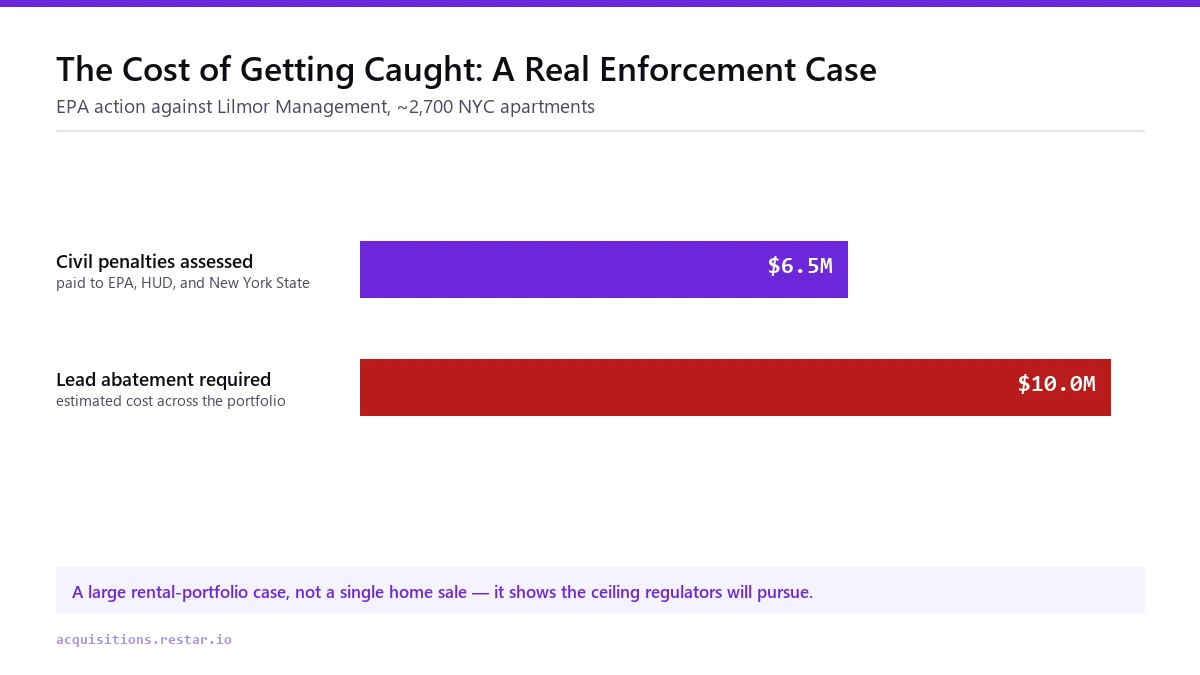
The first is regulatory enforcement. Civil penalties under the Toxic Substances Control Act are inflation-adjusted annually, and in actual enforcement actions they can reach tens of thousands of dollars per violation. The scale these cases can reach is illustrated by the EPA's enforcement action against Lilmor Management LLC in New York City, which required $6.5 million in civil penalties plus an estimated $10 million in lead abatement work across roughly 2,700 apartments. That case involved a large rental portfolio rather than a single home sale, but it shows the ceiling regulators are willing to pursue. See EPA: Enforcing Lead Laws and Regulations.
The cost of getting caught: a real enforcement caseRestar Acquisitions · a large rental-portfolio case, not a single home sale — illustrative of enforcement scale, not a per-violation figure.
The second track doesn't require the EPA to get involved at all. Title X creates a private right of action directly for buyers: under 42 U.S.C. §4852d(b)(3)-(4), a buyer who can show a seller knowingly violated the disclosure rule can sue for three times (treble) their actual damages, plus court costs and attorney's fees. See 42 U.S.C. §4852d for the statute.
The RRP Rule: renovating a pre-1978 home before you sell
A separate but related rule governs what happens if a seller does repair or renovation work on a pre-1978 house before putting it on the market. Under the Renovation, Repair, and Painting Rule (40 CFR Part 745, Subpart E), any work disturbing more than 6 square feet of painted surface indoors, or 20 square feet outdoors, must be performed by an EPA lead-safe-certified firm using an EPA-certified renovator. See EPA's Lead Renovation, Repair, and Painting Program.
Owner-occupants doing work on their own primary residence are exempt from the RRP certification requirement. That exemption does not extend to investors, flippers, or anyone renovating a property they don't live in for resale — that work is treated as paid renovation and falls squarely under RRP.
This is exactly where an as-is, no-repairs cash sale changes the picture: if no pre-sale renovation happens, the RRP Rule simply isn't triggered, because there's no repair work to regulate. What doesn't go away, no matter how the house is sold, is the disclosure obligation covered above.
What this looks like across our markets
Because this is a federal rule, it applies uniformly wherever pre-1978 target housing exists. In Alabama, Arizona, Georgia, Indiana, North Carolina, and Texas, no widely-documented statewide lead-disclosure statute layered on top of the federal requirement turned up in a general review — but state disclosure laws change, so confirm current requirements with a local real estate attorney rather than assuming federal law is the only rule that applies where you're selling. Ohio and Michigan fold the same disclosure obligations into their standard state property disclosure forms without adding new substantive requirements beyond Title X. Maryland is the one state here with its own additional statute, the Reduction of Lead Risk in Housing Act — but that law has historically been aimed at rental housing, so its application to a one-time home sale is narrower; anyone selling a Maryland rental property should ask an attorney how it interacts with a sale.
Housing age makes this rule relevant to a large share of homes in several of these markets. In cities like Rochester, NY and Baltimore, MD, the median home was built around 1920; in Birmingham, AL, around 1955. In markets with housing stock that old, the pre-1978 disclosure rule isn't an edge case — it applies to most homes changing hands. If you're dealing with an older home that also has other condition issues, related guidance on selling a damaged house, selling a house with mold, or selling a house with unpermitted work is worth reading, since older homes often carry more than one disclosure issue at once.
The practical seller takeaway
If your house was built before 1978, plan on these four things regardless of how you sell it: gather whatever records or knowledge you actually have about lead paint in the home (even "I don't know of any" is a valid disclosure); complete the seller disclosure form and attach the Lead Warning Statement language to the contract; provide the EPA pamphlet to the buyer; and honor the 10-day inspection window unless the buyer waives it in writing.
None of that changes because you're selling as-is or for cash — what changes is that you likely won't be doing pre-sale repair work, which means the separate RRP contractor-certification rule simply doesn't come into play. Selling as-is skips renovation, not disclosure. If you're weighing your options for a pre-1978 house, our page on selling your house fast covers how a no-repair, as-is cash sale works — but the lead disclosure paperwork happens either way, and a real estate attorney is the right resource for questions specific to your property or state.
Common questions
Does selling a house as-is for cash remove the lead paint disclosure requirement?
No. The disclosure requirement is tied to the age of the house and the fact that you're the seller, not to the financing or repair terms of the sale. Cash, as-is, and FSBO sales are all fully covered by the same disclosure rule as any other sale.
Do I have to test my house for lead paint before selling it?
No. The federal rule requires disclosure of what you already know — it does not require testing, inspection, or remediation. If you have no test results or records, you disclose that you have no knowledge of lead-based paint hazards.
What if my house was built after 1978 — does any of this apply?
No. The disclosure rule applies specifically to "target housing" built before 1978, when lead-based paint was banned for residential use. Homes built in 1978 or later are outside the rule's scope.
Can a buyer actually sue me if I don't disclose known lead paint?
Yes. Under 42 U.S.C. §4852d(b)(3)-(4), a buyer can bring a private lawsuit for a knowing violation and recover three times their actual damages, plus court costs and attorney's fees, without needing the EPA to take any action first.
Is a foreclosure sale exempt from lead disclosure?
Yes, foreclosure sales themselves are exempt. But that exemption doesn't carry forward — when the lender or new owner later resells that property to someone else, full disclosure obligations apply to that resale.
Selling an older home? We buy houses as-is, disclosures and all
A pre-1978 house doesn't need to be repainted, retested, or repaired before you sell it — the lead-based paint disclosure paperwork applies either way, and a cash sale simply means there's no pre-sale renovation to trigger the separate contractor-certification rule.
We buy houses as-is across 30 markets in Alabama, Arizona, Florida, Georgia, Indiana, Maryland, Michigan, New York, North Carolina, Ohio, and Texas. You disclose what you know, we make a written cash offer within 24 hours, and you pick the closing date.
Every offer on this site is underwritten by a person, not a form. If the
numbers do not work for you, say so and I will tell you what would.
Also from Restar
Want the data behind all of this?
Restar Acquisitions is the acquisitions arm of Restar — a housing-market analytics
platform tracking 180+ metrics across every U.S. market, with composite scores and 12-month
price forecasts. The numbers on this page come from the same work.