A seller's net sheet is a line-by-line estimate of what lands in your account after a sale: sale price minus mortgage payoff, commission, title and escrow fees, transfer tax, prorated property tax, and any repair credits. Build your own with real numbers before you price the house, not after an agent hands you an optimistic one.

Step 1 of 5
Send the address. We will show you, line by line, what a cash offer nets you, side by side with what a listing would need to net the same number.
You’ll talk to Trevor McAmis, Owner & Acquisitions Lead
(313) 710-6129
Takes about two minutes. Your address is never shared.
Educational only. This explains how these situations generally work. It is not legal, tax or financial advice, and the rules differ by state. Talk to an attorney or CPA about your own situation before you act on any of it.
Agents are not hiding anything when their net sheet looks optimistic. It is usually built early, before an inspection finds anything, before a buyer negotiates credits, and around the list price instead of the price you actually settle at. None of that is dishonest. It just means the sheet you saw in month one is not the sheet you will see at closing. Here is how to build one yourself that holds up.
1. Expected sale price. Use a number you can defend: recent comps adjusted for condition, not the top of the range your agent mentioned to win the listing.
2. Mortgage payoff. Call your lender for a payoff statement, not your last billing statement balance. It includes accrued interest to the payoff date and may include a small per-diem that grows the longer closing takes. See our guide on reading a mortgage payoff statement if the document confuses you.
3. Real estate commission. The national blended average runs close to 5.5% to 6% of sale price, split between listing and buyer-side agents, though it is negotiable and varies by market and brokerage. Use the percentage actually in your listing agreement, not a round guess.
4. Title, escrow, and closing fees. Typically 1% to 2% of sale price for the seller's share, covering title search, settlement/closing fee, and any owner's title policy the contract assigns to you. This varies by state; our seller closing costs guide has the fuller state-by-state breakdown, and the CFPB's closing-process overview explains how these fees get itemized on the paperwork.
5. Transfer tax. State and sometimes county/city tax on the deed transfer, ranging from nothing in some states to a percent or more of sale price in others. Check your state's specific rate; this is one of the few line items where a typical number can be off by a wide margin.
6. Prorated property tax. You owe property tax for the days you owned the home this tax year, settled at closing. If you are ahead on payments, you get a credit; if you are behind, it comes out of proceeds. This line gets skipped more than any other and it is rarely zero.
7. Negotiated repair credits or concessions. The number that does not exist until an inspection happens. Build a placeholder based on your home's age and condition (older systems, older roof, higher placeholder) and revise it the day you actually get an inspection report or buyer request.
A $280,000 listing, financed buyer, mortgage balance $140,000 at closing, inspection turns up $4,500 in repair requests the seller agrees to credit instead of fixing.
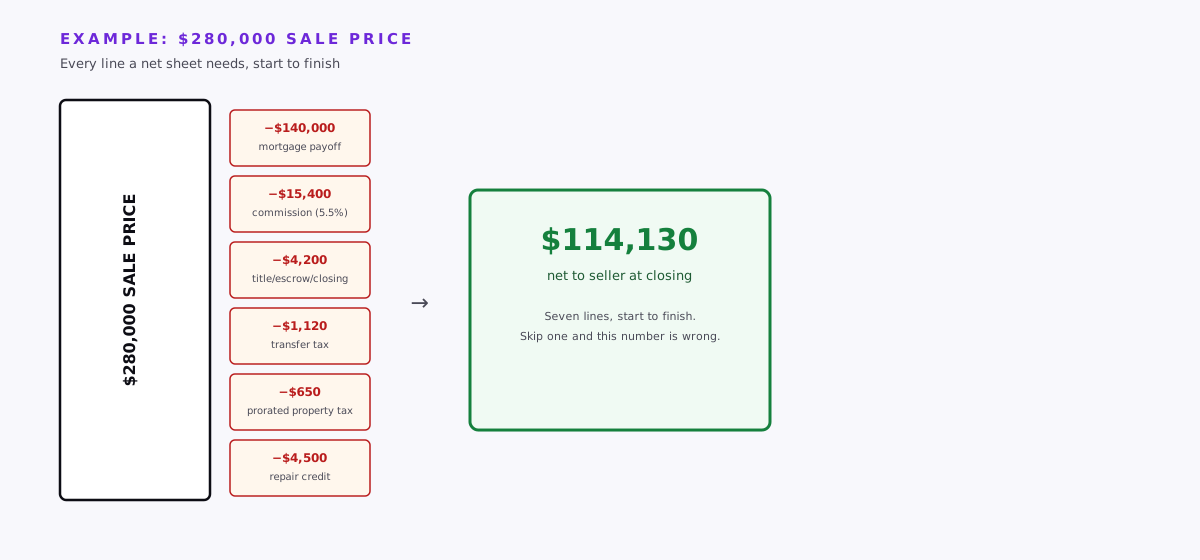
| Sale price | $280,000 |
| Mortgage payoff | −$140,000 |
| Commission (5.5%) | −$15,400 |
| Title/escrow/closing (1.5%) | −$4,200 |
| Transfer tax (0.4%, varies by state) | −$1,120 |
| Prorated property tax owed | −$650 |
| Repair credit to buyer | −$4,500 |
| Net to seller | $114,130 |
Run this with your own mortgage payoff, your own state's transfer tax, and a repair placeholder before you accept any offer, not after.
A cash sale's net sheet is shorter because several lines go to zero: no buyer-side financing means no appraisal gap risk, and a direct cash buyer typically covers its own closing costs and asks for no repair credit because it is buying as-is.
Using the same $280,000-value home, assume it needs the same $4,500 in deferred maintenance and a cash offer comes in at $248,000 to account for buying as-is and closing in two weeks instead of two months.
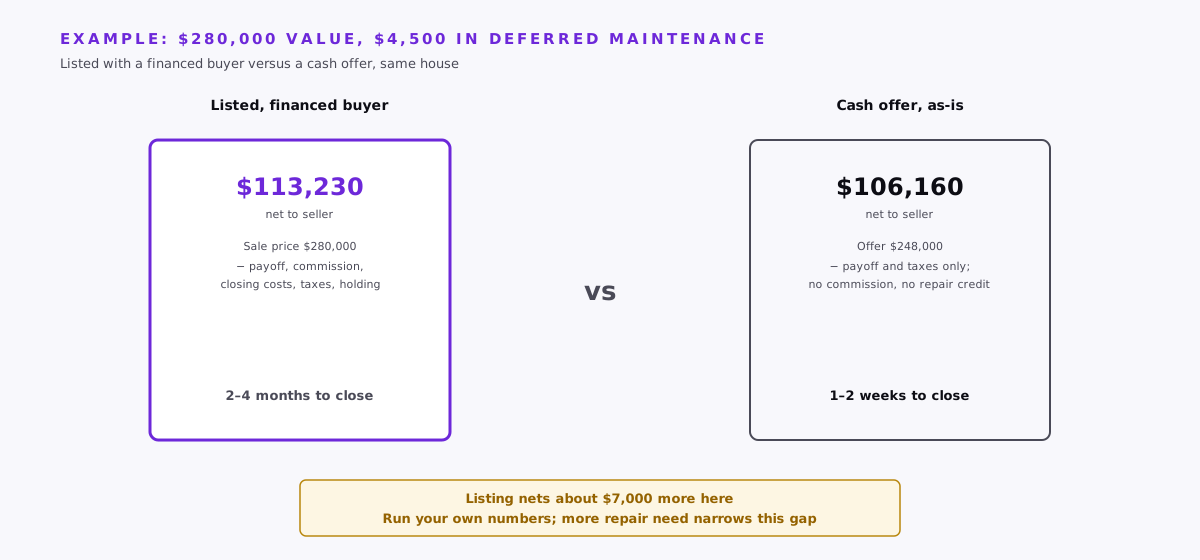
| Listed, financed buyer | Cash offer, as-is | |
| Sale price | $280,000 | $248,000 |
| Mortgage payoff | −$140,000 | −$140,000 |
| Commission | −$15,400 | $0 |
| Title/escrow/closing | −$4,200 | $0 |
| Transfer tax | −$1,120 | −$1,120 (often buyer-paid in a cash deal; confirm with your contract) |
| Prorated property tax | −$650 | −$650 |
| Repair credit | −$4,500 | $0 (priced into the offer) |
| Holding costs | −$900 (3 months) | −$70 (2 weeks) |
| Net to seller | $113,230 | $106,160 |
| Time to cash in hand | 2–4 months | 1–2 weeks |
Here, listing nets about $7,000 more. That is the real comparison: a cash offer trades some proceeds for speed and certainty, and the size of that trade depends entirely on your numbers; your mortgage balance, your repair needs, and how much your market's agents are actually charging. A house with more deferred maintenance or a longer expected days-on-market narrows or flips that gap. Build both sides before you decide which to take.
Forgetting the per-diem on mortgage interest. A payoff statement is only accurate through a specific date. Every day closing slips past that date adds interest. Get an updated payoff figure close to your actual closing date, not at the start of the process.
Assuming commission is a flat number instead of a percentage of the final price. If you negotiate the price down $10,000 during the inspection period, commission drops with it. Recalculate on the final price, not the list price.
Treating transfer tax as basically the same everywhere. It is not. Some states charge nothing; others charge enough to change which offer actually nets more. Confirm your specific state and county rate before comparing any two offers.
If you want to see what your house actually nets in cash, as-is, with no commission and no repair credit line to negotiate, we buy houses as-is, cover standard closing costs, and send a written offer within 24 hours. You pick the closing date. If your numbers show listing nets you more, we will tell you that too.
All guides · Cash offer vs listing net proceeds · Seller closing costs · Mortgage payoff statement explained
Step 1 of 5
No obligation, no fees, no repairs. We respond the same day.
You’ll talk to Trevor McAmis, Owner & Acquisitions Lead
(313) 710-6129
Takes about two minutes. Your address is never shared.
