Almost everything written about selling a house worth less than you owe quietly assumes you have equity anyway. When you genuinely do owe more than the house is worth, the arithmetic runs the other way and most of the usual advice stops applying — including ours. A cash buyer cannot close a sale that does not pay the lender off, and on the worked example below we land $90,500 short. What actually decides this is who has to approve the shortfall, how much of it is left behind, and a federal tax exclusion that expired at the end of 2025.

Step 1 of 5
Send the address and the payoff figure and we will tell you straight whether a sale can even close.
You’ll talk to Trevor McAmis, Owner & Acquisitions Lead
(313) 710-6129
Takes about two minutes. Or call (313) 710-6129 — we answer.
Educational only. This explains how these situations generally work. It is not legal, tax or financial advice, and the rules differ by state — talk to an attorney or CPA about your own situation before you act on any of it.
Selling a house worth less than you owe requires either cash from you to cover the gap at closing, or your lender's written approval of a short sale — nobody can convey clear title until the loan is satisfied or released. A listed sale leaves less debt behind than a cash sale, so listing usually wins here.
This is educational information, not legal, tax or financial advice. Deficiency rules, foreclosure timelines and the tax treatment of cancelled debt vary by state and by loan, and the federal exclusion discussed below has already lapsed once and been revived. Talk to an attorney and a CPA about your own situation, and start with a free HUD-approved housing counsellor.
This is the part of the page that costs us money, so it goes near the top.
A sale closes when the title company can pay every lien in full and hand the buyer clear title. A cash offer is not a magic instrument. If our figure is below your payoff, the closing simply cannot fund, and the only routes left are that you bring the difference in cash, or that your lender agrees in writing to accept less than it is owed and release the lien anyway. That second thing is a short sale, and it is your lender's decision, not the buyer's.
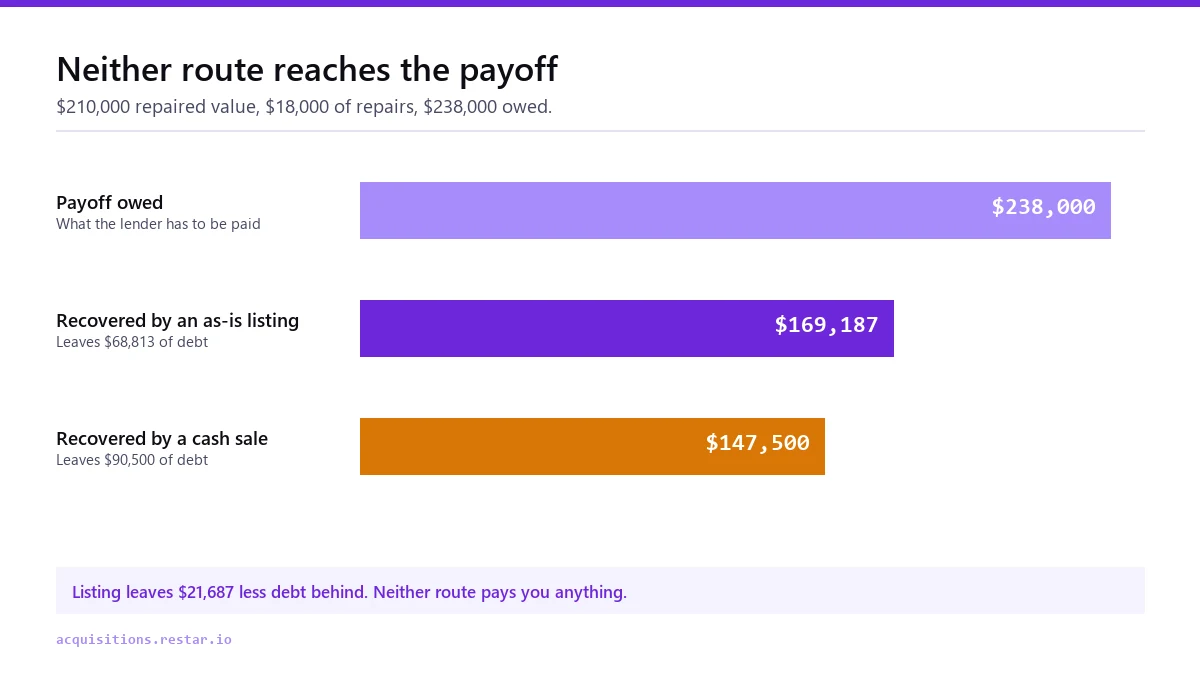
Here is the awkward consequence: because a short sale needs lender approval regardless, the lender is comparing offers on the amount it recovers. And a cash buyer's figure — ours included — is built to leave a margin for repairs, resale costs and risk. A listed sale hands the lender the retail price minus the commission. On the numbers below that difference is $21,687, which is $21,687 less debt following you afterwards.
So the honest ranking on selling a house worth less than you owe, when you are not able to write a cheque at closing, is usually: talk to your servicer's loss mitigation department first, a HUD-approved counsellor second, and an agent experienced in short sales third. We come into this in a narrow set of cases, and they are listed further down.
The Consumer Financial Protection Bureau's mortgage help pages set out the loss mitigation options a servicer is required to consider, and the CFPB's search for HUD-approved housing counsellors will find you free advice near you. Neither of them is selling you anything.
A house worth $210,000 fully repaired, needing $18,000 of work. The payoff statement says $238,000 including accrued interest, late fees and the foreclosure attorney's costs. Assume you cannot fund the repairs and cannot bring cash to closing, which is the ordinary case.
Route one: list it as-is on the open market. Retail buyers discount a house needing work by more than the repair bill — call it the repair cost plus a risk premium of about 45% of it, which is what the market charges for uncertainty and a smaller buyer pool. That prices the house at $183,900.
| Line | Amount |
|---|---|
| As-is list price | $183,900 |
| Agent commission (5.5%) | −$10,115 |
| Seller closing costs (1.5%) | −$2,759 |
| Buyer concessions (1%) | −$1,839 |
| Net proceeds the lender receives | $169,187 |
| Payoff owed | $238,000 |
| Shortfall left behind | $68,813 |
Route two: sell as-is for cash. Built with the four terms we publish in how cash home buyers calculate offers:
| Term | Amount |
|---|---|
| After-repair value | $210,000 |
| Repairs | −$18,000 |
| Resale and holding — commission $11,550, seller closing $2,100, purchase closing $1,600, five months' carry $5,250 | −$20,500 |
| Margin | −$24,000 |
| Illustrative cash figure | $147,500 |
| Payoff owed | $238,000 |
| Shortfall left behind | $90,500 |
A worked illustration on one hypothetical property. Not a quote, not a prediction about your house, and not a fixed formula we apply.
Listing leaves $21,687 less debt behind than selling to us would. Neither route puts a cent in your pocket — that is what underwater means — so the entire decision is about which one shrinks the deficiency more, and how fast each one can be done. There is no version of this page where our number wins on money.
One caution about speed, because it cuts against listing. A short sale is not fast. Servicers commonly take 30 to 90 days to review a complete package, and the whole process from listing to closing runs several months. If a foreclosure sale is four weeks away, the practical question stops being which route nets more and becomes which route can be started in time — and filing a complete loss mitigation application is what pauses the clock, not the offer.
The mechanics are more procedural than people expect, and knowing the order stops you wasting the weeks that matter.
Fannie Mae publishes its own short sale servicing requirements, including the rule that a subordinate lienholder must release the borrower and waive its right to a deficiency before it is paid — useful leverage to know about, and set out in the Fannie Mae short sale servicing guide.
A short sale that closes without addressing the shortfall can leave you owing it. The approval letter either releases you from the balance or it does not, and the difference between the words “release of lien” and “release of debt” is $68,813 in the example above.
Get the waiver in the approval letter, before closing. A lien release lets the sale close. A debt release ends the obligation. Ask for language that says the deficiency is waived and the debt is satisfied in full, and have an attorney read it. Whether a lender may pursue a deficiency at all after a short sale, and for how long, is state law — some states bar it on purchase-money loans, some bar it after a non-judicial foreclosure but not after a consensual short sale, and some allow it outright.
Then check what the waiver costs in tax. Cancelled debt is generally income. If $68,813 is forgiven, the lender may issue a Form 1099-C and the IRS will expect to see it on your return.
The rule most articles still get wrong. The qualified principal residence indebtedness exclusion, which let homeowners exclude forgiven mortgage debt on a main home, does not apply to discharges after 31 December 2025. IRS Publication 4681 states it plainly: qualified principal residence indebtedness cannot be excluded for discharges completed, or discharge agreements entered into, after that date. Congress has revived this exclusion retroactively more than once, so it may come back — but you cannot plan a 2026 closing on the assumption that it will.
What is still available is the insolvency exclusion, and it is permanent. Under it, cancelled debt is excluded to the extent you were insolvent immediately before the cancellation — that is, your total liabilities exceeded the fair market value of all your assets. Worked through on the same example: liabilities of $310,000 against assets worth $215,000 means insolvency of $95,000. Because $95,000 exceeds the $68,813 forgiven, the whole amount can be excluded. Most people in genuine negative equity are insolvent on this test, which is why it matters more than the expired exclusion does.
The rules, the worksheets and Form 982 are set out in IRS Publication 4681 on canceled debts and foreclosures. Run your own numbers with a CPA before you agree to anything — the insolvency calculation is a snapshot taken immediately before the cancellation, and getting the date wrong changes the answer.
Selling is one option among several, and for a lot of people reading this it is not the best one.
Reinstatement. If the problem was temporary and it is over, paying the arrears plus fees stops everything and leaves the loan intact. Ask for a written reinstatement quote with a good-through date.
Loan modification. Servicers of Fannie, Freddie, FHA, VA and USDA loans all run modification programmes that re-amortise the balance and can extend the term to bring the payment down. A modification keeps the house and does not create a deficiency. This is the first thing loss mitigation will look at, and you should let them.
Forbearance or a repayment plan. A pause or a temporary reduction for a defined hardship, with the missed amount added back later. Suited to a job loss with a known end date, not to a payment that was always unaffordable.
Renting it out and waiting. Underrated in exactly this situation, because negative equity closes from both ends at once. On the example above the house is $28,000 underwater against its repaired value. Principal paydown of about $310 a month is $3,720 a year, and 3% appreciation on $210,000 is $6,300 a year — roughly $10,020 a year, which erases $28,000 in about 2.8 years. That only works if the rent covers the payment, taxes, insurance, vacancy and repairs, so price it honestly, and read our guide to holding costs of a vacant house before assuming an empty month is cheap.
Deed in lieu of foreclosure. You hand the property back by agreement. It avoids the sale, is usually faster than a short sale, and often comes with a deficiency waiver — but lenders normally require the property to have been marketed first and the title to be clear of junior liens.
A family sale or a partial payoff. If a relative can fund the gap, a sale at the lender's approved figure with a family member contributing the shortfall closes cleanly and avoids the credit damage of a short sale. Document it properly; an undisclosed side agreement in a short sale is mortgage fraud, and lenders require an arm's-length affidavit precisely to catch it.
We do buy in this situation. It is just rarer than the rest of the internet suggests.
You can cover the gap and want it finished. If you have the cash to bring the shortfall to closing, no lender approval is needed at all and the decision reverts to a normal one: speed and certainty against price. That is the ordinary comparison in cash offer versus listing net proceeds.
The house will not survive a listing. Severe damage, an active code case, a condemnation notice or a property that cannot be shown safely will not attract retail buyers at any price, and the lender's own valuation will reflect that. Where the market's realistic price and our figure converge, the $21,687 gap collapses.
Nobody can run a five-month process. A short sale needs a seller who answers document requests for months. If the owner has died, is unwell, or is three states away with no local support, the route that requires the least of you may be the only one that completes.
Second and third liens make a listing unworkable. Some files are so encumbered that no retail closing can be assembled. That is a real reason to look at every route, ours included.
Foreclosure is days away and nothing has been filed. Sometimes the honest answer is that no sale of any kind will complete in time and the choice is between a deed in lieu and letting the sale happen. Either way, get a written reinstatement or payoff quote first and speak to a counsellor the same week.
One last thing, and it matters more than anything else on this page. People in negative equity are the single most heavily targeted group in this industry. Nobody legitimate needs a decision today, nobody legitimate charges an upfront fee to negotiate with your lender, and nobody legitimate asks you to make your mortgage payments to them instead or to sign a deed as security for help. Your servicer will talk to you for free, and so will a HUD counsellor. If a company's pitch depends on you moving fast, that is information about the company.
The one number that decides everything on this page is what the house is worth in the condition it is in today, against what the lender is owed. We will put the first half of that in writing within 24 hours, with the comparable sales behind it and no obligation, and you can hold it against your payoff statement.
Be aware of what the answer usually is. On the worked example below our figure lands $90,500 short of the payoff, and a listed sale lands $21,687 closer than we do. Where a property is underwater, an agent and a HUD-approved housing counsellor are almost always the right first calls, not us — and we would rather tell you that than waste three weeks of a foreclosure clock. Send us the property here if you want the as-is number for your own comparison.
All guides · Facing foreclosure · Selling a house in foreclosure
Step 1 of 5
No obligation, no fees, no repairs. We respond the same day.
You’ll talk to Trevor McAmis, Owner & Acquisitions Lead
(313) 710-6129
Takes about two minutes. Or call (313) 710-6129 — we answer.