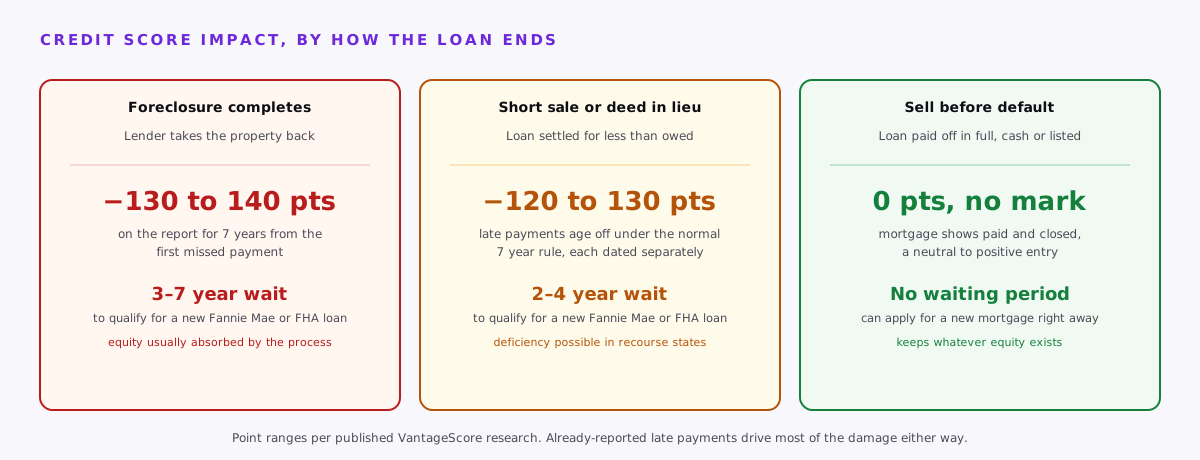
How does foreclosure affect your credit score? A completed foreclosure typically drops a credit score by around 130 to 140 points and stays on the credit report for seven years from the first missed payment. A short sale or deed in lieu runs slightly less severe, roughly 120 to 130 points, but selling the house before either one happens, including a straight cash sale, avoids both the score hit and the multi-year wait most lenders require before approving a new mortgage.

Step 1 of 5
Send the address and we will tell you what a cash sale nets before the next payment is due.
You’ll talk to Trevor McAmis, Owner & Acquisitions Lead
(313) 710-6129
Takes about two minutes. Your address is never shared.
Educational only. This explains how these situations generally work. It is not legal, tax or financial advice, and the rules differ by state. Talk to an attorney or CPA about your own situation before you act on any of it.
The foreclosure, the short sale, and the deed in lieu are not what wrecks a credit score. The missed payments leading up to any of them do most of the damage, and those are already reported before the final event happens. Selling the house before it gets to that point, for any price, protects the score and avoids the waiting period that comes with letting a lender take the property back.
This is educational information, not legal or financial advice. Mortgage investor guidelines and lender overlays change and vary by program. Confirm current terms with a specific lender before deciding.
A foreclosure, short sale, or deed in lieu is the last step, not the first hit. Credit scores start dropping the month a payment goes 30 days past due, and they keep dropping at 60 and 90 days. By the time a house completes a foreclosure sale or closes as a short sale, months of reported late payments have usually already done most of the damage. That is why people who were already several payments behind often see a smaller final drop from the foreclosure itself than someone who was current and then surrendered the house in one move, such as through an early deed in lieu.
This matters for the decision in front of a homeowner right now: the credit damage from being behind is largely already locked in once payments are missed. What is still avoidable is whether it ends in foreclosure, a short sale, or a sale that closes before the next missed payment.
Foreclosure. Based on published VantageScore research on credit-scoring impact, a completed foreclosure generally causes a decline of 130 to 140 points. It remains on the credit report for seven years, measured from the date of the first missed mortgage payment that led to the foreclosure, not from the sale date. Lenders treat it as one of the most serious derogatory events a credit file can carry, behind only bankruptcy.
Short sale or deed in lieu. The same research puts the typical hit at roughly 120 to 130 points, about 10 points less severe than a foreclosure on average. A short sale is not a recorded foreclosure, so there is no separate seven-year foreclosure mark, but the late payments leading up to it and the settled-for-less-than-owed status on the mortgage account still age off the credit report under the normal seven-year rule, each dated to when it happened.
Selling before default, cash or listed. If the house sells and the loan is paid off in full before a payment is ever reported late, there is no derogatory mark at all. The mortgage shows as paid and closed, which is a neutral-to-positive entry, not a negative one. This is the version most sellers do not realize is still available to them once they are a payment or two behind, as long as they move before the account rolls further past due.
Mortgage investors set a required waiting period after a derogatory credit event before they will back a new loan. These are the standard periods under Fannie Mae's Selling Guide B3-5.3-07, last revised August 7, 2019, and HUD's Handbook 4000.1, with the shorter extenuating-circumstances period where one applies:
| Event | Fannie Mae | FHA | VA (typical lender overlay) |
|---|---|---|---|
| Foreclosure | 7 years (3 with documented extenuating circumstances) | 3 years (as little as 12 months under the Back to Work exception) | 2 years |
| Short sale / deed in lieu | 4 years (2 with extenuating circumstances) | 3 years (waived if all payments were on time for the 12 months before the sale) | 2 years, often waived under the same no-late-payments condition |
| Sale before default | No waiting period | No waiting period | No waiting period |
The VA does not set a fixed national waiting period in its own guidance; the two-year figure is a common requirement individual VA lenders apply on top of VA's baseline rules. Always confirm the current figure with a specific lender, since these overlays can shift.
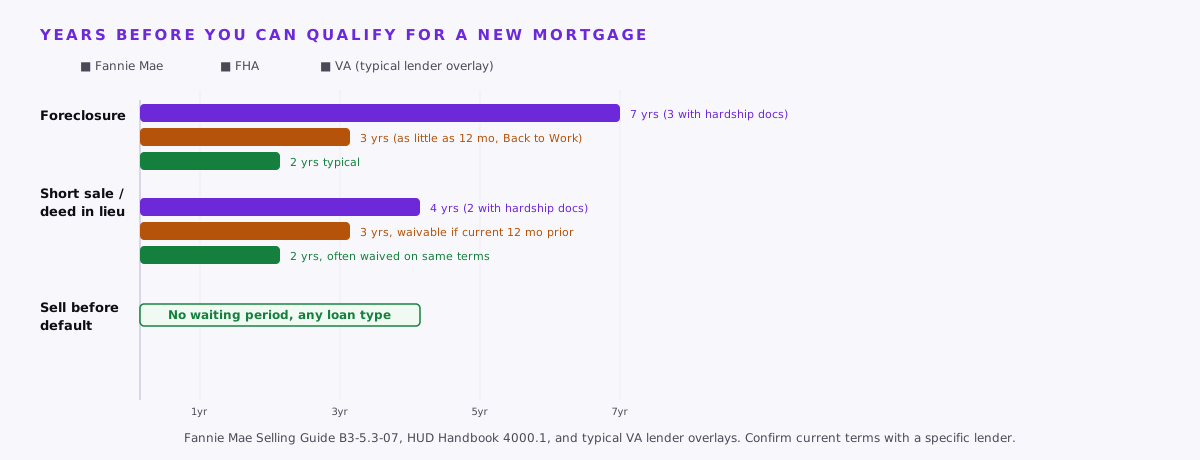
The pattern is consistent across every loan type: the event that happens before the credit hits bottom determines how many years someone is locked out of buying another house, not just how many points the score drops.
Example: A homeowner is two months behind on a $220,000 mortgage with about $40,000 in equity. The house could sell for roughly $240,000 fully marketed, or around $210,000 to $215,000 as a fast cash sale as-is.
If the homeowner does nothing and the loan eventually completes a foreclosure, the foreclosing lender's sale is structured to satisfy the debt and the costs of the foreclosure process first. In many cases there is little or nothing left over for the homeowner, even though there was $40,000 in equity before the process started. Add the 130 to 140 point credit hit and a 3 to 7 year wait to qualify for another mortgage.
A short sale, done with the lender's cooperation, can sometimes preserve a small amount for the homeowner depending on the payoff and the lender's agreement, but it still carries a 2 to 4 year waiting period and a comparable credit hit, and in a recourse state the lender can potentially pursue the difference between the sale price and the payoff unless that is waived in writing.
Selling now, before the next missed payment, at either the $240,000 retail number or the $210,000 to $215,000 cash number, pays off the loan in full, keeps the equity that would otherwise be absorbed by foreclosure costs, and leaves no derogatory mark at all. The retail listing nets more on paper, if there is enough time left before the next payment is due to get it marketed, repaired, and closed, usually 60 to 90 days. A cash sale nets less than retail but can close in 10 to 21 days, which matters when the real deadline is the next missed payment, not the calendar.
Selling is not the only way off this timeline. Before deciding, it is worth checking:
If none of those fit and the house is going to sell regardless, the comparison in this guide is between doing it now, before the next missed payment, and letting the process run. See selling a house in foreclosure for the full foreclosure timeline and what to have ready.
The credit and requalification math on this page only matters if there is still time to act. If a payment has not been missed yet, or you are only a payment or two behind, we can put a written cash figure in front of you within 24 hours so you can weigh it against listing, a loan modification, or riding it out.
We buy as-is, cover standard closing costs, and can close in 10 to 21 days, often before a notice of default would even be filed. Send us the property here.
All guides · Selling a house in foreclosure · The real cost of a short sale
Step 1 of 5
No obligation, no fees, no repairs. We respond the same day.
You’ll talk to Trevor McAmis, Owner & Acquisitions Lead
(313) 710-6129
Takes about two minutes. Your address is never shared.
