Every market page publishes the numbers behind its offer. See the math
Home › Guides › The Real Cost of a Short Sale: Taxes, Deficiency, Timeline
Guide
The Real Cost of a Short Sale: Taxes, Deficiency, Timeline
A short sale rarely takes cash out of your pocket at the closing table — the lender approves the sale and usually pays real estate commission and closing costs out of the proceeds. That's exactly why so many explanations stop there and call it free. The real cost of a short sale shows up in three other places: a possible tax bill on the debt that gets forgiven, a deficiency judgment if the lender doesn't waive it in writing, and months of uncertainty while you wait for an answer.
Underwater and not sure a short sale is even the right move?
Send the address and what you owe. We'll tell you honestly whether a cash sale gets you to the same place faster, or whether you actually need lender approval either way.
Takes about two minutes. Or call
(313) 710-6129 — we answer.
Educational only. This explains how these situations generally work. It is not legal, tax or financial advice, and the rules differ by state — talk to an attorney or CPA about your own situation before you act on any of it.
The real cost of a short sale: the short answer
A short sale usually costs you no cash at closing since lender-approved proceeds cover commission and closing costs, but it can still cost you a tax bill on forgiven debt now that the federal exclusion has expired, a deficiency judgment if the lender doesn't waive it in writing, and 60 to 120-plus days of waiting on approval.
This is educational information, not legal or tax advice. Deficiency rules, lender approval requirements, and the tax treatment of forgiven debt vary by state, by loan, and by your overall financial situation — confirm your specific case with an attorney or a CPA before assuming any of this applies to you.
What a short sale actually is, and what it isn't
A short sale is a sale of your home for less than what you owe on your mortgage, with your lender's advance agreement to accept that shortfall and release its lien. According to the Consumer Financial Protection Bureau, it's a form of loss mitigation — something you and your servicer work out together, not a legal process like foreclosure. You typically still list with a real estate agent and market the house normally; the difference is that every offer has to be submitted to the lender for approval, and the lender can reject a price it considers too low. That approval step is the real cost of a short sale that most explanations skip over entirely.
It is not the same thing as a deed in lieu of foreclosure (no buyer, no sale, you just hand back the deed) and it is not the same thing as foreclosure itself (the lender takes the house through a legal process rather than approving a sale to a third party). It also isn't free just because you don't write a check at closing — that's the entire point of this page.
Cost #1: the tax bill on forgiven debt, and why 2026 changes the math
When a lender forgives part of what you owe, the IRS generally treats that forgiven amount as taxable cancellation-of-debt income, reported to you on a Form 1099-C. For years, a law commonly called the Mortgage Forgiveness Debt Relief Act let homeowners exclude forgiven debt on a primary residence — the "qualified principal residence indebtedness" exclusion — from taxable income, up to $750,000 of debt ($375,000 married filing separately).
That exclusion has been extended repeatedly since it first expired in 2017, but per IRS guidance it applies only to debt discharged before January 1, 2026, or discharged later under a written agreement entered into before that date. As of this writing, it has not been extended further. That means a short sale that closes in 2026 under a new agreement can generate a real federal tax bill on the forgiven amount unless Congress renews the exclusion or you qualify for a separate exception — most commonly the insolvency exclusion, which applies if your total debts exceeded your total assets immediately before the discharge, regardless of what happens with the principal-residence exclusion.
Concretely: forgive $30,000 on a short sale and, without an exclusion, that can add $30,000 of ordinary taxable income in the year the debt is discharged — enough to push some sellers into a higher bracket. This is exactly the kind of number a CPA needs to run before you sign, using IRS Form 982 to claim any exclusion you do qualify for. IRS Publication 4681 covers the full mechanics of canceled-debt income and both exclusions in detail.
Cost #2: deficiency risk if the lender doesn't waive it in writing
The gap between what you owed and what the house sold for is called a deficiency. In many states, a lender can legally sue you for that difference even after approving the short sale, unless the approval letter explicitly waives the deficiency. The CFPB's own guidance on short sales tells homeowners directly to ask their lender to waive the deficiency before going through with the sale — not after.
Whether a lender can pursue a deficiency at all depends on your state's law and your specific loan (purchase-money loans, for example, get different treatment than refinances in some states), so this is not something to assume either way. Get the waiver in writing as a condition of the short sale, and have an attorney confirm what your state allows before you close without one.
Cost #3: time, and what it costs while you wait
Lender review of a short sale offer commonly takes 60 to 120 days or longer, especially if there's a second lien holder who also has to approve the deal. Buyers sometimes walk away during that wait rather than keep their financing locked and their own housing plans on hold, which can send you back to the beginning with a new buyer and a new review.
Meanwhile the carrying costs on the house don't pause: mortgage interest, property tax, insurance, and basic utilities keep accruing. At roughly $1,100 a month, four extra months of waiting is another $4,400 spent just to stand still — on a house you're already trying to get out from under.
The honest math: when a short sale even applies
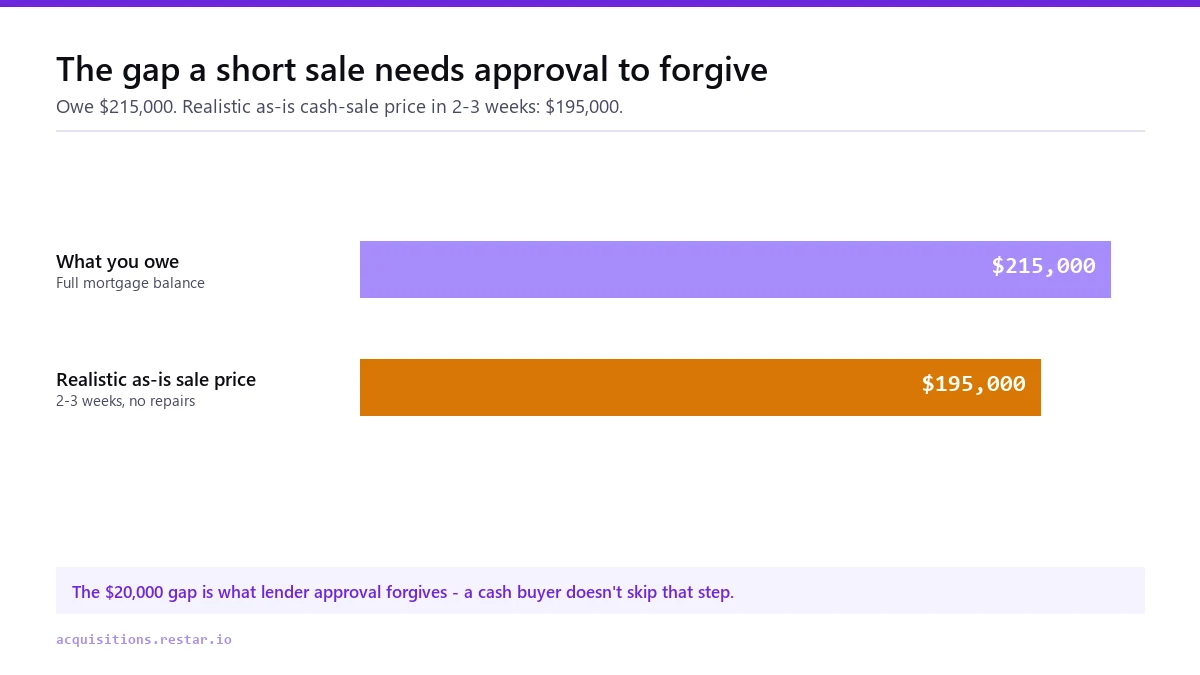
A short sale only matters if a realistic sale price genuinely won't cover the payoff. Work backward from what the house will actually sell for, not its listed value:
You owe
$215,000
Realistic as-is cash-sale price, 2–3 weeks
$195,000
Gap a short sale would need lender approval to forgive
$20,000
The gap a short sale needs approval to forgiveRestar Acquisitions · worked example from this page
A worked illustration on one hypothetical property. Not a quote, not a prediction about your house, and not a fixed formula we apply.
If you can bring $20,000 in cash to the closing table yourself — from savings, a family loan, or another source — you can sell to any buyer, cash or financed, without lender short-sale approval at all, because the lien gets paid in full. That's worth checking before you assume you need one. If you can't cover the gap, the short sale route and a cash-buyer sale converge on the same lender approval step — the real difference a cash buyer offers here is removing the buyer's own financing contingency from an already uncertain approval process, not skipping the approval itself.
Alternatives to a short sale
Reinstatement or a repayment plan — catching the loan back up if you can, avoiding a sale entirely.
Loan modification — permanently changing the loan terms to make payments work.
Deed in lieu of foreclosure — handing back the deed, which also has deficiency and tax implications worth comparing against a short sale directly.
Bring cash to close the gap yourself — if the shortfall is small enough, this avoids lender short-sale approval altogether.
Rent the house out instead of selling, if your finances and the numbers support it.
A HUD-approved housing counselor can walk through all of these against your specific loan at no cost, before you commit to any one path.
Common questions
Does a short sale hurt your credit as much as a foreclosure?
A short sale is generally reported to credit bureaus as a settled or charged-off account and does damage your score, but it's often viewed somewhat less severely than a completed foreclosure, and some future loan programs allow a shorter waiting period afterward. Confirm current waiting-period rules with a lender directly, since they change.
How long does a short sale actually take?
Plan on 60 to 120 days for lender review alone, and longer if there's a second lien or the buyer's financing needs an extension. Some approvals move faster, but treat the shorter timeline as the exception, not the plan.
Do I need a real estate agent for a short sale?
Most lenders expect the house to be listed and marketed normally, so yes, a licensed agent experienced with short sales is standard, and their commission is typically paid from the approved proceeds rather than out of your pocket.
Is forgiven short sale debt taxable in 2026?
By default, yes — the federal exclusion that made this tax-free for many homeowners applies only to debt discharged before January 1, 2026, or under a written agreement signed before that date, and it has not been extended further as of this writing. A separate insolvency exclusion may still apply depending on your finances; a CPA needs to check both.
Can my lender sue me for the difference after a short sale?
It's possible unless your approval letter specifically waives the deficiency, and whether it's even legal for the lender to try depends on your state and loan type. Get the waiver in writing before you close, and have an attorney confirm your state's rules.
What is IRS Form 982 for?
It's the form used to claim an exclusion from cancellation-of-debt income, whether under the (currently expired for 2026 and later) principal-residence exclusion or the insolvency exclusion. A CPA can confirm which, if any, applies to your situation.
A cash buyer doesn't skip lender approval — but it can remove one variable
If your payoff is more than the house is worth, any sale — ours included — still needs your lender to approve releasing the lien for less than you owe. What a cash offer changes is the other side of the deal: no financing contingency that can collapse mid-approval, and no second buyer to find if the first one walks during the wait. Send us the address and we'll tell you plainly whether that's worth anything in your specific situation.
If you have any real equity at all, a short sale doesn't apply to you — a normal sale does, and it will almost always net you more.
Every offer on this site is underwritten by a person, not a form. If the
numbers do not work for you, say so and I will tell you what would.
Also from Restar
Want the data behind all of this?
Restar Acquisitions is the acquisitions arm of Restar — a housing-market analytics
platform tracking 180+ metrics across every U.S. market, with composite scores and 12-month
price forecasts. The numbers on this page come from the same work.