Every market page publishes the numbers behind its offer. See the math
Home › Guides › Deed in Lieu of Foreclosure Explained: What It Costs You
Guide
Deed in Lieu of Foreclosure Explained: What It Costs You
A deed in lieu of foreclosure sounds like a clean way out of a mortgage you can no longer afford, and for some homeowners it is the right move. What almost never gets said plainly is that a deed in lieu pays you nothing for whatever equity is in the house — it satisfies your debt, not your ownership stake, which means the single biggest question before signing one is whether you have equity worth selling for instead.
Takes about two minutes. Or call
(313) 710-6129 — we answer.
Educational only. This explains how these situations generally work. It is not legal, tax or financial advice, and the rules differ by state — talk to an attorney or CPA about your own situation before you act on any of it.
Deed in lieu of foreclosure: the short answer
A deed in lieu of foreclosure is a voluntary transfer of your home's title to the lender in exchange for being released from the loan, skipping foreclosure. It typically pays you nothing for any equity in the house beyond limited relocation assistance, so it is usually wrong if a sale could clear your mortgage and leave you money.
This is educational information, not legal or tax advice. Deficiency judgment rules, tax treatment of forgiven debt, and lender requirements vary by state and by loan — confirm your specific situation with an attorney or a HUD-approved housing counselor before signing.
What actually happens in a deed in lieu
You sign the deed to your house over to your mortgage servicer or its investor, and in exchange the lender agrees to consider your mortgage debt satisfied. There is no buyer, no purchase price, and no closing in the traditional sense — it is a transfer to settle a debt, not a sale. Most major loan owners, including Fannie Mae, run a formal version of this called a Mortgage Release program, which pays qualifying borrowers up to $7,500 in relocation assistance on completion — a fixed number worth comparing against whatever equity the house actually holds before assuming it is a fair trade.
For a deed in lieu to go through, the servicer generally needs to be able to deliver clear and marketable title. If there is a second mortgage, a HELOC, an HOA lien, or a judgment lien on the property, those junior lienholders have to release their claims first. Fannie Mae's own program will pay junior lienholders up to $6,000 in aggregate to obtain those releases — a sign of how routinely other liens complicate what looks like a simple transaction on paper.
The deficiency question: get the waiver in writing
The most important sentence in a deed in lieu agreement is the one that says whether the lender waives its right to sue you later for a deficiency — the gap between what you owed and what the house was actually worth. Some states restrict deficiency judgments after a deed in lieu by law; in states that do not, nothing stops a lender from accepting the deed and coming after you for the difference unless the agreement explicitly says otherwise. The CFPB is direct about this: get the deficiency waiver in writing and keep the document, because a verbal assurance from a loss mitigation representative is not something you can enforce two years later.
The tax bill hiding inside debt forgiveness
Cancelled mortgage debt is generally treated as taxable income by the IRS, reported to you and the IRS on a Form 1099-C once $600 or more is forgiven. For years, the Qualified Principal Residence Indebtedness exclusion sheltered most homeowners from this on their primary residence, but that exclusion expired for debts discharged after December 31, 2025 — it still applies if you entered into a written agreement before that date, even if the actual transfer happens later, which makes the timing of your paperwork worth confirming with whoever is preparing your taxes.
Without that exclusion, the permanent fallback most underwater homeowners rely on is the insolvency exclusion: if your total debts exceeded your total assets immediately before the deed in lieu, you can exclude the forgiven amount from income up to the extent you were insolvent, using IRS Form 982. This is exactly the situation many deed-in-lieu candidates are already in, but it is not automatic — it has to be calculated and claimed on your return.
The equity question nobody selling you on a deed in lieu wants you to ask
A deed in lieu makes sense when there is little or no equity left, because in that situation no sale — retail, cash, or otherwise — would clear the mortgage and leave you anything anyway, and avoiding a completed foreclosure on your record has real value. It stops making sense the moment there is meaningful equity in the house, because a deed in lieu forfeits every dollar of that equity to the lender for nothing beyond the debt release and, in some programs, a flat relocation payment.
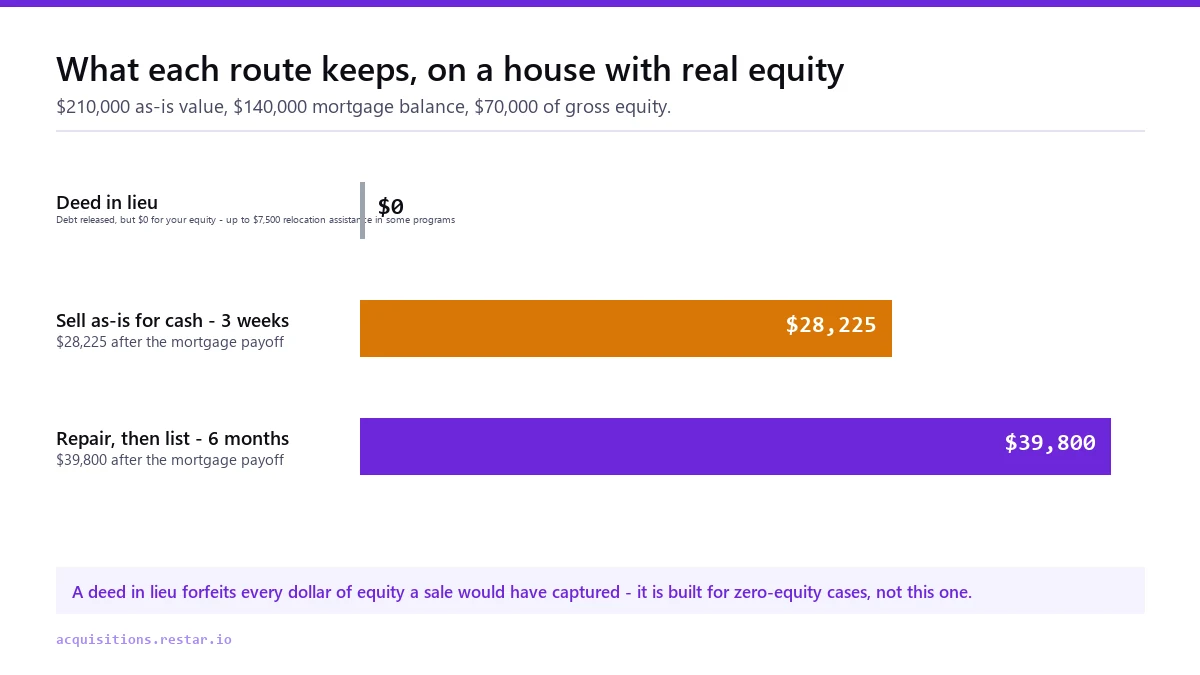
A house worth $210,000 as-is, needing about $8,000 of repairs, with a $140,000 mortgage balance — $70,000 of gross equity before any selling costs.
Route
What you keep after the mortgage
Deed in lieu
$0, plus up to $7,500 relocation assistance in some programs
Sell as-is for cash
$28,225
Repair, then list with an agent
$39,800
The listing figure: $210,000 sale price, minus $8,000 repairs, minus $11,550 commission (5.5%), minus $3,150 seller closing costs (1.5%), minus $2,100 buyer concessions (1%), minus $5,400 of holding at $900 a month for six months, leaves $179,800 before the mortgage, then minus the $140,000 mortgage payoff leaves $39,800. The cash figure follows the four-term formula from how cash home buyers calculate offers: $210,000 after-repair value, minus $8,000 repairs, minus $20,100 of resale commission, resale closing costs and six months of carry, minus $13,000 of margin, leaves a $168,900 cash offer; minus three weeks of the seller's own holding at $675 leaves $168,225 before the mortgage, then minus the $140,000 mortgage payoff leaves $28,225.
A worked illustration on one hypothetical property. Not a quote, not a prediction about your house, and not a fixed formula we apply.
What each route keeps, on a house with real equityRestar Acquisitions · worked example from this page
Listing wins by $11,575 over a cash sale in this example — but the number that actually matters here is the one next to deed in lieu. Signing one on a house with $70,000 of gross equity means giving up as much as $39,800 that a normal sale, even a fast one, would have put in your pocket.
When a deed in lieu is genuinely the right call
You are underwater or at break-even — no sale route would clear the mortgage and leave you anything, so the comparison in this article does not apply.
You need to move quickly and cannot carry a listing process — a deed in lieu is often faster than a full sale once approved, though the servicer's own review can still take weeks.
Avoiding a completed foreclosure on your record matters to you — a deed in lieu is generally viewed as less damaging to future credit and rental applications than a finished foreclosure.
You have already tried and failed to sell — if the house has been listed with no serious offers and time is running out, a deed in lieu becomes one of the few paths left.
Alternatives worth ruling out first
Loan modification or forbearance — if the underlying problem is a temporary cash-flow gap rather than a house you can no longer afford at all, your servicer may adjust the loan instead.
A short sale — selling to a third-party buyer for less than the mortgage balance, with the lender's approval, which can sometimes recover more for the lender than a deed in lieu and occasionally preserves a small payment to the borrower.
Selling for cash or on the retail market, if there is any equity at all, following the comparison above.
Renting the property out while you stabilize your finances, if the mortgage is current enough that this is realistic and your lender allows it.
A HUD-approved housing counselor can review your specific numbers for free before you commit to any of these — the CFPB's page on deeds in lieu links directly to that resource.
Common questions
Does a deed in lieu of foreclosure pay you anything?
Generally no cash for your equity. A deed in lieu satisfies your mortgage debt by transferring title to the lender, but it does not compensate you for any equity in the house. Some programs, including Fannie Mae's Mortgage Release, pay up to $7,500 in relocation assistance — far less than a sale would likely produce if there is meaningful equity.
Will I owe taxes after a deed in lieu of foreclosure?
Possibly. Forgiven mortgage debt is generally taxable income reported on Form 1099-C. The Qualified Principal Residence Indebtedness exclusion that used to shelter most homeowners expired for debts discharged after December 31, 2025, though it still covers written agreements signed before that date. Many underwater homeowners can still exclude forgiven debt using the insolvency exclusion on IRS Form 982.
Can a lender still sue me for money after a deed in lieu?
It depends on your state and the specific agreement. Some states restrict deficiency judgments after a deed in lieu; in states that do not, the lender can pursue you for the gap between what you owed and the home's value unless the agreement includes a written deficiency waiver. Always get that waiver in writing before signing.
What is the difference between a deed in lieu and a short sale?
A deed in lieu transfers your home directly to the lender to satisfy the debt, with no buyer involved. A short sale involves selling to a third-party buyer for less than the mortgage balance, with the lender's approval to release its lien for less than it is owed. A short sale usually takes longer but can sometimes recover more value for both the lender and, occasionally, the borrower.
Do I need to try to sell my house before doing a deed in lieu?
It depends on the lender and program — Fannie Mae's Mortgage Release program does not require the property to have been marketed for sale first, presenting it as a direct alternative to foreclosure. Other servicers may have different requirements, so confirm directly with your loss mitigation representative.
Is a deed in lieu better for my credit than a foreclosure?
It is generally considered less damaging than a completed foreclosure, since it resolves the debt without the lender having to complete a foreclosure sale. It still shows up on your credit history and affects your ability to qualify for a new mortgage for a period of time, so it is not a credit-neutral option.
Check whether you have equity before you sign anything away
A deed in lieu releases you from the mortgage debt, but it does not pay you for any equity in the house — it transfers the property to the lender to satisfy what you owe, full stop. Before you sign one, send us the address and we will tell you honestly whether there is equity worth selling for instead, even on a fast, as-is timeline.
If you are underwater and a deed in lieu genuinely is the least-bad option, we will tell you that too — our business is buying houses with equity in them, not talking someone with none into a sale that cannot happen.
Every offer on this site is underwritten by a person, not a form. If the
numbers do not work for you, say so and I will tell you what would.
Also from Restar
Want the data behind all of this?
Restar Acquisitions is the acquisitions arm of Restar — a housing-market analytics
platform tracking 180+ metrics across every U.S. market, with composite scores and 12-month
price forecasts. The numbers on this page come from the same work.