A loan modification denied notice is not the end of the process. You can appeal it, submit a new or corrected application, ask about a repayment plan or forbearance extension, pursue a short sale or deed-in-lieu, or sell the house, by listing it or taking a cash offer, before a foreclosure sale date arrives. Which option makes sense depends on the reason the servicer gave and how much time is actually left on the clock.

Step 1 of 5
Tell us about the house and where things stand with your servicer, and we'll give you a written cash offer within 24 hours so you have a real backup plan while you appeal or reapply.
You’ll talk to Trevor McAmis, Owner & Acquisitions Lead
(313) 710-6129
Takes about two minutes. Your address is never shared.
Educational only. This explains how these situations generally work. It is not legal, tax or financial advice, and the rules differ by state. Talk to an attorney or CPA about your own situation before you act on any of it.
Under federal mortgage servicing rules, a borrower whose complete loss mitigation application was received 90 days or more before a scheduled foreclosure sale has the right to appeal a denial. The servicer must give at least 14 days to file that appeal after sending the denial notice, and must respond within 30 days.
This comes from Regulation X, the CFPB's mortgage servicing rule at 12 CFR § 1024.41(h). The appeal has to be reviewed by someone who wasn't part of the original decision, not just rubber-stamped by the same reviewer. If your application came in with less than 90 days left before the sale date, this specific appeal right may not apply, but most servicers still take corrected or follow-up submissions. Read the denial notice closely. It has to state the reason for the denial, and that reason determines which fix makes sense.
If a foreclosure sale date has already been set or you're not sure how much time you have left, our guide on what happens during foreclosure walks through the stages and the deadlines that matter most.
Most denials trace back to one of six reasons, and the reason listed on your notice tells you whether an appeal, a new application, or a different option is the right move.
Insufficient income or a debt-to-income ratio that's still too high even after the modified payment is the most common reason. Incomplete documentation (a missing signature, an expired pay stub, a form the servicer says it never received) causes denials that have nothing to do with your actual finances and are often the easiest to fix. Investor restrictions matter too: Fannie Mae, Freddie Mac, FHA, VA, and portfolio (bank-held) loans each run their own modification programs with different eligibility rules, and a modification type available on one loan type may not exist for another. FHA loans in particular follow HUD's own loss mitigation waterfall, detailed on HUD's FHA loss mitigation page.
A default during a trial period plan (even one missed or late payment) commonly ends a modification before it becomes permanent. A property that's no longer owner-occupied, because you moved out, rented it, or it sits vacant, can disqualify a loan from owner-occupant modification programs entirely. And if you already received a permanent modification on this loan before, many programs limit a second one unless your financial circumstances changed in a material, documented way.
A denial is a decision on one application, not a final word on the loan. Depending on the reason given, you can appeal, reapply with corrected or updated information, ask for a different loss mitigation option, or sell the house while there's still time before a foreclosure sale.
Servicers are required to consider other loss mitigation options even after a modification is denied: a repayment plan that spreads missed payments over future months, a forbearance extension that pauses or reduces payments for a set period, a short sale if the home is worth less than the payoff, or a deed-in-lieu of foreclosure that hands the property back without a foreclosure on your record. Our guide on how a deed-in-lieu works covers what that process involves, and the guide on what happens when forbearance ends is worth reading if a payment pause already ran out once and didn't fix the underlying problem.
| Option | What it does | Rough timeline | Certainty |
|---|---|---|---|
| Appeal the denial | Different reviewer re-checks the same application | 14 days to file, 30 days for servicer's answer | Depends on the original denial reason |
| New or corrected application | Fixes documentation gaps or reflects a real change in income | Servicer must acknowledge within 5 business days | Good if the first denial was a paperwork issue |
| Repayment plan | Spreads missed payments across future months | Starts once approved | Needs stable income going forward |
| Forbearance extension | Pauses or reduces payments temporarily | Set period, often 3 to 6 months | Delays the problem if income hasn't changed |
| Short sale | Sells for less than the payoff, with lender approval | Weeks to months to get lender sign-off | Requires lender cooperation |
| Deed-in-lieu | Hands the property back to avoid foreclosure | Weeks once lender agrees | Lender must approve; some debt may remain |
| List with an agent | Sells at or near retail value | Months, from listing to closing | Depends on market time and buyer financing |
| Cash sale | Sells as-is, fast, no financing contingency | Days to a couple of weeks | High; offer is firm once accepted |
A HUD-approved housing counselor can help you sort through which of these fits your situation, free of charge, before you commit to any one path.
A fully repaired home listed on the open market almost always nets more money than a fast cash sale. The honest tradeoff is time and certainty: listing can take months you may not have, with repair costs, commissions, and carrying costs along the way, while a cash sale closes in days with none of that, for less money.
Example: a home worth $240,000 once repaired and listed competitively would, after a 6% agent commission ($14,400), roughly $12,000 in repairs to make it market-ready, 2% in buyer closing-cost concessions ($4,800), and about five months of mortgage, tax, insurance, and utility payments while it sells (roughly $9,500), net an owner around $199,300. That same house, sold as-is for cash with no repairs, no commission, and no concessions, closing in under two weeks, might net around $165,000. The gap, roughly $34,300 in this example, is the real cost of speed and certainty.
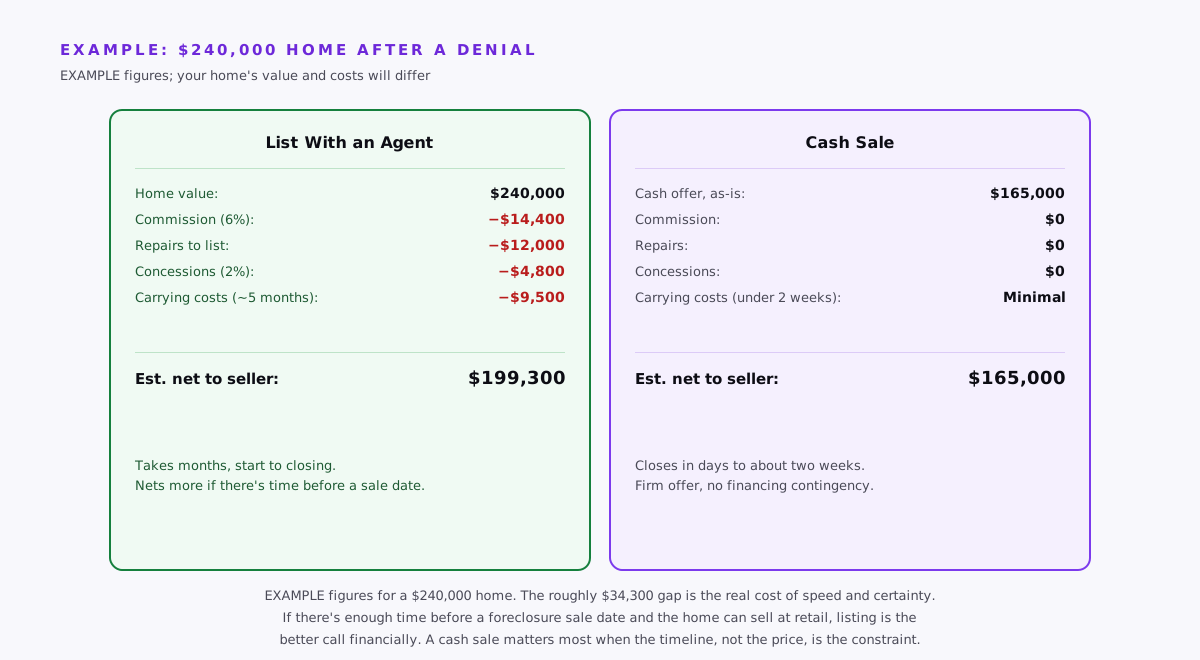
If there's enough time left before any foreclosure sale date and the home can realistically sell at retail in that window, listing is the better call financially. A cash sale makes more sense when the clock is the real constraint: a sale date is already set, the home needs more repair money than you have, or carrying the mortgage for another five months isn't something your budget can absorb while you wait for a buyer.
Once a loss mitigation review ends in a final denial, your servicer can move forward with the existing foreclosure timeline. The appeal window and any new application buy time, but they don't pause a sale date automatically once one is set, so track the actual dates on your notices rather than assuming you have longer than you do. Foreclosure filings were up 21% year over year in the first half of 2026, according to ATTOM's Mid-Year 2026 U.S. Foreclosure Market Report, so servicers are moving through denials and sale dates on tighter timelines than a few years ago, not slower ones.
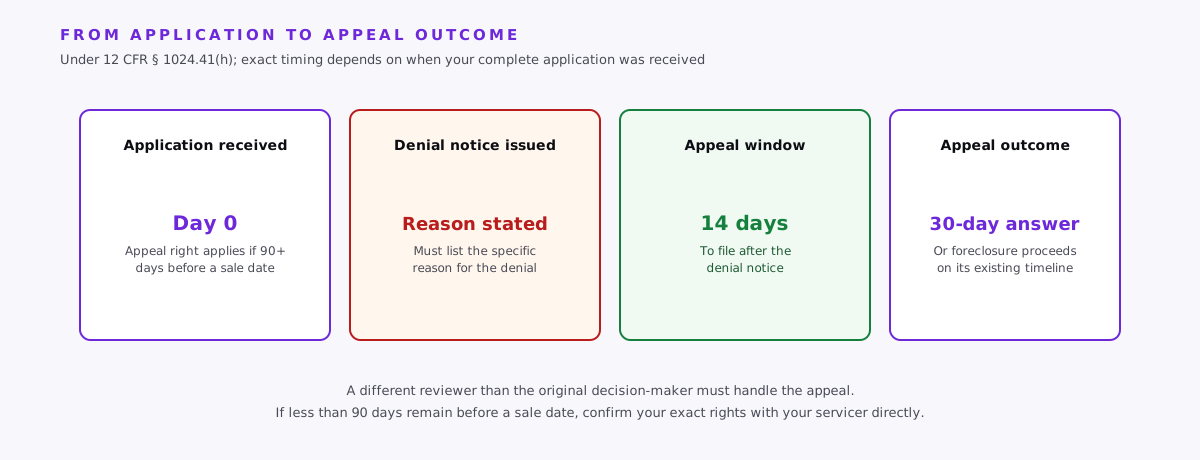
If your complete application was received 90 days or more before a scheduled sale, you get the 14-day appeal window described above and a 30-day response from the servicer. If a sale date is close or already set, call your servicer's loss mitigation department directly to confirm exactly what's still on the calendar. Our guide on what happens during foreclosure breaks down the stages that follow a final denial if a sale date is already in motion.
A HUD-approved housing counselor reviews your denial notice, helps you figure out whether an appeal or a new application makes more sense, and can help assemble the paperwork either way, all at no cost to you. This is a federally backed resource, not a company trying to sell you something.
You can find one through HUD's housing counseling directory. A counselor won't make the decision for you, but they know what servicers commonly require and can catch a documentation gap before it causes a second denial.
Restar buys houses as-is for cash in all 65 of our markets across 14 states. We give a written offer within 24 hours, there are no repairs to make and no commissions to pay, and you pick the closing date. If running the numbers shows that listing with an agent would net you more and there's enough time before any foreclosure sale date, we'll tell you that instead of pushing a sale that doesn't serve you.
All guides · What happens during foreclosure · How a deed-in-lieu works · What happens when forbearance ends
Step 1 of 5
No obligation, no fees, no repairs. We respond the same day.
You’ll talk to Trevor McAmis, Owner & Acquisitions Lead
(313) 710-6129
Takes about two minutes. Your address is never shared.
