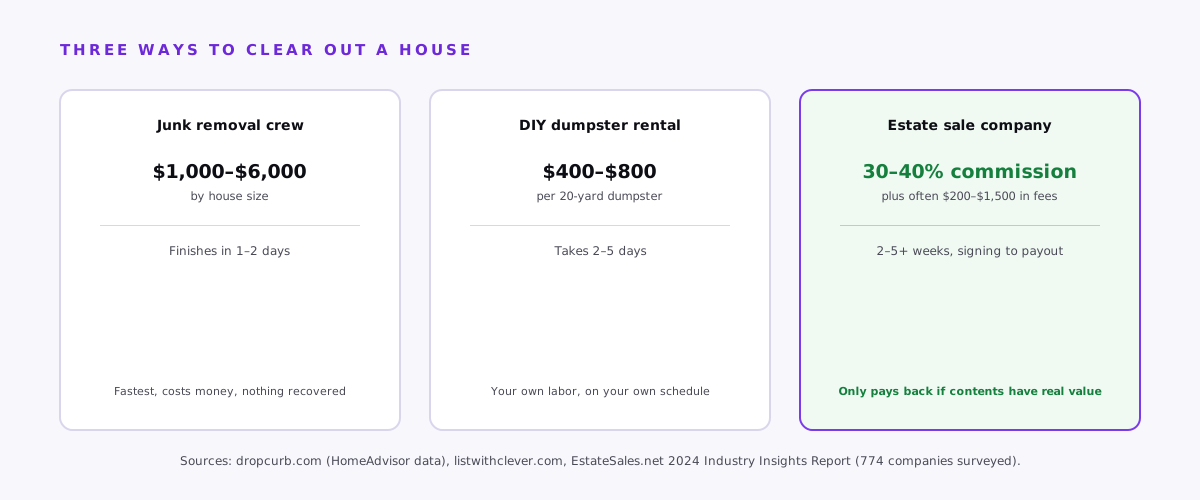
<b>A professional whole-house junk removal crew typically runs $1,000 to $6,000 depending on size, based on national cost-guide data, and finishes in one to two days.</b> An estate sale — pricing and selling the contents instead of hauling them — nets you money back but costs 30 to 40% of what sells, takes two to five weeks, and still usually needs a separate cleanout for whatever doesn't sell. Both are real options, and so is skipping the cleanout entirely and selling the house with the contents left in place. If you've just inherited a house, the belongings inside it are rarely the hard part emotionally — it's the sheer volume of decisions a full house full of someone else's life represents, on a timeline you didn't choose. This guide walks through what clearing it out actually costs by method, what a tax deduction is worth if you donate instead of trash, and the honest math on paying for a cleanout yourself versus letting a cash buyer take the house, and the contents, as they sit.

Step 1 of 5
Send the address and we'll tell you honestly whether selling as-is with the contents in place makes sense for your situation.
You’ll talk to Trevor McAmis, Owner & Acquisitions Lead
(313) 710-6129
Takes about two minutes. Or call (313) 710-6129 — we answer.
Educational only. This explains how these situations generally work. It is not legal, tax or financial advice, and the rules differ by state — talk to an attorney or CPA about your own situation before you act on any of it.
Hiring a crew to haul everything out is the quickest path, and it scales with house size. Cost-guide data from dropcurb.com (citing HomeAdvisor figures) puts the national average whole-house cleanout at around $1,250, with a size-tiered range:
| House size | Typical cost |
|---|---|
| 1-bedroom apartment/condo | $200–$800 |
| 2-bedroom house | $500–$1,500 |
| 3-bedroom house | $1,000–$3,000 |
| 4+ bedroom house | $2,000–$6,000+ |
A separate source, listwithclever.com, breaks it down by load instead of house size: a single junk removal job averages $241, a full truckload runs $600–$800, and a typical whole-house cleanout needs 2–3 truckloads — which lands in a similar range to the size-tiered numbers above. A professional crew generally clears a full house in one to two days; doing it yourself with a rented truck typically takes two to five days for a three-bedroom home, mostly because of trips to the dump and donation centers.
Dumpster rental is the DIY middle ground — you load it yourself on your own schedule instead of paying for labor. A 20-yard dumpster, the size usually recommended for a full-house cleanout, runs roughly $400–$600 per rental period according to dropcurb.com, with other cost guides citing a wider $200–$800 range depending on region and rental length. Get a local quote rather than relying on any single published number, since prices vary meaningfully by region.
An estate sale company doesn't just haul things away — it appraises, prices, stages, advertises, and runs a multi-day sale, then typically arranges donation or disposal of whatever's left. In exchange, it takes a commission.
Industry survey data from EstateSales.net's 2024 Industry Insights Report — a survey of 774 estate sale businesses nationwide — puts the average seller commission at 40% of what sells, with a separate EstateSales.net help page citing 35% as the nationwide average; other sources put the real-world range closer to 30–50% depending on the estate's size and value, plus separate fees many companies charge for advertising, trash removal, and post-sale cleanup (commonly $200–$1,500 on top of commission, per listwithclever.com). The same 2024 survey found that 75% of estate sale companies donate unsold items to clear the property afterward, and 67% pay out sale proceeds to the client within 7 days of the sale.
Timeline matters here more than the commission rate. The 2024 survey found 36% of companies prepare a sale within 14 days of signing, but 35% take over three weeks — and the sale event itself commonly runs about three days, with prices dropping each day it continues. Add it up and a realistic estate-sale pipeline — contract, prep, the sale itself, payout, then any remaining cleanout — runs two to five-plus weeks, against the one to two days a flat-fee cleanout crew needs. An estate sale makes the most sense when the contents genuinely have resale value and the timeline isn't under real pressure; it's the wrong tool when a house needs to close fast.
Donation isn't just the ethical option when items still have life in them — it can reduce both the cleanout cost and your tax bill, within real limits set by the IRS.
Charities like Habitat for Humanity ReStore accept furniture, appliances, and household goods, and many locations offer free pickup of large items — though this varies by location, and not every ReStore offers it, so confirm with your local branch before counting on it. Goodwill and similar organizations also commonly take donated household goods, though confirm pickup availability locally.
On the tax side, IRS Publication 526 allows you to generally deduct the fair market value of donated property to a qualified organization, not what you originally paid for it. The filing requirements step up by value:
IRS Publication 561 is direct about how to value used household items: fair market value is “usually much lower than the price paid when new,” items generally need to be in good used condition or better to deduct (unless you get a qualified appraisal for something worth more), and the IRS points specifically to thrift-store resale prices as a reasonable benchmark for what used furniture and household goods are actually worth. In practice, that means the real tax benefit of donating a house full of ordinary used furniture is usually modest — a deduction based on realistic secondhand value, not replacement cost — but it's not nothing, and it's a legitimate way to offset part of a cleanout that would otherwise cost you money either way.
The option most sellers don't realize exists: skip the cleanout entirely and sell the house with everything still inside it. This is standard for cash and investor buyers.
Multiple real-estate sources confirm that investors routinely build the cost of clearing out furnishings into their purchase offer rather than asking the seller to do it first — in effect, you're paying for the cleanout through a lower price instead of out of pocket before closing. Published figures on as-is cash sales (from case studies cited by homelight.com) suggest sellers taking this route typically net somewhere in the broad range of 75% to 95% of after-repair value, though that spread covers overall property condition generally, not contents specifically — no published source isolates what a cleanout alone is worth as its own line-item percentage, and it would be dishonest to invent one. The real, verifiable fact is directional: investors say they price the cleanout into the number, not that there's a fixed industry-standard dollar figure for it.
Here's what that actually looks like on a typical inherited 3-bedroom house, comparing a $2,000 professional cleanout (mid-range for the size) against selling with contents left in place:
| Clean out, then list retail | Sell as-is with contents in place | |
|---|---|---|
| Cleanout cost paid upfront | −$2,000 (crew) or weeks of unpaid labor (DIY) | $0 |
| Time before the house is market-ready | 1–5 days (crew) to several weeks (estate sale route) | None — sell this week |
| Who absorbs the contents cost | You, upfront, before any offer | Buyer, built into their offer price |
| Realistic path to closing | Weeks to months (list, market, close) | Days to about two weeks with a cash buyer |
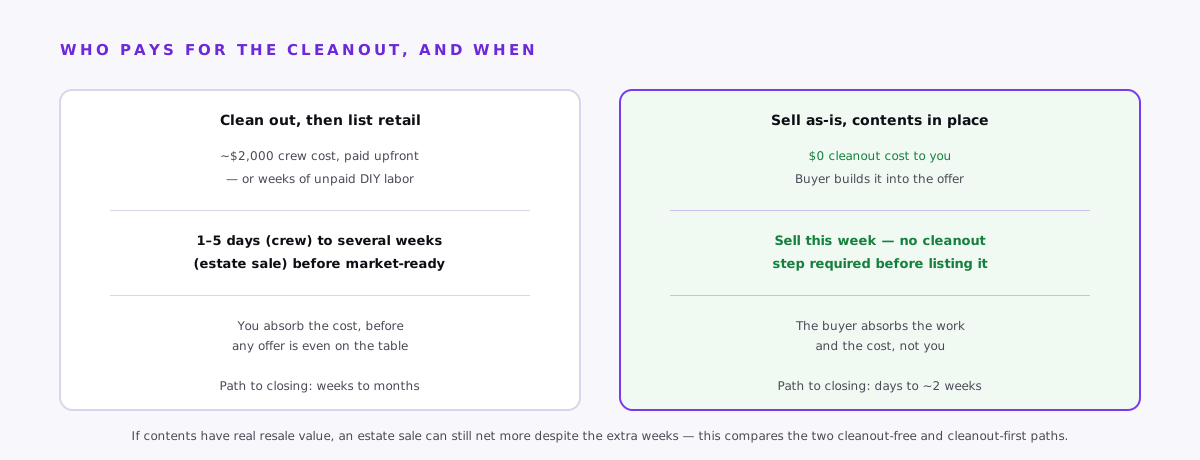
Neither path is automatically better. If the contents have real resale value, an estate sale can put money back in your pocket worth the extra weeks. If the house is mostly ordinary furniture, old clothes, and decades of paperwork, and you're already managing probate, siblings, or a distant location, paying $2,000 for a weekend cleanout crew — or skipping it entirely by selling as-is — is often the less stressful math, even if it's not the highest possible gross number.
Restar Acquisitions buys houses as-is for cash in 45 markets across Alabama, Arizona, Florida, Georgia, Indiana, Maryland, Michigan, Missouri, New York, North Carolina, Ohio, and Texas — contents included. We give a written offer within 24 hours, there are no repairs or commissions, and you pick the closing date. We're a direct buyer, not a real estate agent or broker, and we don't represent you in the transaction.
This article is for general education only and isn't tax, legal, or financial advice. Charitable-deduction rules and valuation standards can change; confirm current IRS requirements with a tax preparer or CPA before filing, and confirm pickup and donation policies directly with any charity before relying on them.
We buy houses as-is, contents and all — no cleanout, no estate sale, no donation runs. We'll give you a written offer within 24 hours and you can leave exactly what you don't want to deal with.
All guides · Selling an inherited house · Cost of probate when selling an inherited house · How cash home buyers calculate offers
Step 1 of 5
No obligation, no fees, no repairs. We respond the same day.
You’ll talk to Trevor McAmis, Owner & Acquisitions Lead
(313) 710-6129
Takes about two minutes. Or call (313) 710-6129 — we answer.