Every market page publishes the numbers behind its offer. See the math
Home › Guides › The Cost of Probate When Selling an Inherited House
Guide
The Cost of Probate When Selling an Inherited House
Before an inherited house can be sold, someone usually has to get through probate first — and probate isn't free. What it costs depends enormously on your state, and the fees on the court's schedule are only part of the bill. Here's the actual arithmetic, not a vague range.
Trying to figure out what probate will actually cost you?
Tell us the state and the estate's rough value. We'll tell you honestly what kind of probate cost and timeline you're likely looking at, and whether selling before it closes is realistic.
Takes about two minutes. Or call
(313) 710-6129 — we answer.
Educational only. This explains how these situations generally work. It is not legal, tax or financial advice, and the rules differ by state — talk to an attorney or CPA about your own situation before you act on any of it.
The cost of probate: the short answer
Probate costs vary enormously by state. Some states set attorney and executor fees as a percentage of the estate — on a $250,000 house, that can run $16,000 or more. Other states bill hourly, often just a few thousand dollars. Either way, every month probate drags on adds property tax, insurance, and upkeep costs while the house sits unsold.
This is educational information, not legal or tax advice. Probate fee structures, timelines, and small-estate thresholds are set individually by each state — confirm the exact costs and options for your estate with a probate attorney.
Where the money actually goes
Four cost categories show up in nearly every probate, though the size of each depends heavily on your state.
Court filing fees. These are flat and modest — California charges $435 for the initial probate petition; a Texas county example runs around $360.
Executor (personal representative) compensation. Some states set this by statute as a percentage of the estate's value. California, for example, uses a sliding scale under Probate Code §10800: 4% of the first $100,000, 3% of the next $100,000, 2% of the next $800,000, and lower percentages above that.
Attorney fees. In statutory-fee states, this is often the same percentage schedule as the executor's fee, billed separately — so in California, the estate can pay that scale twice, once to the personal representative and once to the estate's attorney. In most other states, including Texas, there's no statutory percentage; attorneys bill hourly or a negotiated flat fee, which tends to land lower for a simple, uncontested estate.
Appraisal and, occasionally, bond costs. A date-of-death appraisal commonly runs roughly $300–$500. If the court requires a fiduciary bond, the premium is typically well under 1% of the bonded amount per year for an executor with good credit.
What that looks like on a $250,000 house
Here's the same estate — a $250,000 house as the main asset — run through two different state structures.
Cost path
How it's calculated
Approximate total
Statutory-fee state (e.g., California)
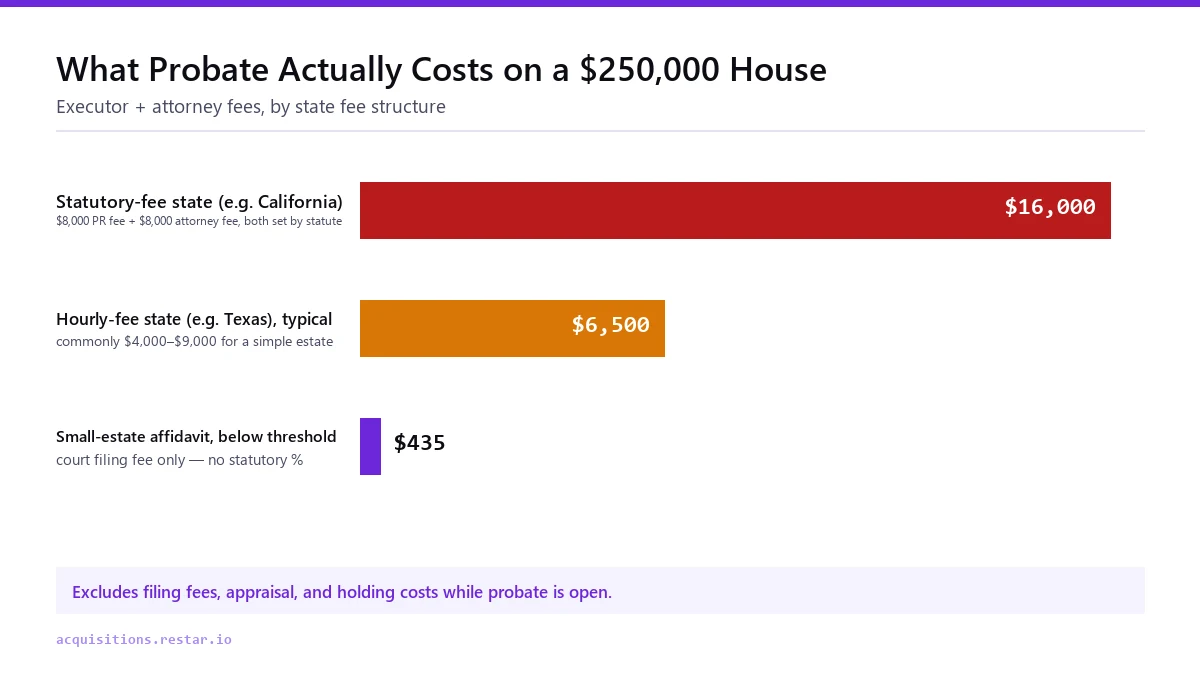
PR fee: 4% of first $100k + 3% of next $100k + 2% of remaining $50k = $8,000. Attorney fee: same schedule, another $8,000.
~$16,000, plus the $435 filing fee and appraisal
Hourly-fee state (e.g., Texas, typical range)
No statutory percentage; attorney bills hourly for a straightforward, uncontested estate
~$4,000–$9,000, plus the ~$360 filing fee and appraisal
Small-estate affidavit (where the estate qualifies)
Skips formal probate entirely if the estate is below the state's threshold
Filing fee only — often under $500
What probate actually costs on a $250,000 houseRestar Acquisitions · excludes filing fees, appraisal, and holding costs while probate is open.
The gap between the first two rows is the whole point: in a statutory-percentage state, probate fees are set by law regardless of how much work the estate actually requires, and they scale with the house's value, not with the complexity of settling it. In a state where fees are hourly, a simple estate with one clear heir and no disputes can cost a fraction of that.
The cost nobody puts on the fee schedule: time
Probate commonly takes anywhere from a few months for a simple, uncontested estate to well over a year — surveys of probate practitioners put the average closer to a year and a half in states with more court supervision. Every month the house sits unsold during that stretch, it's still costing money.
Property tax on a $250,000 house at a typical effective rate runs roughly $190/month. Vacant-home insurance commonly runs $85–$250/month. Minimal utilities to prevent damage run roughly $100–$300/month. Basic upkeep adds another $50–$150/month.
Add it up and a vacant inherited house can realistically cost $400–$900 a month just to sit there. Over a 9-month probate, that's $3,600–$8,100. Over a 24-month probate, it can reach $9,600–$21,600 — on top of whatever the court and attorney fees already took.
The small-estate exception is worth checking before you assume the worst
Most states offer a simplified process for estates under a certain value, and it can be the difference between months of formal probate and a few weeks of paperwork. California allows a small-estate affidavit for estates under roughly $208,000 in personal property, and a streamlined court petition specifically for a primary residence valued at up to $750,000. Texas allows a small-estate affidavit for estates under $75,000, not counting the homestead and other exempt property. Florida raised its summary administration threshold to $150,000 as of mid-2026.
None of these thresholds are universal, and whether your parent's estate qualifies depends on the exact assets and their values — this is a question for a probate attorney or your state's self-help court resources, not a guess.
Can you sell the house while probate is still open?
Often, yes. Most states let the personal representative list and sell real property before probate formally closes, though the exact authority varies. Under some state laws, a PR with full authority can sell after simply notifying the beneficiaries; under others, or if the will doesn't grant an explicit power of sale, the court has to confirm the sale terms at a hearing first. If a faster sale would meaningfully cut your carrying costs, ask the estate attorney early whether your state and your specific will allow selling before probate closes — waiting until the very end isn't always required.
The honest tradeoff
None of this is an argument for any particular way to sell — it's the math you need before choosing one. A traditional listing, once probate clears you to sell, typically nets more after commission and closing costs than a cash sale would, especially if the house is in reasonable condition. But every month spent waiting on probate, and then waiting on a buyer, adds carrying costs on top of the statutory or hourly fees you've already paid. A cash sale that closes quickly — sometimes even while court paperwork is still being finalized, once you have the legal authority to sell — trades some of that net proceeds for cutting the holding-cost clock short. Whether that trade is worth it depends on how much the house is actually costing you to hold, and on your specific numbers, not a national average.
Common questions
How much does probate typically cost?
It depends heavily on the state. States with statutory percentage fees, like California, can run $16,000 or more in executor and attorney fees alone on a $250,000 estate. States that bill hourly, like Texas, often total a few thousand dollars for a straightforward, uncontested estate.
Do I have to pay the executor and the attorney separately?
In statutory-fee states like California, yes — the personal representative and the estate's attorney are each entitled to the same percentage-based fee, so a single estate can pay that schedule twice.
Can I avoid probate entirely?
Sometimes. If the estate qualifies under your state's small-estate threshold — commonly somewhere between $75,000 and a few hundred thousand dollars, depending on the state — a simplified affidavit process can replace formal probate.
How long does probate usually take?
Anywhere from a few months for a simple, uncontested estate to well over a year, with some surveys putting the average closer to eighteen months in states with more court supervision.
Can the house be sold before probate is finished?
Often yes, once a personal representative is appointed, but the exact authority depends on your state and whether the will grants an explicit power of sale — some states require court confirmation of the sale terms first.
What's the biggest hidden cost of a long probate?
Carrying costs on the house itself — property tax, insurance, utilities, and upkeep — which can run $400–$900 a month on top of whatever probate fees the estate already owes.
If the carrying costs are the real problem, we can stop the clock
A long probate is expensive in ways that don't show up on the attorney's invoice — every month the house sits vacant is more property tax, insurance, and upkeep out of the estate. If you have the legal authority to sell, we can give you a plain cash offer and close quickly, sometimes before probate has even formally closed. Send us the address and we'll tell you honestly how it compares to waiting for a traditional sale.
Every offer on this site is underwritten by a person, not a form. If the
numbers do not work for you, say so and I will tell you what would.
Also from Restar
Want the data behind all of this?
Restar Acquisitions is the acquisitions arm of Restar — a housing-market analytics
platform tracking 180+ metrics across every U.S. market, with composite scores and 12-month
price forecasts. The numbers on this page come from the same work.