Every market page publishes the numbers behind its offer. See the math
Home › Guides › Selling a Hoarder House: What the Cleanout Actually Costs
Guide
Selling a Hoarder House: What the Cleanout Actually Costs
Selling a hoarder house is not really a real estate problem for the first few weeks. It is a logistics problem wrapped around a family problem, and most of the advice online skips straight past both to tell you to call a cash buyer. This page does the arithmetic instead: what a cleanout genuinely costs, why the financed buyer pool collapses before you list, which safety issues change the number, and which of the three realistic routes leaves you with the most money.
Takes about two minutes. Or call
(313) 710-6129 — we answer.
Educational only. This explains how these situations generally work. It is not legal, tax or financial advice, and the rules differ by state — talk to an attorney or CPA about your own situation before you act on any of it.
Selling a hoarder house: the short answer
You have three routes: clear it and repair it, clear it and list it as-is, or sell it with the contents in place. A full cleanout runs into five figures and hides an unknown repair bill underneath. Clearing and repairing usually nets most, if you can fund it and wait.
This page is general information, not legal, medical or environmental advice. Contents can conceal genuine hazards, and some cleanouts legally require licensed remediation. Get a professional assessment before anyone starts carrying boxes out.
Why the normal sale route closes before you reach it
Most people selling a hoarder house assume they can list it full and let a buyer deal with the contents. In practice the mortgage market removes that option early, and understanding why saves you two wasted months.
An appraiser working an FHA, VA or conventional file has to physically access every room, verify the mechanical systems function, and note conditions affecting health and safety or the property's structural soundness. A house packed floor to ceiling defeats all three. The appraiser cannot see the walls, cannot reach the furnace, often cannot open interior doors — and if the utilities are off, the systems cannot be tested at all. The report comes back either subject to repairs, subject to a re-inspection nobody can pass, or not completed.
The effect is blunt: the great majority of ordinary buyers, the ones using a mortgage, are eliminated before they ever make an offer. What remains is investors and the small number of retail buyers paying cash. That is not a reason to panic and it is not a reason to accept the first number offered — but it does mean an as-is listing on a full house is competing for a much smaller audience than the listing photos suggest.
This is also why the sequence matters so much. Clearing the contents is what reopens the financed buyer pool, and reopening that pool is worth real money. It is the same dynamic we walk through in should I repair before selling.
What is actually underneath: the part nobody can price
Here is the uncomfortable truth about selling a hoarder house, and it is the reason offers on one carry a wider margin than offers on a merely dated property. Nobody knows the condition — not you, not us, not an inspector. The contents are a curtain.
Water damage that has been running for years. A slow supply-line or roof leak behind stacked material rots subfloor and framing quietly. It is routinely discovered only when the last layer comes out.
Floor loading. Dense storage — books, paper, tools, canned goods — concentrates weight far beyond residential design loads. Sagging floors and deflected joists are common findings.
Pest and rodent occupation. Contamination of insulation and cavities, chewed wiring, and a droppings load that changes how the cleanout must legally be done.
Mold behind everything. Dark, still, humid, undisturbed. See selling a house with mold for how remediation and disclosure work.
Systems that have not run in years. A furnace, water heater or panel that has been off for a decade is an unknown, and utilities being off is itself a barrier to inspection.
This is why a full-cleanout-then-repair route has a genuine risk attached rather than just a cost: you commit the cleanout money first and only then find out what the repair bill is. Sometimes it is $8,000 of paint and carpet. Sometimes it is a subfloor.
Safety: read this before anyone starts
Two rules here are not advisory, and they materially affect what a cleanout costs.
Do not dry-sweep or vacuum rodent droppings. Where there has been an infestation, the CDC's guidance on preventing hantavirus is to ventilate the space first, then wet contaminated material with disinfectant and remove it damp, precisely because sweeping and vacuuming aerosolize the particles that carry the risk. A great many well-meaning family cleanouts start with a shop vac, which is the one thing to avoid.
Human waste, needles and other potentially infectious material move the job into a different category. Handling it is governed by the OSHA bloodborne pathogens standard, which is why licensed biohazard remediation is expensive: trained crews, respiratory protection, containment, and regulated waste disposal rather than an ordinary dumpster.
There is a fire dimension too. Heavy storage blocks egress, obstructs exits and windows, and adds an enormous fuel load — the reason the US Fire Administration treats excessive accumulation as a recognized residential fire risk. If someone is still living in the house, that is the most urgent thing on this page, ahead of every question about price.
What a cleanout actually costs
The largest single variable in selling a hoarder house is the cleanout, and quotes vary wildly by region and by what is inside. So rather than quote a national average, here is how the number is built. You can price your own house from these components.
Disposal. A 30-yard roll-off runs roughly $450–$700 delivered and hauled with a few tons included, plus a per-ton overage. A heavily filled 1,400 square foot single-family commonly takes four to eight of them.
Labor. A three-person crew for four to six full days. Sorting slows this down enormously — a crew told to keep nothing moves several times faster than one told to look for documents and jewelry in every box.
Pest treatment, before or during, if there has been an infestation.
Flooring removal and disposal, which is usually unavoidable and is separate from the general junk haul.
Deep clean afterwards so the house can be shown.
Biohazard remediation, where applicable, which is a different trade at a different rate and can approach the cost of everything else combined.
For the worked example below we use $12,000 for a standard cleanout of a 1,400 square foot house — six dumpsters at roughly $3,300, a crew for five days at roughly $5,400, and about $3,300 across pest treatment, flooring removal and the deep clean. Add roughly $9,000 more if biohazard remediation is required. Get three written quotes; the spread on identical scopes is genuinely wide.
The three routes, with the arithmetic
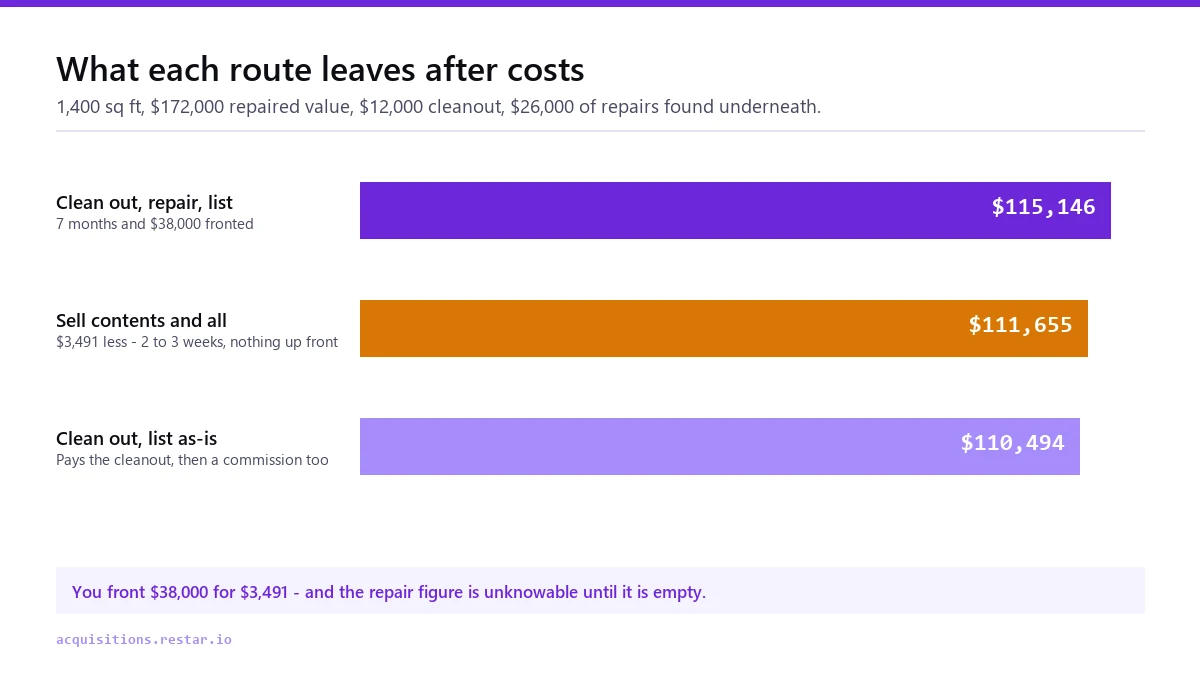
House of 1,400 square feet, repaired value $172,000, no mortgage, carrying costs $690 a month. Cleanout quoted at $12,000, and once it is empty the repairs come in at $26,000 — a figure nobody could have known in advance.
What each route leaves after costsRestar Acquisitions · worked example from this page
Route
Clean out, repair, list
Clean out, list as-is
Sell contents and all
Sale price
$172,000
$138,000
$112,000
Cleanout
−$12,000
−$12,000
—
Repairs
−$26,000
—
—
Agent commission
−$9,460
−$7,590
—
Seller closing costs
−$2,064
−$1,656
covered
Holding costs
−$4,830
−$2,760
−$345
Buyer concessions
−$2,500
−$3,500
—
Net proceeds
$115,146
$110,494
$111,655
Time and cash needed
7 months, $38,000 up front
4 months, $12,000 up front
2–3 weeks, nothing up front
An illustration on one hypothetical house, not a quote and not a prediction. Your figures will differ, and the repair line is the one that moves most.
Clearing and repairing nets the most — $3,491 more than selling it as it stands. That is the honest headline and we are not going to dress it up. If you have $38,000 available and seven months, that is the better route.
But look at what buys that $3,491. You front $38,000, you carry the house for seven months, and you accept that the $26,000 repair figure was unknowable when you committed the first $12,000. On a house where the cleanout uncovers a rotted subfloor instead of tired carpet, the top column loses to both of the others. That asymmetry — small upside, open-ended downside — is the real argument for selling as it stands, and it is a much better argument than the urgency most cash buyers lead with.
The middle column is worth its own note. Cleaning out and then listing as-is is the option families reach for instinctively, and here it comes last, because you pay the whole cleanout and then hand a commission and concessions to the market anyway. It improves sharply if your local as-is price is stronger than the $138,000 used here, so price that before ruling it out.
The part that is not about money
It would be dishonest to write this page as pure arithmetic. Most people reading it are dealing with a parent's house after a death or a move into care, and the contents are not junk to them.
Hoarding disorder is a recognized mental health diagnosis, distinct from ordinary clutter and from simple neglect, and it frequently sits alongside grief, dementia or depression in an older adult. It is classified among the obsessive-compulsive and related disorders, which the National Institute of Mental Health covers in plain language. Whatever anyone tells you at a family gathering, the person who filled that house was not lazy.
Two practical consequences. First, if the owner is alive and the house is theirs, they have to agree. A cleanout arranged around someone is a betrayal that families do not recover from quickly, and it is not yours to authorize. Second, go through it before it goes in a dumpster. Cash, savings bonds, deeds, insurance policies, military records, jewelry and photographs turn up in hoarded houses with real regularity, tucked in books and envelopes. Budget a weekend for a proper look, and tell the crew what to set aside rather than hoping they notice.
If you sell with the contents in place, you can still take out everything that matters first. Nobody sensible asks you to leave the photographs.
What this means for your decision
Selling a hoarder house comes down to one question: can you fund the cleanout and survive not knowing what is under it. If you can fund the cleanout and the repairs and you can wait, clear the house and list it with an agent. That is the higher number in the table and in most versions of this situation. It is also the route that puts the property back in front of financed buyers, which is where the retail price actually lives.
Selling with the contents in place earns its place on a narrower set of facts, and they are not hard to recognize: there is no money for a cleanout and no appetite to borrow for one, the house is vacant and its insurance is in question, the family is scattered and nobody can supervise a crew, an estate needs to close, or the unknown-condition risk is simply more than you want to carry. In those cases the speed is worth what it costs, and the table shows what it costs rather than hiding it.
What should not drive the decision is embarrassment. It is a common and entirely understandable reason people take the first offer on a full house without checking it against anything, and it is the most expensive feeling in this whole process. Nobody buying houses for a living is shocked by a full one.
Alternatives to consider
Clean out, repair, list with an agent — the highest-net route when you have the cash and the time.
Clean out and list as-is — cheaper up front, reopens the financed buyer pool, and worth pricing properly before dismissing it.
Partial cleanout — clear enough for safe access, working utilities and a real inspection, then sell. Costs a fraction of a full cleanout and removes most of the unknown, which is what widens offers.
An estate sale or auction house first — where there is genuine value in the contents, this can cover a meaningful part of the cleanout. Tools, firearms, coins and collections are the usual candidates.
Donation pickup — charities that collect furniture and household goods reduce the dumpster count and produce a receipt.
Rent it out after clearing — only if the systems are sound and someone will manage it.
Sell as it stands for cash — right when there is no money, no time, or no appetite for the unknown repair bill.
Common questions
Do I have to clean out a hoarder house before selling it?
No. Direct buyers purchase houses with the contents in place and handle the cleanout themselves. Clearing it first generally nets more money, because it reopens the property to buyers using a mortgage, but it costs five figures and several months. Take out anything of personal or financial value first either way.
How much does it cost to clean out a hoarder house?
Build the number rather than trusting an average. A 1,400 square foot house commonly needs four to eight 30-yard dumpsters at roughly $450 to $700 each, a three-person crew for four to six days, plus pest treatment, flooring removal and a deep clean. Biohazard remediation, where needed, can approach the cost of everything else combined. Get three written quotes.
Can you get a mortgage on a hoarder house?
Usually not while it is full. An appraiser has to access every room, verify the systems work and note health and safety conditions, and a packed house with the utilities off defeats all of that. This is why an as-is listing on a full house reaches a far smaller pool of buyers than the listing suggests.
Do I have to disclose that it was a hoarder house?
Disclosure duties vary by state, but they generally cover known material defects rather than how the house was used. The issue is what the hoarding caused: water damage, pest infestation, mold, structural or electrical problems. Disclose the conditions you know about. Concealing a known defect is what creates liability after closing.
What if the owner is still alive and will not agree to a cleanout?
Then it does not happen. If the house is theirs and they have capacity, the decision is legally and ethically theirs, and clearing it around them causes real harm. Where capacity is genuinely in question that is a conversation for a doctor and an attorney about guardianship or a power of attorney, not something to work around.
Is it safe to clean out a hoarder house myself?
Sometimes, with limits. Where there has been a rodent infestation, do not dry-sweep or vacuum droppings; ventilate first and remove material damp, per CDC guidance. Human waste, needles or similar material needs licensed remediation under the OSHA bloodborne pathogens standard. Get an assessment before anyone starts carrying boxes out.
If you want a number on a house you have not been able to empty, you do not have to empty it to get one. Tell us the address, the rough condition and whether the power and water are on, and we will put a figure in writing with the reasoning behind it.
Send us the property here. Take whatever you want out first — papers, photographs, anything with meaning. Leave the rest.
Every offer on this site is underwritten by a person, not a form. If the
numbers do not work for you, say so and I will tell you what would.
Also from Restar
Want the data behind all of this?
Restar Acquisitions is the acquisitions arm of Restar — a housing-market analytics
platform tracking 180+ metrics across every U.S. market, with composite scores and 12-month
price forecasts. The numbers on this page come from the same work.