If your spouse won't agree to sell the house in a divorce, the court can order it sold anyway as part of dividing marital property. Expect a motion for a temporary order first, then a hearing. If your spouse still refuses to cooperate, a judge can hold them in contempt or appoint a receiver to sell the house in their place. That path is slower and costs more than any version both of you agree to, which is why it's worth understanding before anyone files anything.

Step 1 of 5
Tell us about the property and where the divorce stands, and we'll give you a written cash offer within 24 hours that either spouse can review.
You’ll talk to Trevor McAmis, Owner & Acquisitions Lead
(313) 710-6129
Takes about two minutes. Your address is never shared.
Educational only. This explains how these situations generally work. It is not legal, tax or financial advice, and the rules differ by state. Talk to an attorney or CPA about your own situation before you act on any of it.
Refusing to agree doesn't freeze the house in place indefinitely. It triggers a sequence of court filings instead, and each step adds weeks or months before anyone sees a dollar at all.
The spouse who wants to sell files a motion asking the court for a temporary or interim order. That motion can ask for several different things: a ruling that the house must be listed, an order for exclusive use and possession (letting one spouse stay while the other moves out), or simply a hearing date to resolve the disagreement. None of this happens instantly. Getting a motion in front of a judge takes however long the local family court's calendar allows, and contested calendars in busy counties routinely run months out.
While the case is open, most states also restrict what either spouse can do with the house without the other's consent or a court order. California is the clearest example: filing for divorce triggers Automatic Temporary Restraining Orders built into the summons itself, which bar either spouse from selling, transferring, or hiding marital property without the other's written consent or a judge's order, with narrow exceptions for ordinary household expenses (California Courts Self-Help Guide). Other states handle this through a standing order, a local rule, or a request either spouse can make for a temporary restraining order specific to the case. The common thread: while the divorce is pending, you generally cannot just list the house and sell it to a third party without your spouse's sign-off or the court's permission, even if you're sure it's the right move.
A judge does not need both spouses to agree in order to force the issue. Dividing marital property, including real estate, is squarely inside a family court's authority, and that authority includes ordering a sale when the spouses can't agree on anything else.
A legal aid guide for homeowners in New York states it directly: "the court can order the home to be sold" as part of equitable distribution, though a judge may delay that order for a period if minor children are living in the house, sometimes until a child finishes school (Legal Assistance of Western New York, last reviewed August 2025, updated February 2026). This authority exists in both equitable-distribution states and community-property states. The legal label for how proceeds get split differs by state, but the court's power to order a reluctant spouse's house sold does not depend on that label.
If the court orders the sale and a spouse still won't cooperate, refusing to sign a listing agreement, blocking showings, or refusing to vacate, that spouse is defying a direct court order. That's grounds for a contempt motion. California's courts, for example, publish a standard form (FL-410, Order to Show Cause and Affidavit for Contempt) specifically for asking a judge to enforce a violated order (California Courts Self-Help Guide). A contempt finding can carry fines or, in extreme and repeated cases, jail time, though judges generally use it as leverage to get compliance rather than as a punishment in itself.
When contempt alone doesn't move things, judges in many states can appoint a receiver or special master: a neutral third party, often a real estate professional or attorney, who steps into the process and lists, markets, and closes the sale without needing either spouse's signature. The receiver can typically sign the listing agreement and closing documents directly, and some orders let the receiver have an uncooperative spouse removed from the property if they're actively interfering. Courts tend to treat this as a last resort, reached only after less drastic orders haven't worked, because it hands control of the sale to someone with no stake in getting either spouse the best possible outcome.
If you've researched this, you may have come across "partition action" and wondered whether that's the tool here. It generally isn't, and mixing the two up leads people down the wrong path.
A partition action is a lawsuit used to force the sale or division of property shared by co-owners who aren't going through a divorce, most often unmarried partners, business partners, or heirs who inherited a house together and can't agree on what to do with it. Our guides on the cost of a partition action and what happens when heirs cannot agree to sell cover that process in detail, and it runs on different rules: proceeds generally get split by each owner's percentage of ownership, not by what a court decides is fair.
A divorce case folds the house into equitable distribution (or community property division) instead, and a sale ordered inside a divorce case is handled by the family court judge already presiding over the case, using the state's marital-property rules rather than a separate partition lawsuit. You generally would not file a partition action against your own spouse while a divorce is open; the family court already has the authority and the case to do the same thing. The distinction matters because the forms, the court division, and even the math for how proceeds split are different. If you're married and the house is marital property, this is a divorce-court problem, not a partition problem.
Example: a couple's house is worth $300,000 with a $190,000 mortgage, leaving $110,000 in equity before any costs come out. Here's what three different paths do to that number.
If both spouses agree to list the house with an agent and cooperate through the process, a sale near full value (say $300,000), minus roughly 5.5% commission and about 1.5% in other seller closing costs, minus the $190,000 mortgage, nets around $89,000 total, or $44,500 each. That's the best outcome of the three, and it only requires that both spouses show up and cooperate: sign the listing agreement, allow showings, and agree on an offer.
If both spouses instead agree to a fast cash sale rather than waiting out a retail listing, say $275,000 as-is with no commission, minus about $2,500 in closing costs and the $190,000 mortgage, nets around $82,500 total, or $41,250 each, usually closing in two to three weeks with proceeds split right away.
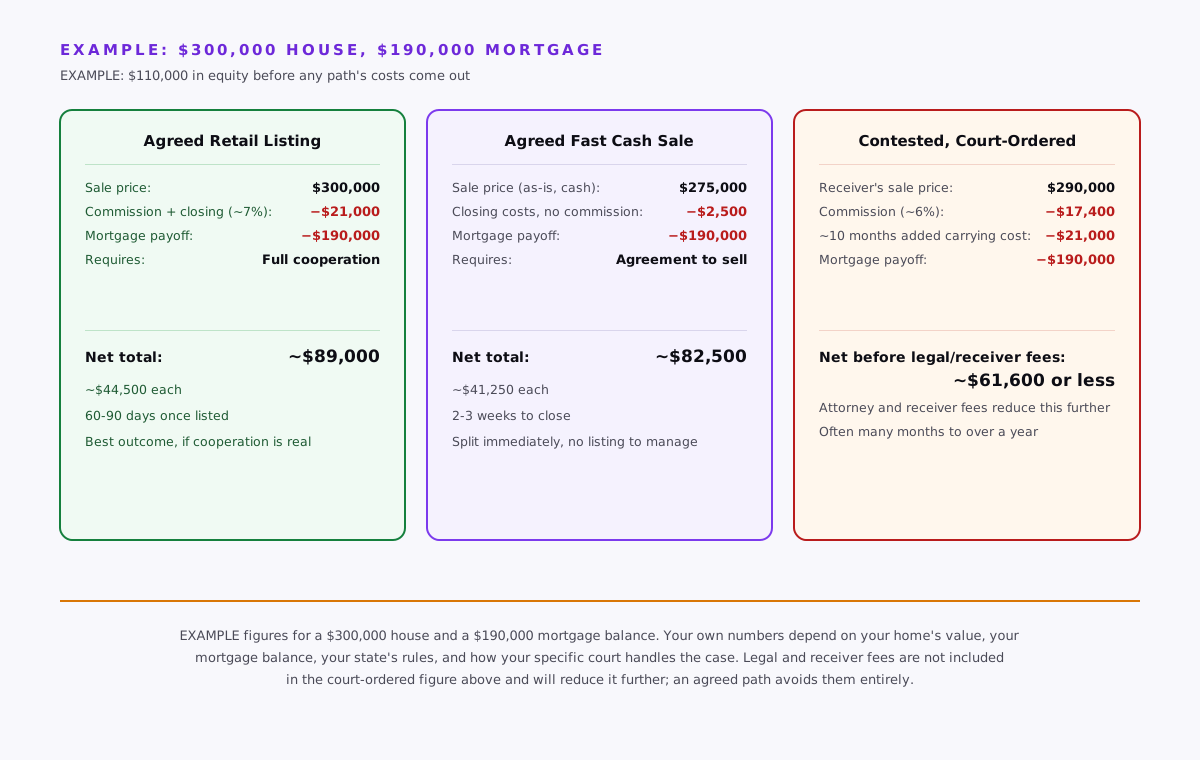
Now the contested path. If one spouse refuses to cooperate at all and it takes motions, a hearing, and ultimately a receiver appointment to force a sale, add the cost of that fight on top. Both spouses typically keep paying the mortgage, taxes, insurance, and upkeep on a house neither can fully use while the case drags on, often while one or both are also paying for separate housing elsewhere. At a combined carrying cost of roughly $2,100 a month, ten months of contested proceedings adds about $21,000 beyond what the quick paths above would have cost. A court-appointed receiver then lists and sells the house, often at or near market value but without much incentive to hold out for the best offer, say $290,000, minus 6% commission ($17,400), minus the added $21,000 in carrying costs, minus the mortgage, leaves roughly $61,600, before subtracting the receiver's own fee and either spouse's attorney fees for the motions and hearing, both of which come straight out of what's left. Attorney fees for a contested motion fight commonly run into the thousands of dollars per side, more if it goes to a full hearing, so the real number after all of it is often well under $30,000 each, not $44,500.
The gap between the best case and the forced-sale case isn't small, and it isn't quick either. If your spouse can be brought to the table for a normal listing or a fast cash sale, either one beats fighting it out in court on the numbers alone. Court-ordered sale is the right tool only once cooperation has fully broken down, not a first move.
Mediation. A neutral mediator helps both spouses agree on one of the paths below without a judge deciding it for you. Usually far cheaper and faster than litigating, and it's often required or strongly encouraged before a contested hearing gets scheduled.
A buyout. One spouse refinances the mortgage solely into their own name and pays the other their share of the equity, and the house doesn't get sold to anyone. See our guide on buying out a spouse vs. selling the house in a divorce for the full math on whether that makes sense at today's rates.
An agreed joint listing with an agent. Both spouses cooperate with a single listing, a shared agent, and a plan for splitting proceeds. This nets the most of any path in the example above, but it requires real cooperation on showings, pricing, and offers. Our guide on selling a house during divorce walks through that process step by step.
A fast cash sale both of you agree to. Skips the listing, the showings, and the back-and-forth over offers. Nets less than a strong retail sale, but it closes in weeks, splits the proceeds immediately, and removes the house as a source of ongoing conflict.
Court-ordered sale. The last resort, for when a spouse simply won't engage with any of the above. Slower and more expensive than every other option, but it's the backstop that exists specifically because one spouse can't be allowed to hold the house, and the other spouse's finances, hostage indefinitely.
| Path | Who controls the process | Typical timeline | Cost to get there |
|---|---|---|---|
| Mediation | Both spouses, with a neutral mediator | Days to a few weeks to reach agreement | Mediator's fee, usually split and far below litigation costs |
| Buyout | The spouse keeping the house, via refinance | Roughly 30-60 days to close a refinance | Refinance closing costs instead of a sale; no commission |
| Agreed joint listing | Both spouses, together, with their agent | Weeks to find a buyer, then 30-60 days to close | Commission plus standard seller closing costs; nets the most if it works |
| Agreed fast cash sale | Both spouses, together, with the buyer | About 1-3 weeks to close | No commission, but a lower sale price than a full retail listing |
| Court-ordered sale | The court, often through a receiver | Often many months to over a year | Attorney fees, a receiver's fee, and months of added carrying costs |
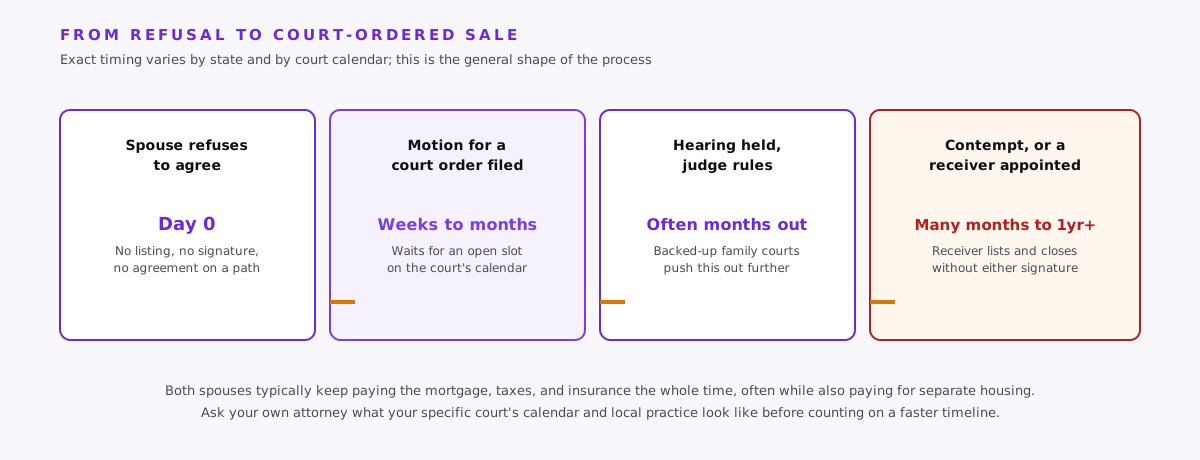
There's no single number for how long it takes when a spouse won't agree to sell house in divorce proceedings, and anyone who gives you one is guessing. The timeline depends on your state's rules, how backed up your local family court's calendar is, and how many separate motions get filed before anyone agrees on anything.
The general shape looks like this: the refusal itself, a motion asking the court to intervene (which has to wait for an open slot on the court's calendar), a hearing where the judge rules on the motion, and then, if the spouse still won't cooperate, an order appointing a receiver or holding the spouse in contempt. Each of those steps can take weeks on an uncontested calendar or months on a backed-up one, and contested property disputes in many courts commonly run well past a year once every step is counted. Treat "many months to over a year" as the honest range, and ask your own attorney what your specific court's calendar looks like before counting on any faster number.
Court orders, contempt motions, and receiver appointments are not something to handle on your own. If your spouse has stopped cooperating and you're looking at any of this, a family-law attorney licensed in your state should be the one filing the motions and telling you what your specific court is likely to do.
Restar buys houses as-is, in all 65 of our markets across 14 states, including houses caught in a divorce where one spouse wants out fast and the other is ready to cooperate with a sale rather than fight one. We give a written offer within 24 hours, there are no repairs to make and no commissions to pay, and you both pick the closing date together. We're not either spouse's attorney and we don't take sides in how the divorce gets resolved. If running the numbers shows that an agreed retail listing would net you more than a quick cash sale, we'll tell you that directly instead of pushing a sale that doesn't serve you.
All guides · Buying out a spouse vs. selling the house · Selling a house during divorce · Cost of a partition action
Step 1 of 5
No obligation, no fees, no repairs. We respond the same day.
You’ll talk to Trevor McAmis, Owner & Acquisitions Lead
(313) 710-6129
Takes about two minutes. Your address is never shared.