Every market page publishes the numbers behind its offer. See the math
Home › Guides › Buying Out a Spouse vs. Selling the House in a Divorce
Guide
Buying Out a Spouse vs. Selling the House in a Divorce
Whether to keep the house and buy out your spouse, or sell it and split the proceeds, is a decision that's often made on emotion when it's really a math problem. A buyout looks free because no commission changes hands — it isn't. Here's what each path actually costs, with real numbers.
Trying to run the numbers on a buyout vs. selling?
Tell us your mortgage balance and rough equity. We'll tell you honestly how a cash sale compares to a buyout refinance or a traditional listing, so you're deciding with real numbers.
Takes about two minutes. Or call
(313) 710-6129 — we answer.
Educational only. This explains how these situations generally work. It is not legal, tax or financial advice, and the rules differ by state — talk to an attorney or CPA about your own situation before you act on any of it.
Buying out a spouse vs. selling: the short answer
A buyout means refinancing solely into one spouse's name — a new loan at today's rate on the full balance, not your old rate. Selling and splitting the proceeds avoids that reset but adds commission, closing costs, and time on market. Which nets more depends on your mortgage size, the rate gap, and how fast you need to close.
This is educational information, not legal, tax, or financial advice. Every divorce settlement is different — confirm the numbers and the tax treatment for your specific situation with a family law attorney and a CPA before you decide.
How a buyout is actually calculated
The starting point is simple: appraised value minus the mortgage balance equals the equity to be split. Where it gets less simple is a question many couples don't think to ask — should the calculation subtract a notional cost of sale (commission plus closing costs, commonly 6–8%) before splitting the equity, to reflect what the house would actually net if it were sold? This is common practice in negotiated settlements and with some mediators, as a fairness adjustment for the spouse being bought out — but it isn't required by law everywhere, and courts and attorneys don't agree on it universally. It's worth raising explicitly in your settlement discussion rather than assuming either way.
The part of a buyout that catches people off guard: the interest rate
To remove the departing spouse's name and liability from the mortgage, the spouse keeping the house typically has to refinance solely in their own name — which means qualifying alone on income and credit, and taking on today's market rate for the entire remaining balance, not the rate on the original loan.
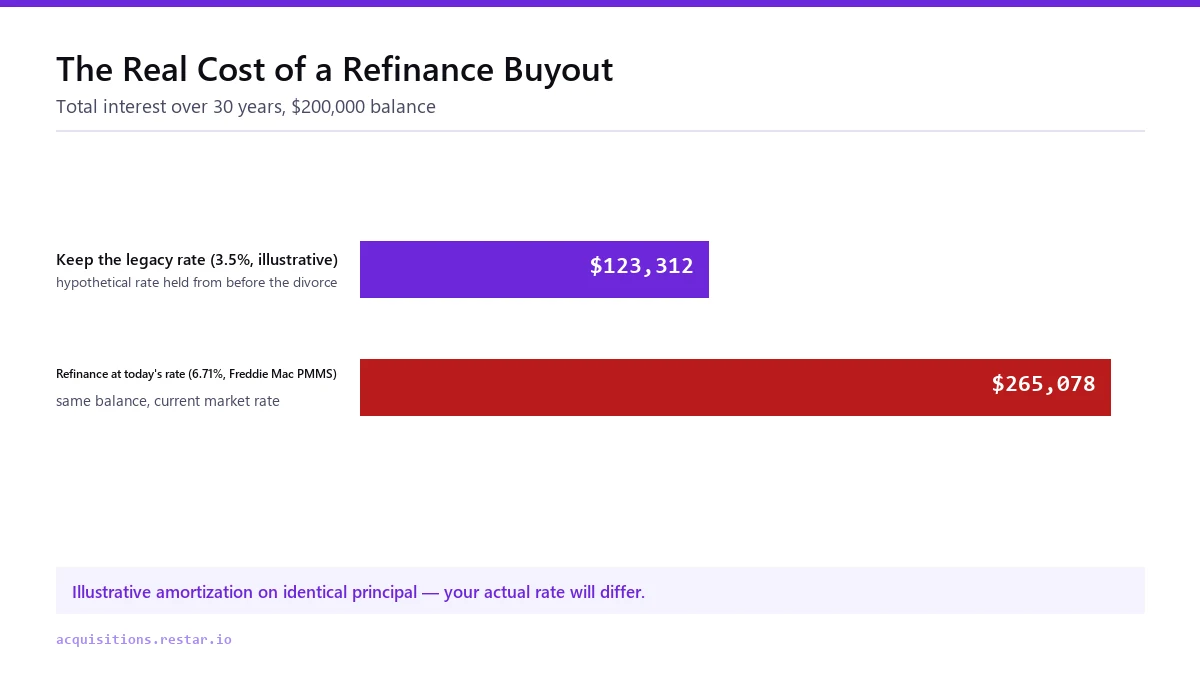
As of early September 2026, Freddie Mac's Primary Mortgage Market Survey put the average 30-year fixed rate at 6.71%. Compare that to a loan locked in a few years earlier at 3.5%, on a representative $200,000 balance, re-amortized over a fresh 30-year term.
Legacy rate (3.5%)
Refinance at today's rate (6.71%)
Monthly principal & interest
$898
$1,292
Total interest over 30 years
$123,312
$265,078
The real cost of a refinance buyoutRestar Acquisitions · illustrative amortization on identical principal — your actual rate will differ.
That's roughly $394 more every month, and about $141,800 more in total interest over the life of the loan — for the exact same $200,000 principal. This is illustrative math using representative rates, not a quote; your actual numbers depend on your credit, your loan program, and the rate available the day you refinance. But the direction of the math is real: a buyout isn't free just because no commission changes hands.
One option worth asking about before defaulting to a refinance: if the existing loan is FHA or VA, it may be assumable, meaning the staying spouse could potentially keep the original loan and rate by qualifying to assume it, rather than opening a brand-new loan at the current rate. The CFPB has flagged cases where servicers steer divorcing homeowners toward a refinance without mentioning assumption as an option — it's worth asking your servicer directly whether your specific loan qualifies.
Costs unique to each path
Buyout path: refinance closing costs — the Federal Reserve's consumer guide puts typical refinance fees at 3–6% of the loan balance, or roughly $6,000–$12,000 on a $200,000 refinance — plus a new appraisal (typically $300–$600) and possible added legal drafting for the settlement. A QDRO applies specifically to dividing retirement accounts, not the house itself; the property transfer is handled by a quitclaim or interspousal transfer deed instead.
Sell-and-split path: agent commission, commonly averaging around 5.5–5.7% total nationally, though it varies by state and is negotiable, plus other seller closing costs of roughly 1–3% (title insurance, transfer taxes, prorated items), plus continued holding costs until the house actually closes, typically split per the divorce decree. A cash-sale alternative closes in one to two weeks instead of a typical 30–60 days for a financed buyer, at a price that's usually below full market value in exchange for that speed and certainty.
The tax difference most people don't realize
A buyout is not a taxable sale. Under IRS Publication 504, property transfers between spouses "incident to divorce" — generally within one year of the divorce, or within six years if required by the divorce agreement — carry no recognized gain or loss under IRC Section 1041. The spouse keeping the house simply inherits the other spouse's cost basis; no capital gains tax is due at the time of the transfer.
Selling the house is a different story, but the timing can matter a great deal. The Section 121 exclusion on capital gains from a primary residence is $250,000 for a single filer and $500,000 for a married couple filing jointly. Selling before the divorce is final, while you can still file jointly, can preserve the full $500,000 exclusion; selling after, each ex-spouse generally has to qualify individually for their own $250,000, though divorce decrees can sometimes let a non-occupying spouse "tack" on prior ownership and use to help meet the test. If the house has appreciated significantly, the timing of the sale relative to the divorce being finalized is a conversation worth having with a CPA before either of you signs anything.
Putting it side by side
Keep the house (buyout)
Sell and split
Immediate cash to each spouse
None to the staying spouse; a lump sum to the departing spouse
Both spouses get their share of net proceeds
Interest rate risk
Full exposure — new loan at today's rate on the full balance
None — no new mortgage taken on
Selling costs
None right now (deferred until an eventual future sale)
Commission + closing costs, ~7–9% combined
Capital gains at transfer
None (IRC §1041)
Section 121 exclusion applies; timing before/after divorce affects the amount
Speed
As fast as the refinance can close, typically 30–45 days
30–60 days for a financed sale; 1–2 weeks for a cash sale, at a lower price
The honest tradeoff
A buyout keeps one spouse in the house and avoids a market sale, but it isn't free — it can mean a materially higher monthly payment and tens of thousands more in lifetime interest if rates have moved against you since the original loan. Selling avoids that rate reset entirely but costs real money in commission and time, or trades some of the proceeds for a faster, more certain close if either spouse needs this resolved quickly. Neither path is automatically better; run both sets of numbers against your actual mortgage balance, your actual current rate offer, and your actual timeline before deciding, and loop in a CPA on the tax-timing question if the house has real appreciation in it.
Common questions
Does a divorce buyout trigger capital gains tax?
No. Under IRC Section 1041, property transfers between spouses incident to divorce aren't a taxable event. The spouse keeping the house takes on the other spouse's cost basis, and any gain is deferred until they eventually sell.
Why does a buyout usually require a refinance?
To remove the departing spouse's name and legal liability from the loan, the staying spouse typically has to qualify for and close a new loan solely in their own name, which resets the interest rate to whatever's available that day, not the original loan's rate.
Should the buyout calculation subtract a hypothetical cost of sale?
It's common practice in some settlements and with some mediators to deduct a notional 6–8% before splitting the equity, as a fairness adjustment — but it isn't required everywhere and isn't settled law. Raise it directly in your negotiation rather than assuming either way.
Is it better to sell before or after the divorce is final?
Selling while still married and filing jointly can preserve the full $500,000 capital gains exclusion; selling after, each spouse generally needs to independently qualify for their own $250,000 exclusion. If the house has significant appreciation, this timing is worth reviewing with a CPA before the divorce is finalized.
Can the staying spouse keep the original mortgage rate instead of refinancing?
Sometimes, if the loan is FHA or VA and assumable — the staying spouse may be able to qualify to assume the existing loan and rate rather than opening a new one at today's rate. Ask the servicer directly whether your specific loan qualifies.
Is a cash sale ever the better option in a divorce?
It can be, if both spouses need the situation resolved quickly or can't agree on managing a listing together. It trades some of the sale proceeds for a much faster, more certain closing than either a buyout refinance or a traditional listing.
If neither of you wants to manage a sale together, there's a simpler path
A buyout and a traditional listing both take time and cooperation neither of you may have the appetite for right now. If selling is the direction you're headed, we can give both of you a plain cash offer and close quickly, without either of you needing to manage repairs, showings, or a drawn-out negotiation. Send us the address and we'll tell you honestly how the numbers compare to the other paths.
Every offer on this site is underwritten by a person, not a form. If the
numbers do not work for you, say so and I will tell you what would.
Also from Restar
Want the data behind all of this?
Restar Acquisitions is the acquisitions arm of Restar — a housing-market analytics
platform tracking 180+ metrics across every U.S. market, with composite scores and 12-month
price forecasts. The numbers on this page come from the same work.