A partition action — a lawsuit asking a court to force the division or sale of jointly owned property — typically costs somewhere in the ballpark of $10,000–$30,000 in attorney and court fees for a relatively straightforward case, and can run well beyond that if it's contested. It also usually takes months, sometimes over a year. Selling by agreement, or selling to a buyer willing to work directly with co-owners, is almost always cheaper and faster. Owning a house with someone else works fine right up until one of you wants to sell and the other doesn't. It happens most often with inherited property split between siblings, but it comes up between unmarried co-owners, former business partners, and divorcing couples too. When co-owners genuinely can't agree — not just disagree on price, but actually can't reach any agreement at all — a partition action is the legal mechanism that exists specifically to break that deadlock. It's worth understanding what it actually costs and how it works before you either threaten one or get threatened with one.
Step 1 of 5
Send the address and we'll give every owner a fast, clean number to evaluate together.
You’ll talk to Trevor McAmis, Owner & Acquisitions Lead
(313) 710-6129
Takes about two minutes. Or call (313) 710-6129 — we answer.
Educational only. This explains how these situations generally work. It is not legal, tax or financial advice, and the rules differ by state — talk to an attorney or CPA about your own situation before you act on any of it.
A partition action is a court proceeding that divides or forces the sale of property owned by more than one person, used when the owners can't agree on what to do with it themselves. Any co-owner can generally file one without the others' permission, needing only a legitimate ownership interest in the property.
Cornell Law School's Legal Information Institute defines partition as "a division of concurrent interests in land," noting that while co-owners are always free to divide or sell property by mutual agreement, a judicial — compulsory — partition is available when they can't (Cornell LII: Partition). It exists specifically as a legal backstop for exactly this kind of standoff.
This guide is distinct from our guides on when heirs cannot agree to sell and selling a house with an unmarried co-owner, which cover the broader situation — this one focuses specifically on the partition action itself: what it is, what it costs, and how proceeds actually get split.
Courts have two basic tools, and which one applies determines almost everything else about cost and outcome. Cornell LII lays out the default rule plainly: "If the property cannot equitably be partitioned in kind, it will be sold by judicial process, and the proceeds paid out accordingly" (Cornell LII: Partition).
Partition in kind means physically dividing the property itself — splitting a large parcel of land into separately owned lots, for instance. Courts generally prefer this option when it's actually workable, because it lets each owner keep a direct interest in real property rather than converting it to cash. For a single-family house, though, it's rarely practical — you can't cut a house in half and give each sibling a functioning home, so most residential partition actions end up on the second track.
Partition by sale means the court orders the property sold — historically at a courthouse auction, though many states now require a more conventional open-market sale — with the proceeds divided among the owners according to their ownership shares, after accounting for any credits or offsets. This is the outcome in the overwhelming majority of single-house partition cases, since a house can't practically be divided in kind.
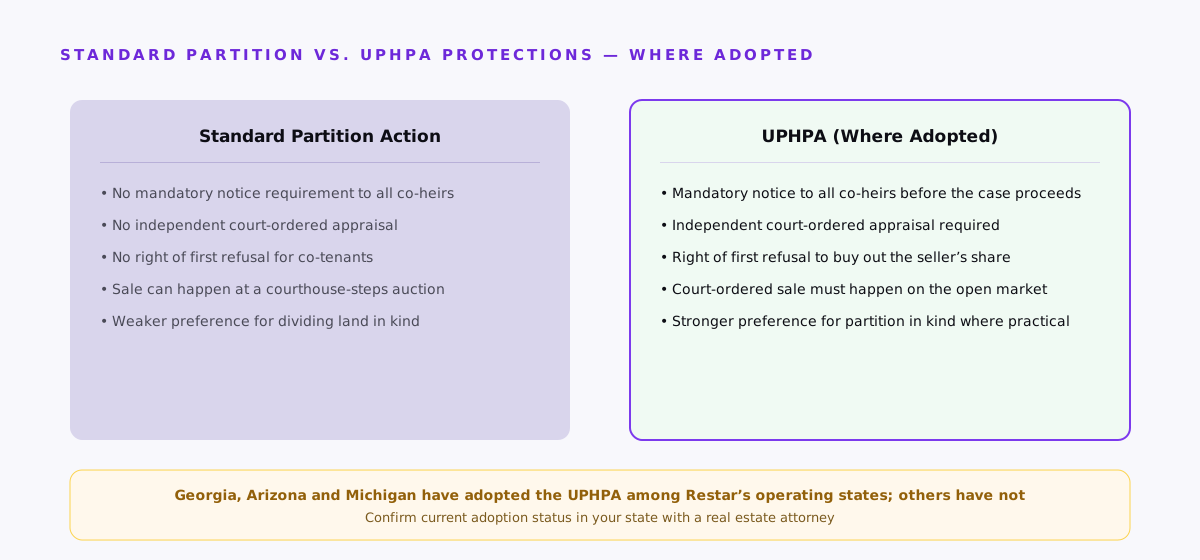
If the property is "heirs' property" — inherited by multiple relatives, often without a will spelling out how to handle disagreements — a growing number of states have adopted extra protections for that situation under the Uniform Partition of Heirs Property Act (UPHPA). Heirs' property is more common than most people assume: a 2023 USDA Forest Service study identified more than 444,000 heirs' property parcels nationwide, covering over 9.2 million acres (USDA Forest Service: How Much Heirs' Property Is There?, 2023).
As of 2026, several of Restar's operating states have enacted some version of the UPHPA, including Georgia (codified at O.C.G.A. §§ 44-6-180 through 44-6-189.1, effective 2013), Arizona (HB 2521, signed 2024), and Michigan (Public Act 215 of 2024) — while other states, including North Carolina, Indiana, and Ohio, had not adopted it as of this writing. State legislatures update this list regularly, so confirm current status with a local real estate attorney rather than assuming.
Where it applies, the UPHPA generally adds several protections beyond the older default rule: mandatory notice to all co-heirs before a case proceeds, an independent court-ordered appraisal of the property, a right of first refusal letting co-tenants buy out the interest of the owner who wants to sell before the whole property goes to sale, a stronger preference for partition in kind where practical, and a requirement that any court-ordered sale happen on the open market rather than a courthouse-steps auction. The point of all of it is to prevent a small ownership stake from forcing a distressed, below-market sale of family property — a longstanding problem the law was specifically written to address.
A relatively straightforward, uncontested partition action typically costs roughly $10,000–$30,000 in attorney fees; a contested or complex one can run $20,000–$100,000 or more. Costs vary by state, by how contested the case is, and by how many owners and how much property is involved, so treat any figure here as a general ballpark rather than a quote.
The California Lawyers Association, in a 2024 practitioner overview, put that "relatively vanilla" range at $10,000–$30,000 in attorney fees (California Lawyers Association: The Costs of a Partition Action). That same overview cited real referee fees — the court-appointed professional who oversees the sale — ranging from roughly $20,000 to over $60,000 in individual cases, on top of attorney fees. Those figures come from California litigation and aren't a national fee survey, but the general shape holds elsewhere: legal fees, court costs, an appraisal, and a referee or commissioner's fee, all coming out of the property's value before anyone gets paid.
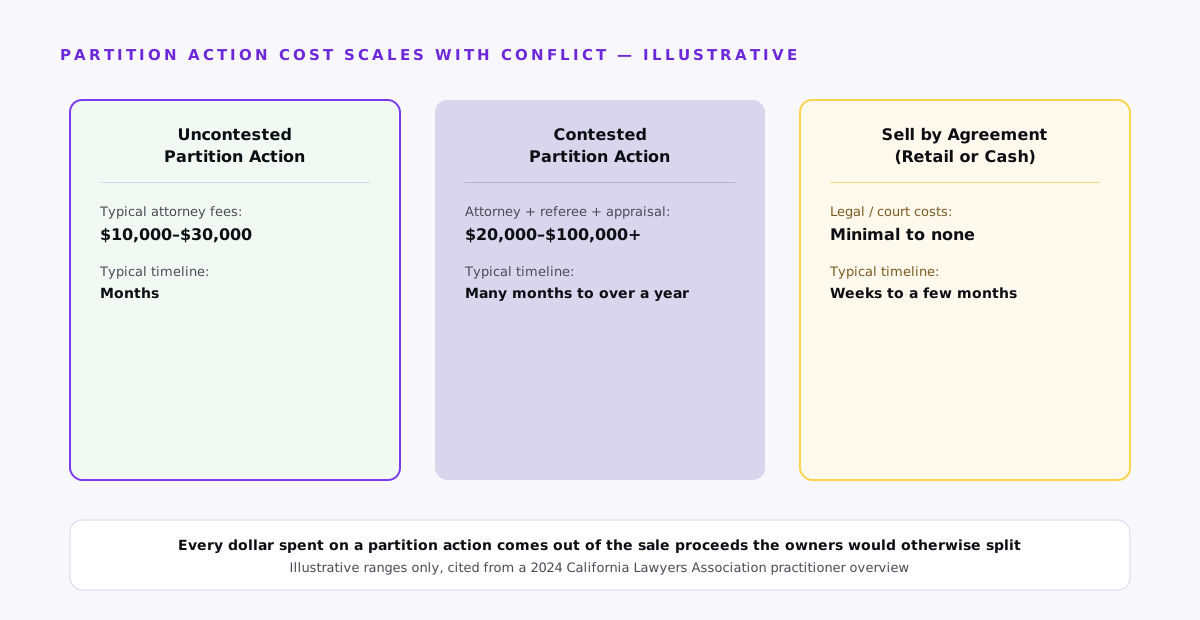
Timelines follow the same pattern: an uncontested case can sometimes resolve in a matter of months, while a contested one — multiple owners fighting over valuation, occupancy credits, or whether partition in kind is possible — can run well over a year. There's no single authoritative national timeline source; treat any specific number you hear as a rough estimate for your situation, not a guarantee.
The baseline rule is straightforward: proceeds are split according to each owner's percentage of ownership. In practice, it's rarely that clean, because courts routinely adjust the split with credits and offsets — an owner who paid the mortgage, property taxes, insurance, or necessary repairs while the others didn't is typically entitled to be reimbursed for more than their share of those costs before the remaining proceeds are split; an owner who lived in the property rent-free while excluding the others may owe an offset for the fair rental value of that use. Exactly how a given court calculates and applies these adjustments is fact-specific and varies by state, which is a significant part of why contested partition cases take as long and cost as much as they do.
These numbers are illustrative only, built around a hypothetical $240,000 house owned equally by two co-owners, not a quote for any specific property or case.
| Contested Partition Action | Sell by Agreement (Retail or Cash) | |
|---|---|---|
| Legal/court/referee costs | Roughly $20,000–$60,000+ split between the proceeds | Minimal to none |
| Typical timeline | Many months to over a year | Weeks to a few months |
| Requires co-owner cooperation | No — that's the entire point | Yes |
| Outcome | Court-ordered sale, proceeds split per ownership share and adjustments | Owners agree on price, timing, and split directly |
A partition action exists precisely because it doesn't require the other owner's cooperation — that's its value when negotiation has genuinely broken down. But every dollar spent on attorneys, appraisers, and referees comes directly out of the sale proceeds that would otherwise go to the owners, which is why it's generally the most expensive way to resolve a co-ownership disagreement, not the cheapest. If there's any real chance of reaching an agreement — even an uncomfortable one, even with a mediator involved — it's almost always worth trying before filing. See our cash offer vs. listing net proceeds guide for how a straightforward sale compares financially once you are in agreement to sell.
Filing a partition action is usually the last resort, not the first move.
Try a direct buyout. If one owner wants to keep the property and the other wants out, a private buyout — sometimes financed with a new mortgage — can resolve the disagreement without a court case at all.
Use mediation. A neutral third party can often get co-owners to a written agreement on price, timing, and process faster and far cheaper than litigation, especially when the real disagreement is more personal than financial.
Sell by mutual agreement to a cash buyer. If everyone actually wants to sell and the disagreement is really about which buyer or what price, a direct cash sale that all owners agree to sidesteps the entire partition process.
File the partition action. If one or more owners genuinely won't engage, and enough value is at stake to justify the cost, a partition action remains the legal backstop — just go in knowing the real cost and timeline, not an optimistic guess.
Restar Acquisitions buys houses directly, as-is, for cash, in 45 markets across Alabama, Arizona, Florida, Georgia, Indiana, Maryland, Michigan, Missouri, New York, North Carolina, Ohio, and Texas. If co-owners in one of those markets have reached agreement to sell — even if getting there was the hard part — we can typically give a written offer within 24 hours and close on a timeline that works for everyone, without the cost or delay of a court-supervised sale.
We are not real estate agents, brokers, or attorneys, and we do not represent any individual owner in a multi-owner property — we're a direct buyer, and our interests in a transaction are our own. Like any as-is cash offer, ours typically nets less than a fully repaired retail listing would once all owners agree to sell — an as-is sale to us trades some of that net proceeds for speed and for not having to coordinate repairs, showings, and a listing timeline across multiple owners. If listing with an agent nets more for your situation and there's no urgency, we'll say so. We can't resolve a genuine standoff between co-owners who won't agree to anything; that's a job for mediation or, if it truly comes to it, the courts. What we can do is give every owner a fast, clean number to evaluate once you're ready to sell together.
This article is for general educational purposes only and is not legal or financial advice. Partition law, UPHPA adoption, and how courts calculate credits and offsets vary significantly by state. Talk to a real estate attorney in your state before filing or responding to a partition action.
Once co-owners are in agreement, we'll give a written offer within 24 hours and close on a timeline that works for everyone — without the legal, appraisal, and referee costs of a court-supervised sale.
All guides · When heirs cannot agree to sell · Selling a house with an unmarried co-owner · Cash offer vs listing net proceeds
Step 1 of 5
No obligation, no fees, no repairs. We respond the same day.
You’ll talk to Trevor McAmis, Owner & Acquisitions Lead
(313) 710-6129
Takes about two minutes. Or call (313) 710-6129 — we answer.
