Every market page publishes the numbers behind its offer. See the math
Home › Guides › Vacant Property Registration: What It Costs You When You Sell
Guide
Vacant Property Registration: What It Costs You When You Sell
If your house has sat empty for a while — after a death, a move to assisted living, a landlord who walked away, or a slow probate case — there is a good chance the city already knows, and a good chance it has quietly started a clock you haven't heard about. Vacant property registration is the ordinance most American cities now use to track empty houses, and it comes with a real annual fee, a real deadline, and real penalties for ignoring it — none of which show up on a for-sale sign, and all of which a title company will find the moment you try to close.
Takes about two minutes. Or call
(313) 710-6129 — we answer.
Educational only. This explains how these situations generally work. It is not legal, tax or financial advice, and the rules differ by state — talk to an attorney or CPA about your own situation before you act on any of it.
Vacant property registration: the short answer
Most cities require an owner to register a house within 30 days of it becoming vacant, pay an annual fee that commonly runs $25 to $250 per structure, and keep it secured. Miss the deadline, and unpaid fees and fines typically become a lien a buyer's title search will find.
This is educational information, not legal advice. Vacant property registration is set by city or county ordinance, not state or federal law, and the deadline, fee and penalty structure vary enormously from one city to the next — even between two cities in the same county. Check with the specific city's building or code department before assuming any figure below applies to your address.
Why cities register vacant houses at all
Vacant property registries spread fast after the 2008 foreclosure wave, when cities with large numbers of empty, bank-owned and heir-owned houses got tired of paying out of pocket to board windows, mow lawns and demolish structures nobody was maintaining. The ordinances do two things at once: they give code enforcement a name, phone number and often a cash bond to work with instead of an empty house and no owner to call, and they put a recurring cost on staying vacant, meant to push owners toward occupying, renovating or selling rather than letting a property sit indefinitely.
The sellers who run into this most often are not landlords ducking responsibility. They are heirs who inherited a house mid-probate, a family that moved a parent into care and hasn't dealt with the house yet, or someone who moved for a job and never told the city the house was empty. None of them necessarily did anything wrong — the registration requirement exists whether or not you knew about it.
What actually triggers registration, and how fast
Ordinances differ on the exact trigger, but the common pattern is a structure with no lawful occupant for a defined stretch — often 30 consecutive days — combined with visible signs like disconnected utilities, boarded openings, or accumulating code complaints. Once that threshold is hit, the owner (or, after a foreclosure, the lender) is generally required to:
Register with the city's building or code department, usually within 30 days of the property becoming vacant, and renew annually.
Name a local agent if the owner lives outside the county, so the city has someone reachable.
Keep the structure secured and maintained — mowed, boarded if necessary, free of accumulating hazards.
In some cities, file a plan stating whether the property will be occupied, rehabbed, sold, or demolished.
Toledo requires registration within 30 days of vacancy or by January 31 each year, whichever comes first, and requires the registration to stay current with an annually renewed local-agent designation. Cleveland runs its registration through an online portal and requires current property tax status and no open code violations for an owner to qualify for certain exemptions.
What it actually costs, city by city
There is no national number here — this is entirely local — but the range across cities in our own footprint gives a sense of scale:
City
Annual registration fee
Notable detail
Cleveland, OH
$70 per unit (1–3 dwelling units); $1,000 for commercial/4+ unit structures
Cash bond of $5,000–$15,000 required for larger commercial/industrial structures; owners with no code violations, current taxes and an active rehab permit can qualify for an exemption
Toledo, OH
$100 per year
Reduced from $200 under 2025 updates specifically to encourage compliance; due by January 31 or within 30 days of vacancy
Akron, OH
Set under city code §154.08
Akron's registration program is scoped to vacant commercial and industrial buildings, not single-family homes — a reminder that even neighboring cities structure these programs completely differently
Two things matter more than any single number. First, these fees are almost always annual, not one-time — a house that stays vacant for two or three years while an estate is settled accrues the fee again each year, sometimes at an increasing rate the longer it sits. Second, the fee is usually the smallest part of the exposure; the fines for not registering, and the liens that follow, are where the real cost shows up.
What happens if you don't register
Cities generally do not let a missed registration simply lapse. Toledo's ordinance authorizes administrative penalties and daily fines for owners who ignore outreach, followed by formal notices of liability and, where necessary, court action. Structures that go unregistered and unmaintained also tend to accumulate separate nuisance citations — tall grass, an unsecured door, exterior deterioration — each of which can carry its own fine.
The part that catches sellers off guard: unpaid registration fees and code fines typically attach to the property itself as a lien, the same way an unpaid HOA assessment or a contractor's mechanic's lien does — see our guides to selling a house with a lien on it and selling a house with code violations for how those liens behave at closing. That means the obligation doesn't stay with whoever let the house go vacant — it runs with the title, which is exactly what an heir who inherited an already-neglected house discovers when a title search turns up two or three years of fees and fines nobody in the family knew existed.
The honest math: clear it and list, or sell as-is and let the closing absorb it
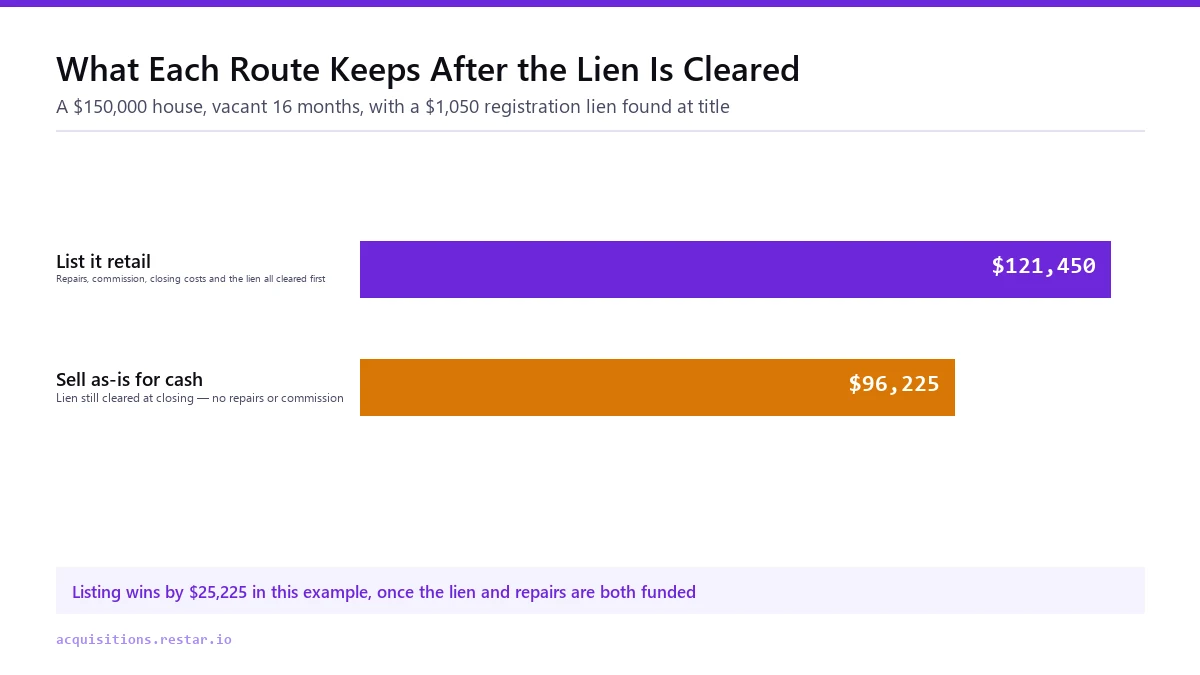
Either way you sell, a lien has to be cleared before a buyer can get clean title — that cost doesn't disappear, it just gets paid out of proceeds at closing. Here is a worked example: a $150,000 after-repair-value house, vacant for sixteen months during a probate case, needing about $14,000 of repairs, with $1,050 owed in accumulated registration fees and nuisance-abatement liens.
This is a worked illustration on one hypothetical property, not a quote, not a prediction about your house, and not a fixed formula we apply.
Line
List it retail
Sell as-is for cash
Sale price
$150,000
$97,500
Repairs funded first
−$14,000
$0
Agent commission (5.5%)
−$8,250
$0
Seller closing costs (1.5%)
−$2,250
$0 — we cover it
Buyer concessions (1%)
−$1,500
$0
Holding, 5 months incl. one more registration renewal while marketing
−$1,500
−$225 (3 weeks)
Vacant-property lien cleared at closing
−$1,050
−$1,050
You keep
$121,450
$96,225
The cash figure follows the same four-term formula published in how cash home buyers calculate offers: $150,000 after-repair value, minus $14,000 of repairs, minus resale and holding costs, minus margin.
What each route keeps after the lien is clearedRestar Acquisitions · worked example from this page
Listing wins by $25,225 in this example, which is the honest answer if you can fund the repairs, wait out a normal marketing period, and don't mind one more registration renewal landing while the house is on the market. The reason people in this situation often choose the faster route anyway isn't that it pays more — it's that every month the house sits vacant during a drawn-out estate or a family disagreement is another year's fee, another possible citation, and another few hundred dollars of holding cost stacking on top of a lien that's already there. See holding costs of a vacant house for the fuller math on what an empty house costs by the month regardless of registration.
If you're keeping the house: how to stop the fees
Selling isn't the only way to stop the clock. If the plan is to keep the property:
End the vacancy. Occupying the house yourself, placing a tenant, or having a family member move in generally removes the “vacant” classification entirely in most ordinances.
Apply for a rehab exemption where one exists. Cleveland, for example, will exempt an owner from certain requirements if there are no open code violations, property taxes are current, and an active rehabilitation permit is on file — worth asking your city's code department about directly rather than assuming it doesn't apply.
Register and pay rather than ignore it. The registration fee itself is almost always far cheaper than the fines, liens and collection costs that follow non-compliance — the entire point of these ordinances is to make registering the cheaper option.
Secure the structure to code even while you decide, since most of the worst fines are for physical neglect (broken windows, overgrown lots, unsecured entry points) rather than the registration paperwork itself.
What to do next
Call the city's building or code enforcement department directly and ask, by address, whether the property is currently registered, what's owed, and whether any citations have gone to lien.
If you're an heir or a family member who didn't cause the vacancy, ask specifically whether an exemption or payment plan applies — cities dealing with inherited and estate properties have often seen the situation before.
Get a title search early if you're planning to sell, so a registration lien surfaces during your own preparation rather than during the buyer's closing.
A local ordinance, set by a city or county, requiring the owner of an empty structure to register it with the building or code enforcement department, pay an annual fee, name a local contact, and keep the property secured and maintained. It is not a state or federal requirement — the rules are set city by city.
How much does it cost to register a vacant house?
It varies enormously. In our own footprint, Toledo charges $100 a year; Cleveland charges $70 per unit for 1-3 unit residential structures and up to $1,000 for larger commercial buildings, with cash bonds required for the largest ones. Check your specific city's code department for the actual figure.
What happens if I don't register a vacant house before selling?
Cities generally pursue unpaid registration through daily fines, administrative penalties, formal notices of liability and, if needed, court action. Unpaid fees and related nuisance citations typically become a lien against the property, which a buyer's title search will find at closing.
Do unpaid vacant-property fees become a lien?
Commonly, yes. Like an unpaid HOA assessment or a mechanic's lien, unregistered or unpaid vacant-property fees and fines typically attach to the property itself rather than staying a personal debt of whoever let the house go vacant — meaning the obligation can pass to an heir or a new owner along with the title.
Can I get an exemption from vacant property registration?
Some cities offer one. Cleveland, for example, exempts owners with no open code violations, current property taxes and an active rehabilitation permit from certain requirements. Ask your specific city's building department directly — exemption criteria are set locally and are not standardized.
If a title search on your vacant house turns up unpaid registration fees or nuisance-abatement liens, we can still put a written offer in front of you within 24 hours — and standard closing costs are covered as part of that offer, the same as on any other sale. We are a buyer, not a real estate agent, and we don't take on the city's local-agent or compliance obligations on your behalf by making you an offer.
If you can fund the repairs and clear the lien yourself, listing with an agent will often net you more once the house is compliant — our worked example below shows the honest comparison. Where funding that isn't realistic right now, or the vacancy has already gone on longer than you'd like, send us the address and we'll tell you plainly what the numbers look like.
Every offer on this site is underwritten by a person, not a form. If the
numbers do not work for you, say so and I will tell you what would.
Also from Restar
Want the data behind all of this?
Restar Acquisitions is the acquisitions arm of Restar — a housing-market analytics
platform tracking 180+ metrics across every U.S. market, with composite scores and 12-month
price forecasts. The numbers on this page come from the same work.